


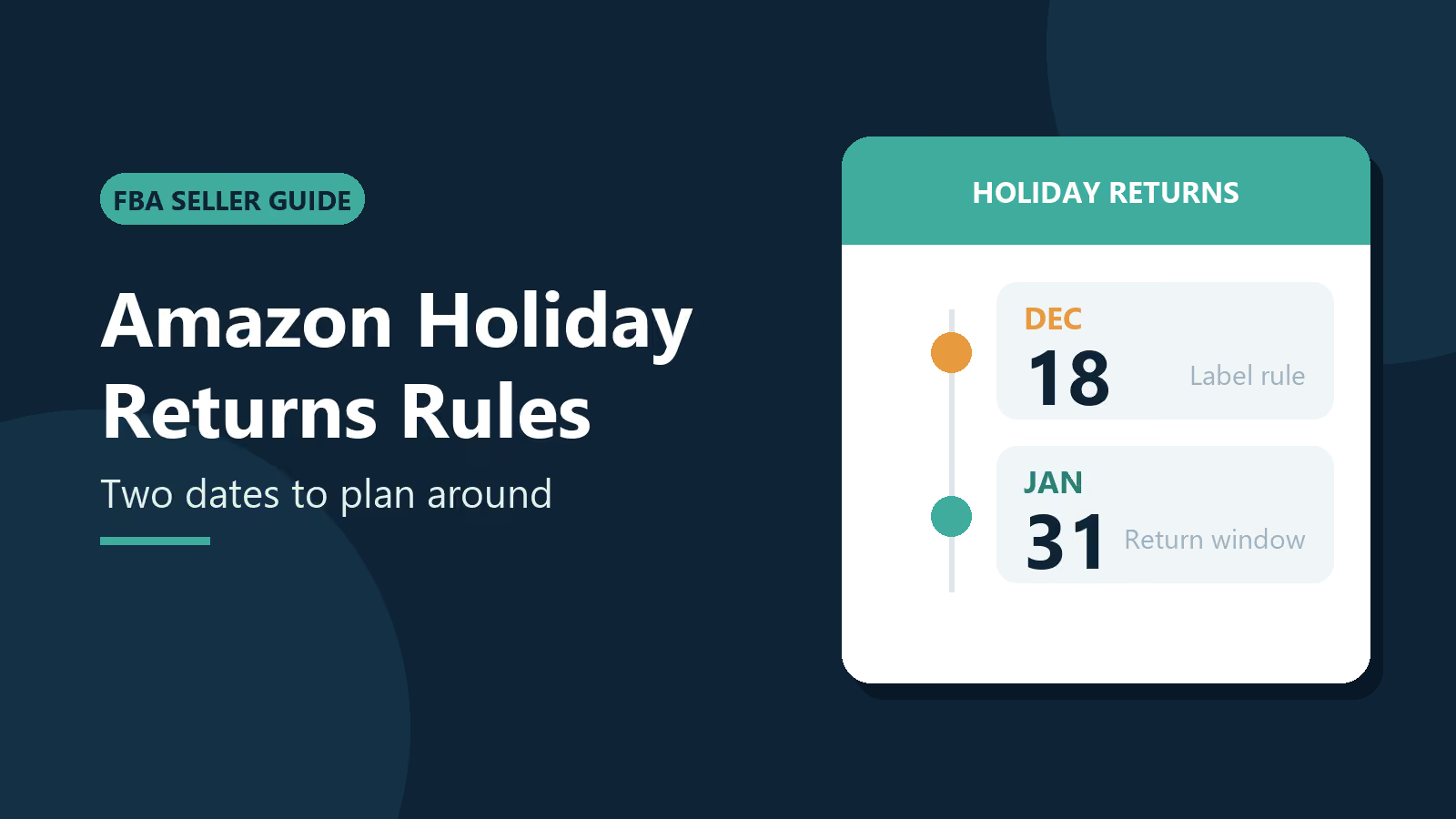
Amazon will take returns on holiday orders until January 31, and it will do this every year. If you ship orders yourself, a second rule starts on December 18. Address-only return labels, where the buyer pays the postage, stop counting, and if a return is not covered by Amazon’s own prepaid labels, you have seven days to supply a prepaid label or refund the buyer in full. Miss that, and Amazon may refund the buyer for you and take the money from your account.
For sellers, that means your holiday sales are not final until the last returns come in, which can be mid-February, and any return that Amazon’s own labels don’t cover forces a choice: pay for a label, or refund the buyer and let them keep the item.
The short version: expect refunds to leave your account until January 31, decide which products get a label and which get a refund, and make sure your listings answer what buyers ask before they order.
Amazon sets the return rules, so the one thing left in your hands is what buyers know before they order. That is where Alexa for Shopping, Amazon’s AI shopping agent, comes in: more shoppers now ask it questions before they buy.
To see what that looks like, we scored five holiday bestsellers on October 22, 2026. The Score left 37 of the 71 buyer questions it generated for them unanswered. This guide covers both rules, the math, those results, and what to check.
What did Amazon change about holiday returns this year?
Amazon announced two changes, and the first makes a deadline permanent.
On October 16, Amazon posted on Seller News that its longer holiday return window will apply every year, as PPC Land reported. Amazon’s words were “This policy will apply every year.” The longer window is not new. Amazon ran it in 2025 and said “Similar to previous years, we’ll temporarily extend our standard return window for holiday sales”. What is new is that you can now count on it.
The second is about shipping labels. In an email to sellers, Amazon said that from December 18, all US returns for seller-fulfilled orders need a prepaid return label. Address-only labels, where the buyer pays the postage, no longer count, except temporarily for heavy and bulky items. Sellers have posted the email word for word in the Seller Forums.
| Rule | Dates | Covers | What you do |
|---|---|---|---|
| January 31 return window | Bought November 1 to December 31, 2026. Return by January 31, 2027 | Orders Amazon ships for you and orders you ship | Nothing to set up. Plan around it |
| Prepaid label rule | Starts December 18, 2026 | US returns on orders you ship yourself. Heavy and bulky items are left out for now | If Amazon’s labels don’t cover the return: upload a prepaid label within seven days, or refund in full |
Put both dates next to your 2026 holiday calendar. The label rule starts while Amazon’s peak fees are still running, and the return window runs past the end of those fees.
Holiday orders can come back until January 31
Amazon’s usual return clock starts when an order is delivered. For items bought from November 1 to December 31, the deadline is fixed at January 31, which EcomCrew describes as the clock starting at purchase. A buyer who orders on November 1 can send the item back as late as January 31. That is 92 days if you count both end dates. Most items get 30 days.
A few facts to plan with:
- Apple products have an earlier deadline, January 15.
- The window covers orders Amazon ships for you and orders you ship yourself. Amazon’s help page says return eligibility stays the same.
- Amazon’s peak fulfillment fees run from October 15 to January 14. The return window ends more than two weeks after that.
That means an order placed on December 31 can still come back a month later. According to Amazon’s seller help, after you authorize a return the buyer has 15 days after the window closes to ship the item back, and you refund within two business days of receiving it. So refunds can keep coming out of your account into February. Treat your holiday revenue as a draft until those last returns are in.
How does the December 18 prepaid return label rule work?
From December 18, a US return on an order you ship yourself needs a prepaid label. Prepaid means the postage is already arranged. Labels where the buyer pays the postage stop counting. For now, heavy and bulky items can still use them. The email does not say what counts as heavy and bulky, or when that exception ends.
Amazon’s own prepaid labels are not going away. In a Seller Forums thread, an Amazon team member said the change “does not remove Amazon-generated prepaid return labels.” If Amazon already provides labels for your returns, that will not change. The new requirement covers returns that Amazon’s labels do not cover. For those, you must provide a Merchant Prepaid Return Label (MPRL) instead of an address-only label. Return eligibility rules stay the same.
For those returns, you have seven calendar days from the request to do one of two things. The clock starts when the buyer asks, not when the order arrives.
- Upload a prepaid label in the Manage seller-fulfilled returns tool in Seller Central.
- Refund the buyer in full and let them keep the item.
A label sent through Buyer-Seller Messaging, or anywhere outside that tool, does not count.
If you do neither within seven days, Amazon’s email says a returnless refund “may be automatically issued and the balance deducted from your selling account.” The buyer keeps the item, and you take the loss.
Check two things in Seller Central. We could not find this rule on Amazon’s public help pages on October 22.
First, who pays for the label. Seller Essentials points out that “prepaid” only describes how the postage is arranged. Amazon’s return-reason rules still decide who pays.
Second, the 24-hour reply rule. Amazon’s help page says you must respond within 24 hours to return requests that need manual authorization, and the December email does not mention changing that. The seven days are for the label, not for answering the request.
Amazon already removed the high-value item exemption from prepaid return labels on February 8, 2026, for US seller-fulfilled orders, as PPC Land reported. For more on the refund option, read our guide to how returnless refunds work.
What do Amazon’s own help pages say about prepaid returns today?
We read Amazon’s seller help pages on October 22, 2026. They do not mention December 18, a seven-day deadline or a label-upload step. The rule comes from Amazon’s email to sellers, which sellers have posted word for word in the Seller Forums. Here is what the public pages do say:
- Prepaid returns are already the default. US sellers are enrolled automatically for seller-fulfilled orders. Amazon provides the label through Buy Shipping and charges the return shipping to your seller account.
- Some products are exempt. Handmade items, certified preowned watches, non-physical items, items that can’t be returned by law, dangerous goods, and extra-large or heavy items don’t need an exemption request. You can ask for an exemption on other products. For exempt products, you provide the label yourself.
- The return reason decides who pays. Amazon tags each reason the buyer can pick as customer fault or seller fault. When the buyer is at fault, you can deduct return shipping from the refund. When you are at fault, you pay.
- Two cases make you pay either way. If you offer free returns on a product, you pay whatever the reason. Amazon also requires free returns on soft-line items such as fashion.
- Postage is not a flat fee. USPS or UPS sets it from the package weight and the zone. UPS adds surcharges and a fuel charge that typically runs 13% to 15%.
Some seller-fault reasons are about what the buyer knew before ordering. They include “Different from website description,” “Fabric not as expected,” “Missing parts or accessories,” and “Product is not fully compatible with my existing system.” Customer-fault reasons include “Item is too large,” “Item is too small,” and “Incompatible or not useful for intended purpose.” You can’t know which reason a buyer will pick. But the reason they pick decides who pays for the label, and some of those reasons point back at your listing.
US sellers are enrolled in Amazon’s prepaid labels by default, and the December 18 change leaves those labels in place. In plain terms: if Amazon already generates your return labels, nothing changes for those returns. The new rule covers the rest.
What do these rules do to your margin and cash?
Start with the label choice. On a return that Amazon’s own labels don’t cover, you can send a label, or refund the buyer and let them keep the item. A label costs you postage but gets the item back, while a refund costs you the item. So a label is worth it only when the item is worth more than the postage.
Here is an example with made-up numbers. It assumes the returned item can be sold again as new, and it ignores fees.
| Item | What it cost you | Label cost (assumed) | Cheaper choice | Savings |
|---|---|---|---|---|
| $15 accessory | $4 | $8 | Refund, buyer keeps it | $4 |
| $40 kitchen tool | $12 | $8 | Send the label | $4 |
| $90 gadget | $30 | $8 | Send the label | $22 |
Use your own numbers: what you could actually resell the item for after inspection and repackaging, and your real postage rate. Amazon charges return postage to the buyer or to you based on the return reason, so the label is your cost only on seller-fault returns, unless you offer free returns or sell fashion. Your return shipping charges show up in your Settlement and Payments reports in Seller Central. Products that fail this test are good candidates for a full refund with no return. That also keeps them out of the seven-day rush.
Now cash. Look at your own return rate. Say you expect 10% of $100,000 in November and December sales to come back. Plan for $10,000 to leave your account, and do not spend it on January inventory or ads. Base your January orders on a demand forecast that uses sales after returns, not before.
Use a separate return rate for each product category, because one average rate can hide the products that cause most of your January refunds.
How can your listing help with holiday returns?
Amazon sets the return rules, and you can’t change them. What you can change is what the buyer knows before they order.
More buyers now ask Alexa for Shopping questions before they buy. On Amazon’s July 30 earnings call, Andy Jassy said over 350 million customers had used it in the past 12 months, and that second-quarter interactions were up over 5x from a year earlier, according to CX Dive. Amazon says that on a product page, Alexa for Shopping builds its answers from listing details, customer reviews and community Q&As, so your listing is one input. If your listing does not answer a question, the buyer may have to guess.
Return surveys show where guesses go wrong. In a survey of 500 representative consumers in Germany by the EHI Retail Institute, reported by KPMG, 60.4% listed an inaccurate description, or a product that did not match its photos, among their reasons for returns. The release is dated December 11, 2025, and the survey is not about Amazon, so treat it as a hint and not a rule.
We found no proof that answering more questions in your listing lowers your returns. What we do know is narrower. Each order that misses what the buyer expected now stays open to return until January 31. If you ship it yourself and Amazon’s labels don’t cover the return, it ends in a label you must send or a refund you must give. So it makes sense to check that your listing answers what buyers ask before the orders come in.
The AI Readiness Score is a free ZonGuru tool for a live Amazon listing. One of its two layers, Alexa for Shopping Q&A Coverage, shows which buyer questions your listing leaves unanswered. It reads your listing text, not your images. If it finds gaps, Helix™ is how ZonGuru fixes them. Helix is a platform that engineers a listing for both A9, Amazon’s keyword search engine, and Alexa for Shopping, then keeps it current after you publish. Our guide to what Alexa for Shopping means for your listing explains how the agent reads it.
We scored 5 holiday bestsellers. Here is what buyers couldn’t find out
On October 22, 2026, we ran the AI Readiness Score on five live US bestsellers from Amazon’s Best Sellers pages. We picked one per gifting category, from different brands, and none of them ours. The Score reads listing text only: title, bullets, description and Item Highlights. It makes no claim about images or returns.
| Listing | Overall score | Q&A Coverage | Fully answered | Partly answered | Unanswered |
|---|---|---|---|---|---|
| STANLEY Quencher H2.0 Flow State Tumbler, 40 oz (B0CJZW65R3) | 62 | 60 | 5 | 5 | 4 |
| Roku Streaming Stick HD with Voice Remote (B0DXXYS4BJ) | 48 | 39 | 1 | 6 | 7 |
| Mattel KPop Demon Hunters HUNTR/X Rumi Fashion Doll (B0GCBV5MZT) | 37 | 33 | 2 | 5 | 8 |
| Hanes EcoSmart Pullover Hooded Sweatshirt (B071WWY2X3) | 41 | 24 | 1 | 4 | 9 |
| Yankee Candle Spiced Pumpkin Candle, 22oz (B0F3DRTCB2) | 47 | 20 | 1 | 4 | 9 |
Together, the five listings left 37 of 71 questions unanswered, answered 24 partly and answered 10 in full. The median Q&A Coverage score was 33. Across more than 6,000 reports, the median is 53.
The unanswered questions cluster in four places:
- Fit and size. The Score found no answer on whether the Hanes hoodie runs true to size, how long its torso is, or how heavy the fabric is. The Mattel doll’s listing did not give her height or say whether she stands on her own.
- How it holds up. The Hanes listing did not say whether the hoodie shrinks or fades in the wash. The Yankee Candle listing did not say whether the wick soots, or how long the scent lasts after the candle is blown out.
- What is in the box and how it sets up. The Roku listing did not say what comes in the box besides the stick and remote, whether setup needs a phone, or how much WiFi it needs.
- Weight and warranty. Even the highest scorer, the STANLEY, left four questions open, including its weight when full and what the lifetime warranty covers.
What this does and does not show: the Score builds the question list for each product type, so these are not Amazon’s own shopper logs. Five listings is a small sample. It does not show that these gaps cause returns. It shows what a buyer could not learn from the listing text before ordering, and that part is yours to change. You can run the same check on your own top listings with the free AI Readiness Score.
Your returns checklist
Before December 18, if you ship orders yourself:
- ☐ Find your return rate and your cost for each product. Compare each one with your label cost.
- ☐ Decide which products get a full refund with no return instead of a label.
- ☐ Check how your labels work today: whether Amazon supplies them or you do, and which products are exempt. If you upload your own, test an upload in Seller Central before the rush.
- ☐ Give one person the return requests every day, with a backup. The seven days start at the request.
- ☐ Mark your heavy and bulky products. They are left out for now, but the email does not say how it defines them.
- ☐ Read your five top holiday listings like a buyer. Write down every question the listing does not answer, starting with the gaps we found above: fit and size, how it holds up, what is in the box, and weight. Our AI readiness scoring guide explains what the score checks.
Before January 31, for all orders:
- ☐ Set aside a returns reserve from November and December sales, based on your own return rate.
- ☐ Check returns every week until the last ones arrive, which can be mid-February. Wait until then to close out Q4 profit and ad results.
- ☐ Plan January orders from sales after returns, not before.
Pair this list with our Q4 2026 preparation guide, which covers the inventory and deal dates around these two rules.
Frequently asked questions
Does the January 31 holiday return window apply to orders I ship myself?
Yes. It covers orders Amazon ships for you and orders you ship yourself. Return eligibility stays the same, according to Amazon’s help page. Apple products have an earlier deadline, January 15, 2027.
Does the December 18 rule end Amazon’s own prepaid return labels?
No. An Amazon team member said in the Seller Forums that the change does not remove Amazon-generated prepaid return labels. It removes address-only labels as an option for standard returns. If Amazon already supplies labels for your returns, that does not change.
What happens if I miss the seven-day deadline?
Amazon may refund the buyer automatically and take the money from your account. The buyer keeps the item. A label sent through Buyer-Seller Messaging, or anywhere outside the Manage seller-fulfilled returns tool, does not count.
Do I still have to answer return requests within 24 hours?
Yes, for requests that need your approval. Amazon’s help page requires a response within 24 hours, and the December email does not mention changing that. The seven days apply to supplying the label, not to answering the request.
Are heavy and bulky items exempt from the December 18 rule?
For now, yes. Amazon’s email lets them use labels where the buyer pays postage. The email does not define heavy and bulky or say when this ends, so check how your large products are classified.
Is the holiday return window the same every year now?
Amazon says it is. Orders placed from November 1 to December 31 can be returned until January 31, and Apple products until January 15. The deadline is fixed, whatever the delivery date. Check Seller News each October in case the dates change.
Where this leaves you before December 18
By December 18 you should have a label plan and a reserve set aside for January. One question is left: what do buyers want to know before they order, and does your listing tell them? A buyer who guesses wrong can send the order back until January 31.
Returns now stay open until January 31, and from December 18 a seller-fulfilled return needs a prepaid label. See which buyer questions your listing leaves unanswered.
We analyze only your public listing data, charge you nothing, ask for no credit card, and never send spam. The AI Readiness Score reads any live US or UK Amazon listing.