


Shopping on Amazon is starting to work differently: a shopper asks a question and reads one answer, where they used to type a keyword and scan a page of results. Amazon says more than 400 million customers worldwide used AI shopping assistance in the past 12 months.
In November 2026, the assistant doing the answering grew in three directions.
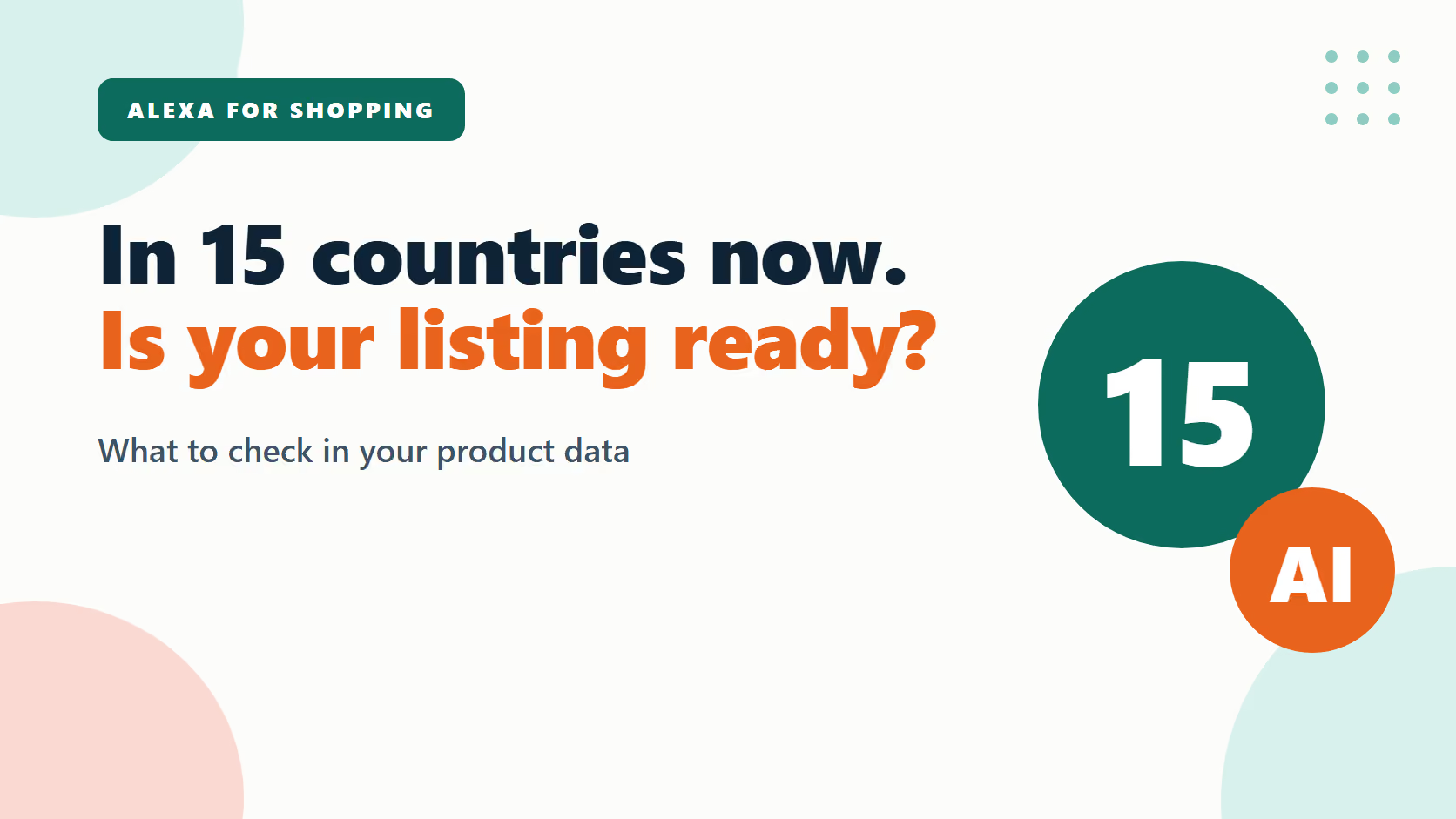
- It reached 15 countries. Alexa for Shopping arrived for shoppers in Canada and Australia this month. Amazon's list now shows 13 countries with full access and two in beta. If you sell in any of them, shoppers can already ask it about your product.
- It opened to stores that don't sell on Amazon. On 4 November Amazon launched the Shop Direct Merchant Workspace, a self-service portal where outside merchants submit their products. This is live in the US only.
- Amazon is reported to be planning for every product. On 13 November Reuters reported an internal plan to collect data on virtually every item for sale, whether Amazon stocks it or not. It is a plan, and Reuters says it may change or be dropped.
Each move puts more products within reach of a shopper who asks Alexa for Shopping a question. So we checked what it does with a listing it already has.
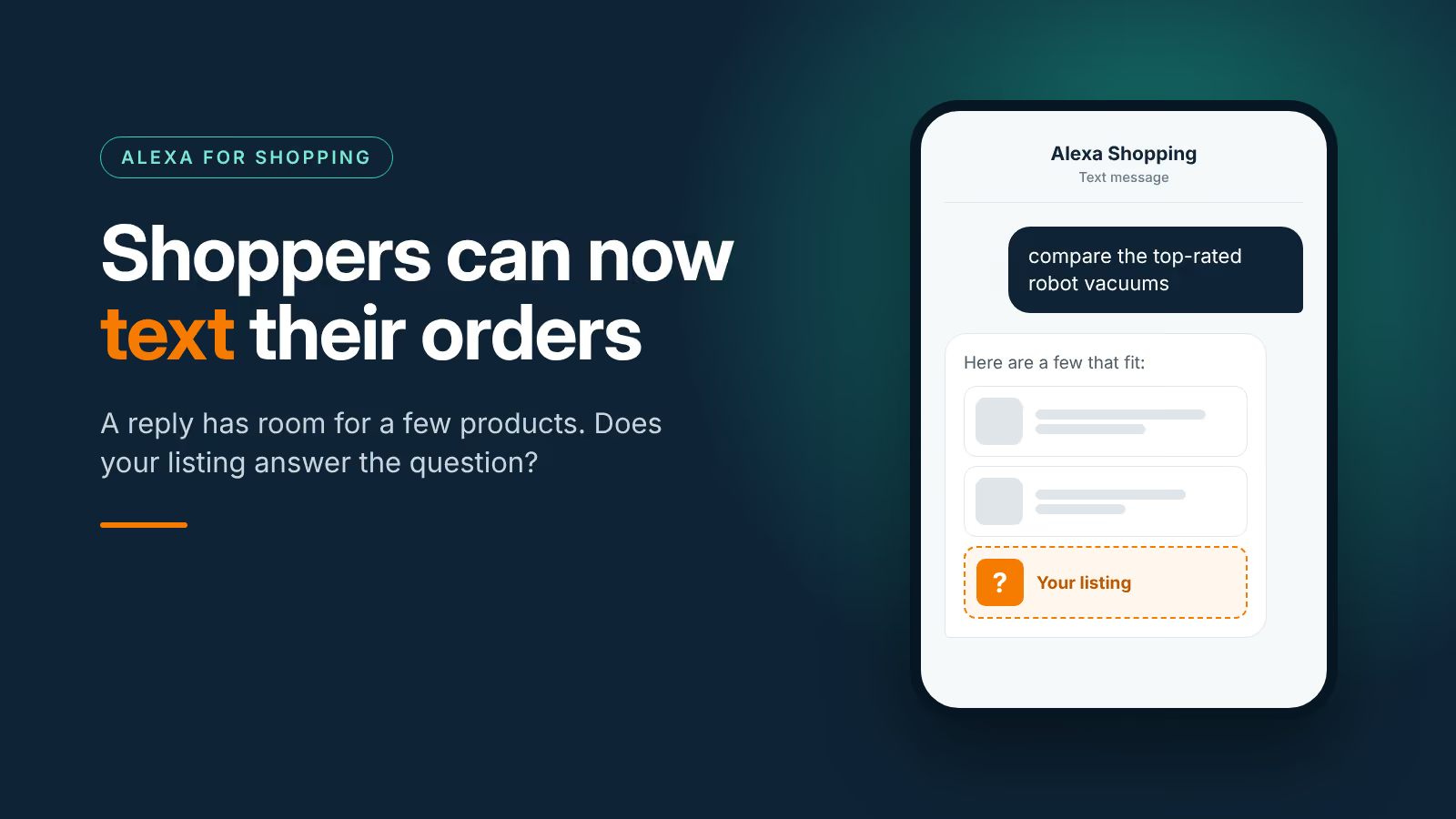
We asked six questions about a well-known sneaker on Amazon.com. Where the seller had written the answer, Alexa repeated it. Where the seller hadn't, reviewers answered, often with a score attached. The listing promises "premium durability", and Alexa reported that 39% of durability mentions in reviews are positive. Three times out of four it also offered other shoes. We followed one of those offers and landed on Skechers, Brooks and ASICS.
When your listing leaves a question open, your reviewers answer it, and Amazon's assistant adds a way out. The more products it can reach, the more ways out it has.
Every way out is also a way in to someone else's listing. The sneaker brand is a household name, and its listing scored 59 out of 100 and left four of 14 buyer questions open. A change in how people shop reopens places that keyword rankings had settled. For a seller entering a category or a new country, a leader with open questions is an opening.
This post covers the three moves, then the six answers, then a one-week checklist for running the same test on your own listing. To see which questions your listing leaves open, start the AI Readiness Score now and let it run while you read. It is free, and the report takes about 2 minutes.
Run Your AI Readiness Score
Where is Alexa for Shopping available?
Amazon's page lists 13 countries with full access and two in beta. Here is the list as of 19 November 2026.
The assistant has been two years in the making, and each step has come faster than the last. Its predecessor, Rufus, launched in beta to a small group of US customers on 1 February 2024 and took until 12 July 2024 to reach all of them, a little over five months. By the end of October 2024 it was in eight countries, and in every one outside the US it was a beta.
Alexa for Shopping succeeded it in the US on 13 May 2026. Six months later, Amazon's list shows 13 countries with full access. Canada shows the change of pace. Rufus arrived there as a beta in October 2024. On 12 November 2026, Amazon Canada wrote that Alexa for Shopping "will roll out to all Canadian customers over the coming week". Five days after that, on 17 November, Amazon said it was available to customers in Australia.
It is free to Amazon customers with a signed-in account, and Amazon says you need no Prime membership, Echo device or Alexa app. Our posts on selling on Amazon Canada and Amazon FBA in Australia cover each marketplace.
What this means for Amazon sellers: A rollout that once took five months now takes a week, so the next country may arrive with little notice. If you sell in any of these 15 countries, shoppers can ask an assistant about your product today, and it will answer whether or not your listing does. Each marketplace carries its own reviews, so the answer about the same product can differ from country to country. Check every marketplace you sell in, starting with the newest. In those countries the established brands start from the same place you do. Their listings were written for keyword search, and every buyer question they leave open is an opening for a seller who answers it.
Stores that don't sell on Amazon can now submit their products
On 4 November Amazon launched the Shop Direct Merchant Workspace, a self-service portal where eligible merchants register, connect their store and submit product feeds. They can connect through providers such as Feedonomics or directly through SP-API. Amazon says the products then become discoverable to customers using Alexa for Shopping and the Amazon shopping website and app. It charges no fees to take part, and the merchant handles shipping, returns and customer service. Shop Direct is available to all US customers on Amazon.com.
We went looking for it. Signed in to Amazon.com with a US delivery address on 19 November 2026, we searched "allbirds wool runners". The page returned Amazon listings and, further down, a strip headed "Shop other stores directly" with results from zappos.com, which Amazon owns, and cloveandtwine.com. Amazon labels the strip "Results from the web. Prices may differ." Each card carries a "Shop direct" or "Buy for me" button.
Asked to compare Allbirds Wool Runners, Alexa for Shopping put both kinds in one table: two Amazon listings with star ratings and Add to cart buttons, and two products it said come from Allbirds' own storefront, shown as a link and a price. It added that it couldn't verify their stock or compare prices across stores.
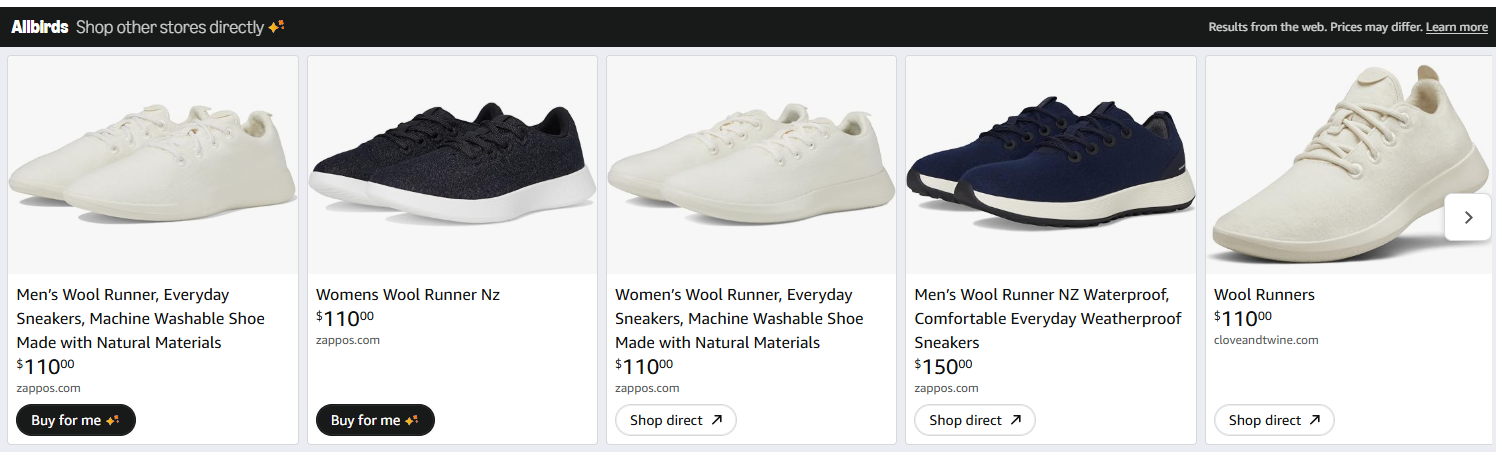
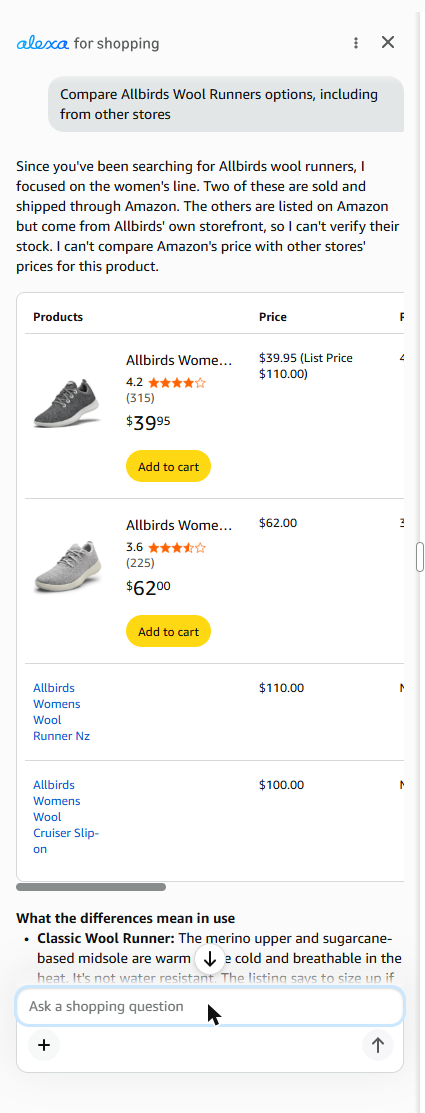
On this evidence an Amazon listing still holds the stronger position, with ratings, reviews and a cart button the outside products lack. Amazon hasn't said how often Shop Direct products appear or how they are ordered against listings. The portal has been open for two weeks.
What this means for Amazon sellers: In the US, the products set beside yours in an Alexa answer no longer have to be Amazon listings. A brand's own store can sit in the same comparison table. Your edge over those products is your ratings, your reviews and your cart button, so the listing text has to do its part. If you also run your own store and are eligible, the portal is open to you too.
Reuters reported a plan to collect product data on every item
On 13 November, Reuters reported a larger idea. The report, by Greg Bensinger, is based on an internal Amazon document written as a PR/FAQ and on people familiar with the matter. It describes a plan called World Product Graph, which would collect data on virtually every item for sale, whether Amazon stocks it or not. The document gives an "aspirational future release date of October 1, 2027."
Reuters reported that the plan "could be modified or aborted due to financial or other concerns." The plan would involve some brands and retailers contributing product data continuously. It would also involve "Amazon independently crawling other retailers' websites." The document says Amazon has already signed up Coca-Cola and Bayer, among others, to contribute product data. Employees describe the plan as "an expansion of existing services known as 'Buy for Me' and 'Shop Direct'."
The internal document, and parts of Reuters' report, still call the assistant Rufus.
Amazon said in a statement that a brainstorming document "doesn't necessarily reflect our current plans." Whether the plan launches is unknown. So is how any crawling would work. Amazon has announced no World Product Graph program that sellers can join, and nothing in the sources asks sellers to act on the report.
ZonGuru's reading: Put this year's changes in a row and they look like one project. First Amazon asked its own sellers for cleaner product data: it capped titles at 75 characters in all categories except media and added the Item Highlights field, 125 characters for the facts that used to be crammed into the title. Then, with Shop Direct, it asked stores outside Amazon for structured product feeds. The plan Reuters describes would be the third step: the same kind of data for every product, gathered whether or not the seller hands it over.
Amazon has not said these are connected. The link is our inference. But each step gives its assistant more products it can read and compare, and each one rewards the seller whose product facts are short, specific and consistent wherever they appear, your own site included.
Reuters describes the plan's aim as ensuring shoppers never need to leave Amazon's site. Our inference from that: with data on products it doesn't sell, Amazon would be the gate shoppers pass through for those purchases too, and it would see what they search for, compare and choose in stores where it has no listing. Neither Amazon nor Reuters says that is the goal.
What this means for Amazon sellers: There is no program to join and no deadline to meet. The direction is the part to act on. The title limit, Item Highlights, Shop Direct feeds and this reported plan all ask for the same thing: product facts stated plainly enough for a machine to read. A seller who has those is ready whether or not the plan ships.
What Alexa for Shopping does with a listing today: six questions, one US product
A wider catalog matters to a seller at one moment: when a shopper asks a question on your product page. We ran that moment on one of the Wool Runner listings from the search above.
On 19 November 2026 we asked Alexa for Shopping whether the shoes are slip resistant on wet surfaces. It said the listing doesn't mention slip resistance or list a tread rating for wet surfaces, cited a reviewer whose tread wore away within about a month and who began slipping on wet surfaces, and said that for wet or slippery conditions you should look for a shoe that lists a slip-resistant rating. Under the answer sat a button: "Slip-resistant walking shoes".
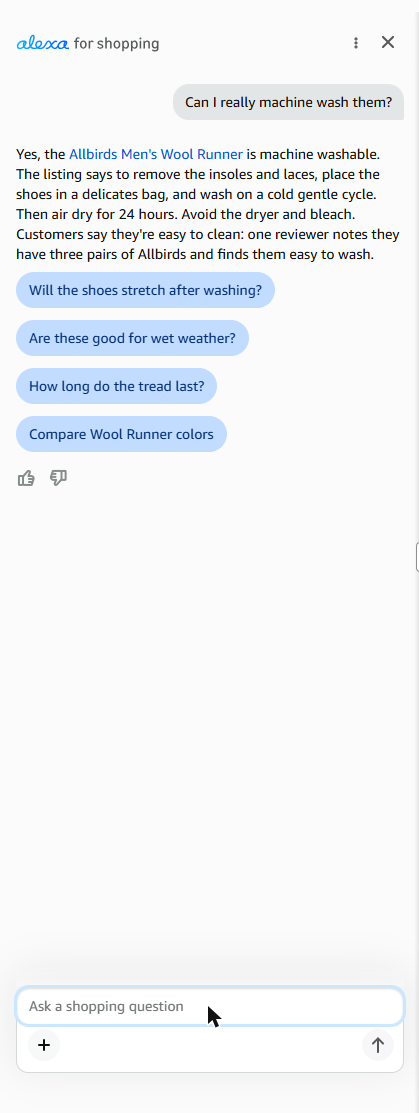
Then we asked whether they can go in the washing machine. The listing covers that in a bullet, and Alexa passed the seller's instructions on almost unchanged: cold gentle cycle, delicates bag, air dry for 24 hours. Every prompt under that answer stayed with the shoe.
The listing is the Allbirds Men's Wool Runner on Amazon.com (ASIN B0CWM9FV8S), 4.4 stars from 373 ratings on the day we looked. We picked it because Allbirds is a well-known brand and the listing already does a lot right.
The Score gave it 59 out of 100, labelled Adequate: 55 for COSMO Semantic Mapping, which rates how well the text states what the product is for and who it suits, and 67 for Alexa for Shopping Q&A Coverage, which rates how well it answers shopper questions. Of 14 buyer questions the Score tested, the listing text fully answers 6, partly answers 4 and leaves 4 unanswered.
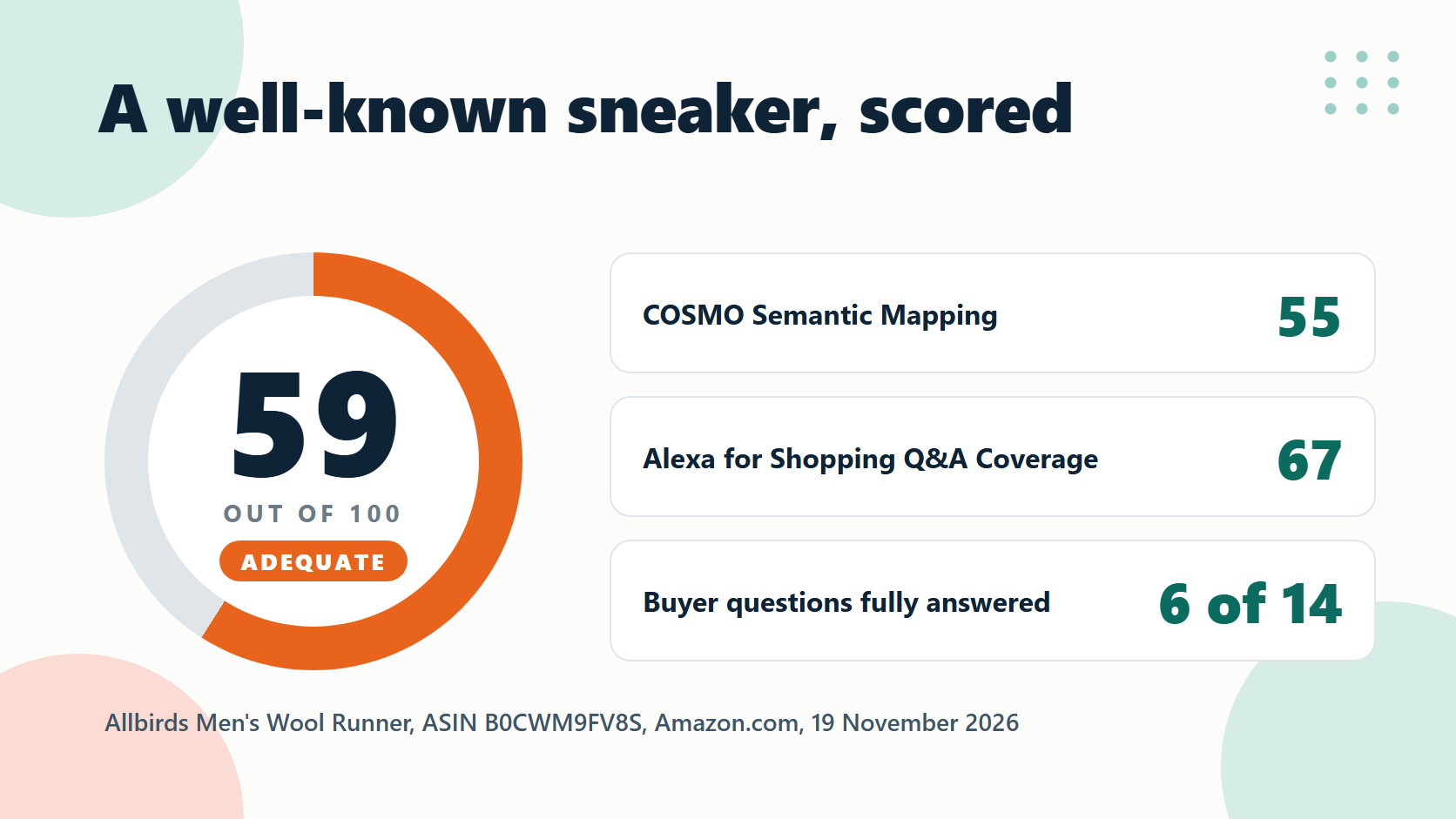
We took all four unanswered questions to Alexa for Shopping on the listing's own page, signed in to Amazon.com. For contrast we added one question the Score marks as partly answered and one it marks as answered.
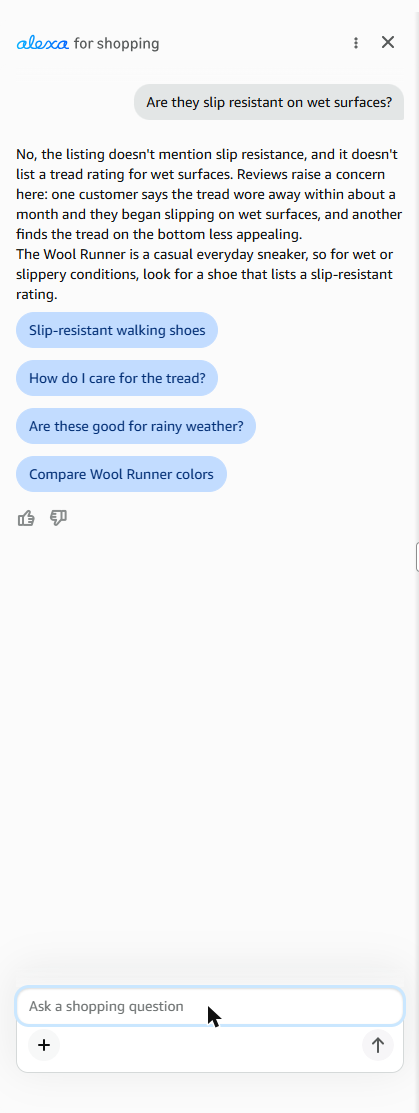
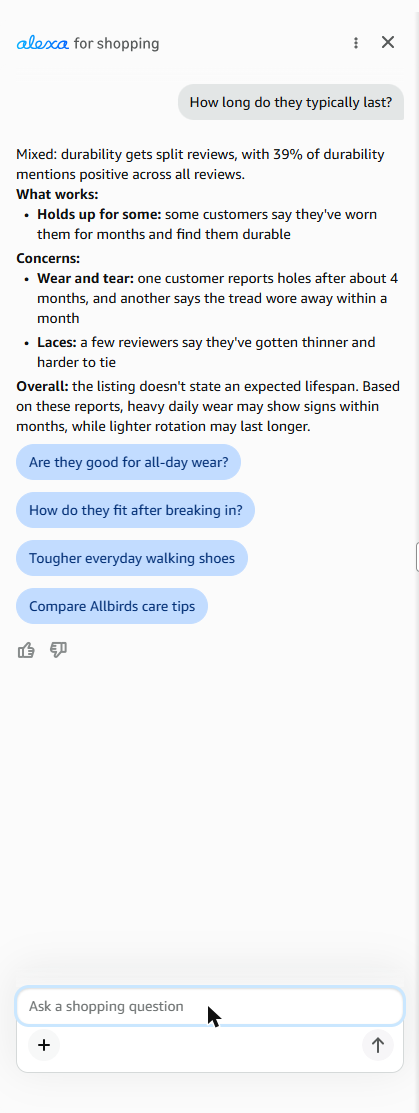
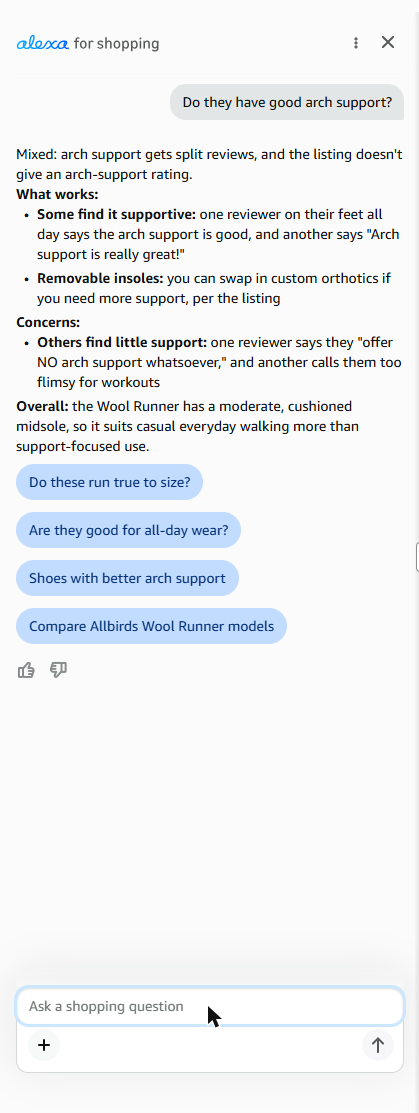
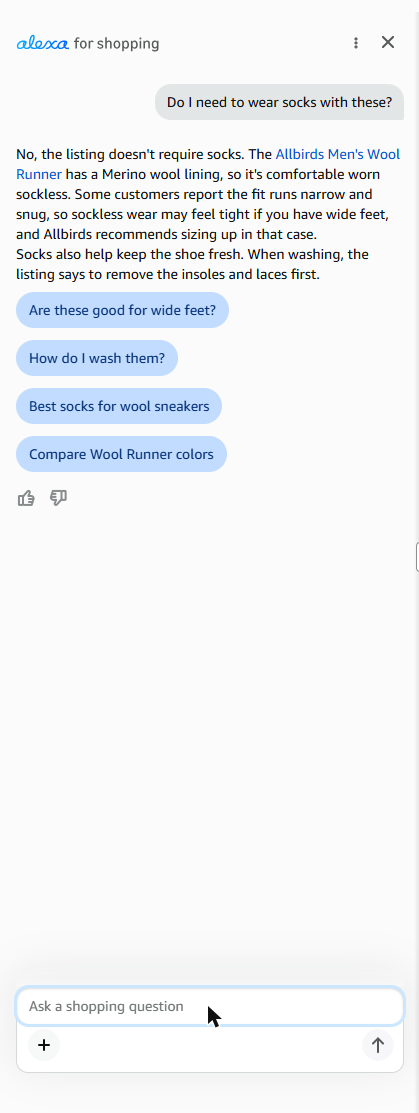
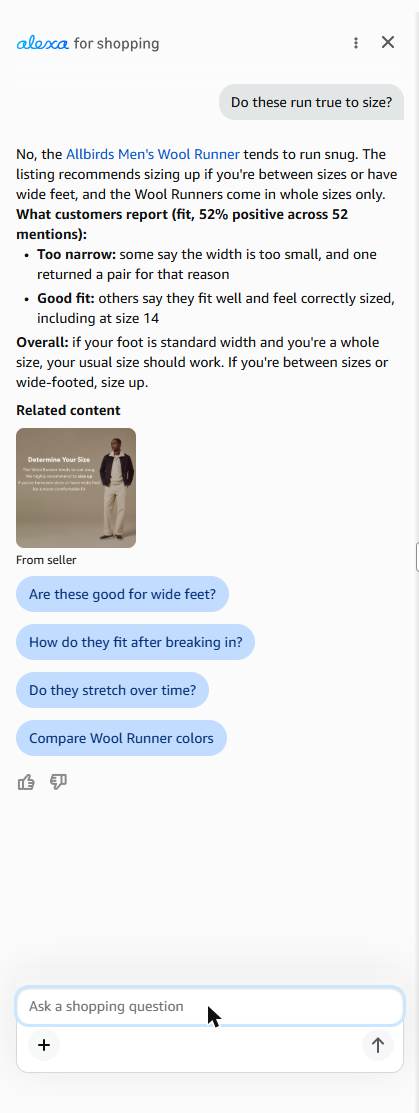
The Alexa columns summarise what it showed us on one account on one day. Its answers differ between shoppers and between asks: we put the arch-support question more than once, and an earlier answer carried a figure (about 46% positive mentions) that today's did not.
When the listing is silent, reviewers answer with a number
The machine-wash answer is what a seller wants. The seller's bullet became Alexa's answer, a reviewer agreed, and none of the four prompts underneath pointed to other shoes.
The three answers on grip, lifespan and arch support read differently. Each one leaned on reviews, and the lifespan answer put a percentage on it. A shopper asking how long the shoes last learns that 39% of durability mentions are positive before learning anything the seller wrote.
The seller did write something about durability. The first bullet promises "premium durability". Alexa didn't repeat it. It noted that the listing gives no lifespan and went to the reviews. An adjective gave it nothing to pass on, and the washing bullet, with a cycle, a bag and a drying time, gave it everything.
Vague wording fails twice. Shoppers type specifics into Amazon's keyword search, the system sellers call A9: "non slip walking shoes", "sneakers with arch support", "shoes for standing all day". "Premium durability" holds none of those words, and it sits in the bullet where they could have gone. In Alexa for Shopping it is a claim with no fact behind it, so the assistant has nothing to quote and turns to the people who wore the shoes. "Lasts 300 miles of daily walking" or "outsole guaranteed for a year", if true, would give both systems something to work with: words a shopper searches for and a fact an assistant can repeat.
Sizing sits in between. The listing has a sizing tip, Alexa repeated it, and then it added the review tally and the complaint about narrow width. A partial answer keeps the seller in the reply without keeping reviewers out of it.
Socks is the exception among the open questions. The listing says nothing, Alexa answered from product facts and reviews, and no prompt pointed elsewhere. An open question doesn't always cost you the shopper.
What this means for Amazon sellers: Every buyer question your listing skips gets answered by your reviewers, in whatever mood they were in when they wrote. Give Alexa a specific fact and it has your version to repeat. Give it an adjective and it goes looking for someone else's.
The way out leads to named competitors
Three of the four open questions ended with a prompt to other shoes. We clicked one, "Shoes with better arch support".
Alexa said it had focused on men's shoes with stronger arch support because we were looking at the Wool Runner. It said testers and experts also recommend the Brooks Adrenaline GTS and the Skechers Arch Fit line, and showed product cards for two Skechers Arch Fit shoes, the Brooks, the ASICS Gel-Kayano and a budget orthopedic walking shoe, each with a price and an Add to cart button.
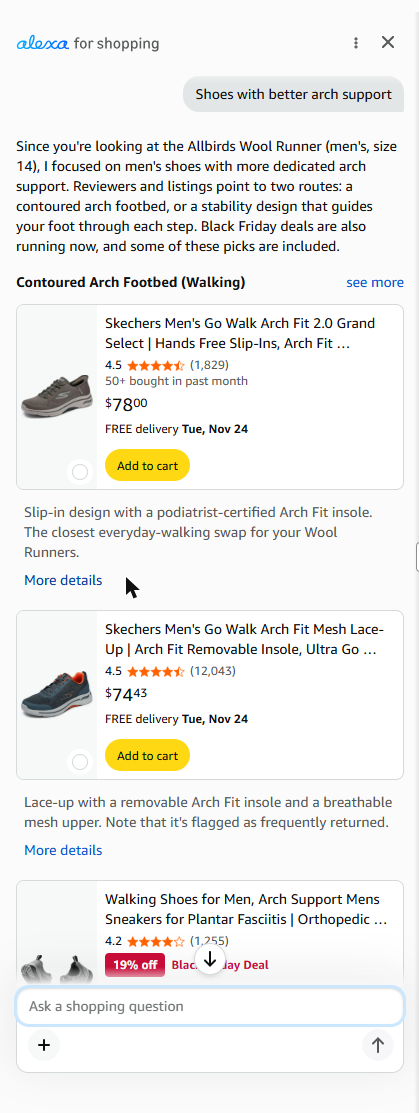
Those were Amazon listings, and in the US the same answer could also draw on stores outside Amazon. Either way, that is two clicks from an Allbirds product page to a competitor's listing, and the first click was a question the listing text doesn't address. We didn't test whether adding an arch-support line to the listing changes Alexa's answer or removes the prompt. What a seller controls is whether the fact exists in the seller's own words.
Now read the same trail from the other side. A shopper on a rival's page asked about arch support, and two clicks later was looking at a Skechers listing with "Arch Fit" in its title. Skechers didn't need to outrank Allbirds for "wool runners" to get that visit. It needed to be the clear answer to a question Allbirds left open.
That is the opportunity in the expansion. Alexa for Shopping is new in Canada, Australia and most of the 15 countries, and the established brands there have listings written for keyword search. When we scored 13 Amazon Australia bestsellers, none of them said how it differs from the alternatives. A smaller seller who answers the questions a category leader skips gives the assistant something specific to point to. Amazon hasn't published how it picks the products it offers, and we didn't test whether a better-answered listing gets picked. What we saw is where the shopper was sent.
What this means for Amazon sellers: An open question on your listing can hand your shopper to a competitor, and an open question on a competitor's listing can hand theirs to you. Find both sets. The checklist below does that in a week.
The Score reads the title, bullets, description and Item Highlights. It doesn't read images, A+ Content, backend attributes or Brand Stores, and Alexa can. Its socks and arch answers both mentioned removable insoles and attributed them to the listing, although the Score counts both questions as unanswered. So "unanswered" in the Score means unanswered in the text it reads.
The Score counted the title at 138 characters with its colour and size variant, against Amazon's 75-character limit, and found Item Highlights not in use. Its output notes that a title over 75 characters keeps that field hidden. That statement is the Score's, not Amazon's.
What does Alexa for Shopping read about your product?
Amazon has not published how Alexa for Shopping chooses which products to recommend. It has said what the assistant draws on: deep product knowledge and information from across the web. In our test the answers named the listing, the manufacturer and customer reviews, and the competitor answer cited testers and experts.
In its third-quarter results release of 29 October 2026, Amazon said customer interactions with Alexa for Shopping rose 570% year over year. That figure counts use. It doesn't show sales, and it doesn't show which listings were recommended.
Two earlier posts cover the background: what Alexa for Shopping means for Amazon sellers for the US launch in May, and how Alexa for Shopping, COSMO and About You connect for the wider system. COSMO is the knowledge system described in Amazon's own research.
A one-week checklist for your product data
Each step below is a check. None promises a result.
- Day 1. Pick your top ASIN and run the Score on it. Write down the questions it marks as open, and count the title's characters with the variant included. The Wool Runner's came to 138 against a 75-character limit.
- Day 2. In the Amazon Shopping app or on the website, ask Alexa for Shopping each open question on your own listing. Note where each answer came from, any percentage it quotes and the prompts underneath.
- Day 3. Click every prompt that points to other products and write down the brands it names. Those are the competitors Alexa sets against you on that question. Then ask the same questions on the category leader's listing. The ones it leaves open are where your listing can be the clearer answer.
- Day 4. For every answer that came from reviews, write the fact into your bullets or description in plain words. On the Wool Runner that would be a line on wet-surface grip, a line on arch support and the removable insole, and what a buyer can expect on lifespan.
- Day 5. Find the adjectives in your bullets and swap each for something Alexa could repeat. "Premium durability" gave it nothing. A cycle, a bag and a drying time gave it the whole answer.
- Day 6. If you sell in the US, search your main keyword on Amazon.com and look for a "Shop other stores directly" strip. Note which stores appear. If you use Shop Direct yourself, check that the feed and the listing state the same facts.
- Day 7. Once your edits are live, ask Alexa the same questions again and re-run the Score. Note what changed, then repeat the check monthly.
Days 4 and 5 are the slow ones, and they multiply with every ASIN. Helix™ is our listing engineering tool for that work: it researches your niche, competitors and reviews, then writes the title, bullets, description and Item Highlights to answer the questions the Score finds open. Helix is currently available for Amazon US, UK, CA & AU marketplaces.
Frequently asked questions
Is Alexa for Shopping available in my country?
As of 19 November 2026, Amazon lists 13 countries with full availability. They are the US, UK, Germany, France, Italy, Spain, Canada, Japan, India, Brazil, Mexico, Austria and Australia. The United Arab Emirates and Turkey are in beta. Amazon Canada said the rollout would reach all Canadian customers over the week after 12 November.
Does Alexa for Shopping use customer reviews to answer product questions?
In our test, yes. All six answers about one Amazon.com listing drew on customer reviews to some degree. Where the listing text answered the question, Alexa gave the seller's answer first and used reviews to back it up. Where it didn't, reviews were the answer. That is one listing on one day, and Amazon has not published how the assistant chooses its sources.
Does Alexa for Shopping recommend competitors on my product page?
It did in our test. Three of four questions the listing text left open ended with a prompt to other shoes, and the one we clicked named three competing brands, Skechers, Brooks and ASICS, and showed their listings. The two questions the listing addressed carried no such prompt. Six questions on one listing can't show that one causes the other.
Can stores that don't sell on Amazon appear in Alexa for Shopping?
Yes, in the US. Amazon says products from eligible merchants in Shop Direct are discoverable to customers using Alexa for Shopping and the Amazon shopping website and app. In our test, one comparison table mixed Amazon listings with products from another storefront.
Do I need to do anything about the World Product Graph?
Nothing in the sources asks sellers to act on it. Amazon has announced no program that sellers can join, and Reuters reported that the plan may change or end. The one-week checklist is still worth running, because it checks facts that Alexa for Shopping can read whichever way the plan goes.
Does Helix™ cover all 15 countries?
No. Helix covers the Amazon US, UK, Canada and Australia marketplaces. The other countries on Amazon's list are outside Helix coverage. The AI Readiness Score covers the same four marketplaces. For the other countries, this post reports Amazon's news and makes no claim about either product.
Where to start this week
Pick the question you'd least like a reviewer to answer for you, and ask Alexa for Shopping on your own listing. Then run the Score to find the rest.
See Where Your Listing Stands - We analyze only your public listing data, charge you nothing, ask for no credit card, and never send spam.
The Score covers Amazon US, UK, Canada and Australia listings. To engineer fixes across a catalog, see Helix™.