


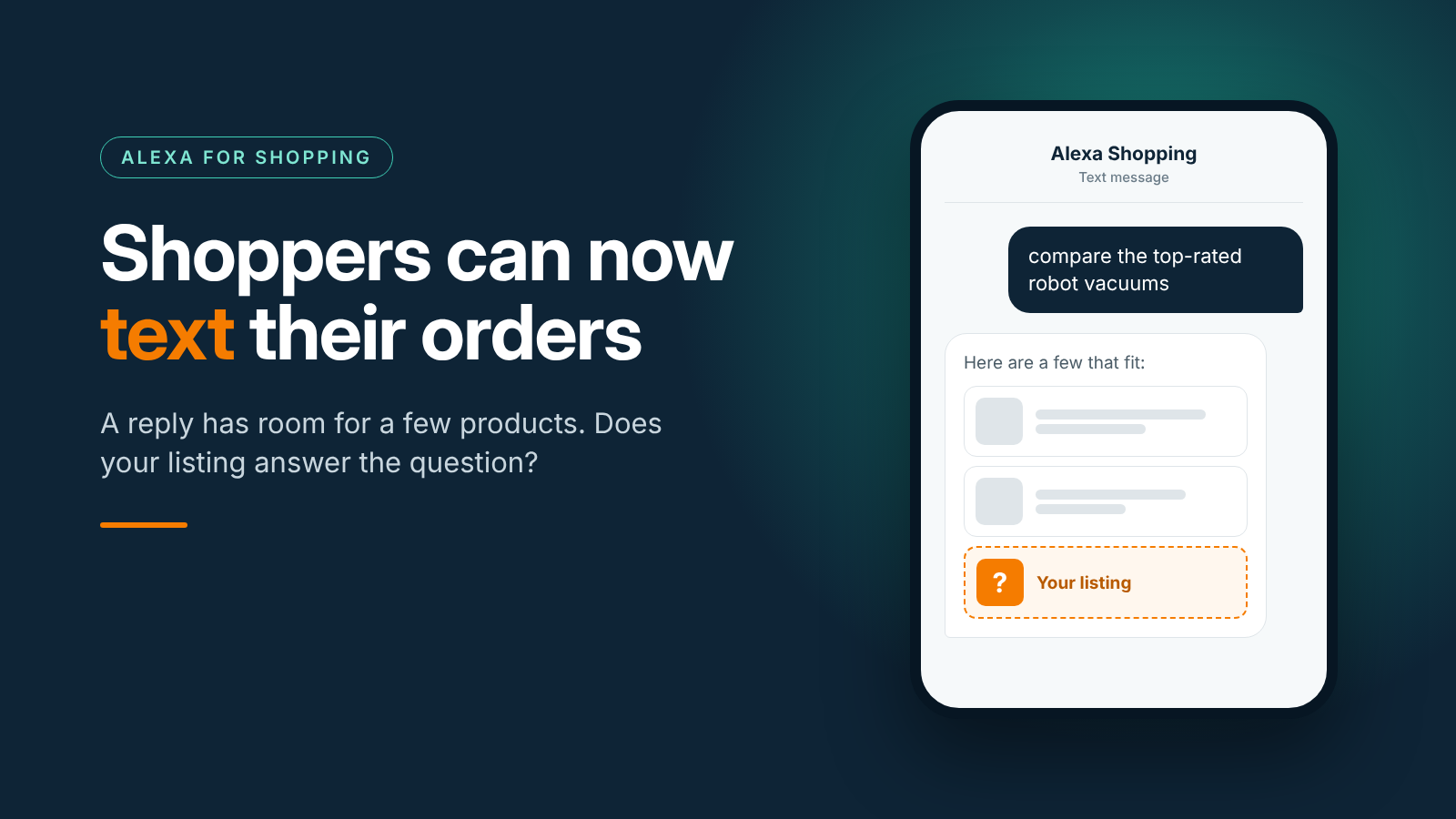
On 6 November 2026, Amazon began the rollout of text-based shopping. A small group of invited US shoppers can now send text messages to Alexa for Shopping, Amazon's AI agent. They can use it to search for products, compare them and complete purchases without opening the Amazon app or website. Amazon says the option will reach “millions more customers in the coming weeks,” so it lands in the middle of the holiday shopping season.
In a search box, shoppers type three or four words. You could research those words. In a message thread, they type what they'd say to a person: the budget, the deadline, the awkward detail. You can't research that. Amazon gives sellers no report of what gets typed there, and the list of possible questions has no end.
So the problem fits in one line. You can't research a question nobody has asked yet.
But you can do two things about it. First, you can check whether your listing states enough about the product to answer a new question. Second, you can keep your keywords working, in case the agent leans on search rank more than the early evidence suggests. This guide covers both. It explains what Amazon launched, why the old research method runs out, and how the agent appears to pick products. Then it shows what we found when we scored a Tide listing, and it ends with a five-step method you can use on your own.
The short version, if you read no further. While writing this guide, we ran the free AI Readiness Score on a Tide PODS listing. The Score tested fifteen questions shoppers ask about laundry detergent. The listing text fully answered four. “Is it safe for sensitive skin?” wasn't one of them. Yet Amazon's own agent suggests that exact question on the Tide product page. If a household-name listing leaves that out, a smaller brand that states it has an answer the big one doesn't. That's an opening, so it's worth seeing what yours leaves out. The Score lists the gaps question by question, so you know what to write.
Run Your Free AI Readiness Score - We analyze only your public listing data, charge you nothing, ask for no credit card, and never send spam. Once you enter the ASIN, the report comes back in about two minutes.
How does shopping by text with Alexa for Shopping work?
Amazon's notice explains how to sign up and then gives a list of examples. Here is the sign-up part first.
Invited customers get a text message, accept the terms and link their phone number. After that, the AI shopping agent appears in their contacts as “Alexa Shopping.” From there, users text Alexa the way they'd message a person. For everyone else, Amazon has opened a waitlist at amazon.com/text-alexa-shopping, which also puts them on Amazon's marketing texts. Rajiv Mehta, Amazon's vice president of Conversational Shopping, summed it up this way:
“Now with Alexa for Shopping, your personal shopping agent is just a text away.”
Next, the examples. These are in Amazon's own words, and they show what a shopper is expected to type:
| Shopper texts | What the agent does |
|---|---|
| “reorder the laundry detergent I bought last month” | Finds it in purchase history and reorders, with approval in Amazon's example |
| “add broccoli to my last order” | Edits an open grocery order |
| “let me know when AirPods go on sale” | Tracks the price and alerts, or buys at a target price if told to |
| “compare the top-rated robot vacuums” | Returns a comparison, not a results page |
| “what's the price history on this Kindle?” | Shows up to a year of price history |
| “update me when Nike drops new running shoes” | Sets a new-release alert |
| Photos of products or outfits “spotted while scrolling” | Searches for similar items |
Only one row in that table is a contest between listings. In the other rows, the shopper has already named the product or the brand. So the agent just fetches it and reports back. Whatever copy Nike writes for its next running shoe, the shopper who asked for the alert will hear about it.
The robot vacuum request is different. There, the shopper names a need, and the agent decides which products go in the reply. That's the kind of request the rest of this guide is about.
Amazon also left several things out. It named no messaging technology (SMS, RCS or iMessage). It gave no size for the first group and said nothing about a Prime requirement. And it gave no count of products per reply.
One more piece of context matters here. The new feature follows Amazon's decision on 20 September to block Meta's Muse AI agent from shopping on its site. So for now, Amazon is keeping conversational e-commerce on its own agent and holding third-party AI agents out. That may not last. Amazon sued Perplexity over its shopping agent and won a court order against it in March. But on 4 August, a US appeals court lifted that order, and the case continues. Amazon also says it's in talks with Meta. Today, though, Alexa for Shopping is the AI shopping assistant that matters for a seller on Amazon.
Why can't you research what shoppers will text?
Keyword research works because search leaves a record. Search term reports and Amazon Brand Analytics show you what people typed. The list is long, but it's finite. So you can write a listing to match it.
Text shopping breaks each part of that.
First, the request is a sentence. Amazon's own examples show how far it drifts from a keyword: “search for a birthday gift you need by Saturday,” or a standing instruction such as “only show me organic options.”
Second, the agent learns each shopper's preferences over time. As a result, two people asking about the same product are asking different questions.
Third, there's no record for you to read. As of this guide's date, Amazon has announced no report that shows sellers what shoppers ask the agent about their category.
The same need, typed two ways
Meanwhile, the answer has shrunk. On the site, the agent replies in a panel beside a results page, so a shopper who doesn't like the answer can still scroll. In a thread, there's no page to scroll. Digiday reported Amazon's statements on launch day and described the format as having “room for a handful of products at most.” We made the general point in our guide to the future of Amazon SEO: a page shows dozens, but an answer names a few. Text is the sharpest case of it so far. Amazon has published no per-reply count, so this guide won't give you one.
And the audience is already large. On Amazon's third-quarter earnings call on 29 October, Andy Jassy, Amazon's CEO, said: “Over 400 million customers have used Alexa for Shopping, our agentic shopping assistant, in the last 12 months.” Amazon also said interactions rose 570% year over year, and that US customers who use it “are spending 50% more per order than those who don't.” Treat that last figure with care. It compares two groups of shoppers, and heavier shoppers tend to adopt new tools first, so it doesn't show that the agent causes the difference.
How does Alexa for Shopping choose which products go in the reply?
Amazon describes the inputs, but not the method. Its May launch notice says the agent “uses what it knows about you and its product expertise.” It draws on preferences, shopping history, product information and reviews. No ranking formula is published.
So far, there's one independent sample. Autopilotbrand.com captured it in May and June 2026, and Marketplace Pulse reported it on 16 July. Across 1,963 non-branded “best of” questions, the agent made 12,810 recommendations. Of those, 63.9% fell outside the organic top 10 for the matched search term. And 40.9% never appeared on the visible results page at all. It's one US account and one early snapshot, so treat the percentages as direction, not precision.
That's the headline. But read the same numbers from the other side. Out of every 100 products the agent recommended, 36 came from the organic top 10. Another 23 were on the results page, but further down. The other 41 weren't on the visible results page at all. A results page holds far more than ten organic listings, yet the top ten alone supplied more than a third of the picks.
Out of every 100 products the agent recommended
So the evidence doesn't say rank has stopped mattering. It says there are two ways into a reply. Either the product ranks at the top of the matching search, or its listing answers the question well enough to be picked from further down.
Which route will carry more weight a year from now? Nobody outside Amazon knows, and Amazon can change the balance without telling anyone. That's the practical argument for not choosing.
Consider the two bets. A listing written only for keywords loses if the agent favours the best answer. A listing rewritten only for conversation, with the keywords stripped out, loses if the agent keeps drawing on the top of search. Both engines read the same listing text, so one listing has to serve both.
For how the engines share that text, see Amazon's AI shopping stack explained. For the longer background, see our guide to Alexa for Shopping for Amazon sellers.
Known questions and invented ones
The keyword half of that job is familiar. You already have tools and reports for it. The question half has no report, so it needs a different kind of check.
That check is the AI Readiness Score. It's a free 0 to 100 read of how well a live listing's text answers what Amazon's AI discovery asks, and it has two halves.
The first half is Alexa for Shopping Q&A Coverage. It tests the listing against the questions shoppers ask in that category, and it marks each one answered, partly answered or missing.
The second half is COSMO Semantic Mapping. It checks eleven kinds of fact about the product: what it's used for and in which situations, who it's for, where and when it's used, what it works with, what it's compared to and which problem it solves. COSMO is the knowledge system described in Amazon's own research, and those relationship types come from it. Our Amazon COSMO guide covers it in full.
Here is how we read the two halves. It is our reading, because Amazon hasn't published how the agent uses either one. The first half covers the questions someone has already thought of. The second half covers the raw material for the questions nobody has thought of yet.
Why does that matter? An agent can only answer from what is written down. So a listing that states those eleven kinds of fact plainly has something to offer when a shopper invents a question. A listing that only answers a known list has nothing to fall back on.
For reference, the field sits near 65 overall across the listings scored so far. It sits near 54 on the Q&A half and near 70 on the semantic half. Scores below 50 are the clearest place to start.
If you skipped the check at the top, run the Score on your own ASIN now. The next section is easier to follow with your own two numbers beside it. And for more detail on both halves, see our AI readiness scoring guide.
We scored a Tide listing: ready for the known questions, not for new ones
Amazon's launch example is “reorder the laundry detergent I bought last month.” So on 9 November 2026, we ran the Score on Tide PODS Laundry Detergent Pacs, Original Scent, 112 count (ASIN B0B9YVG4LR, US). When we checked the page on 11 November, it ranked #1 in Laundry Detergent Pacs & Tablets on Amazon.
15 buyer questions tested
The pattern is the reverse of the usual one. On known questions, the listing is level with the field. It fully answers four of the fifteen tested, including cold water and HE washers. It partly answers four more and misses seven. We checked the gaps against the live listing on 11 November. Here are six that hold up:
| A shopper texts | What the listing text says today |
|---|---|
| Is it safe for sensitive skin? | Not mentioned |
| Is it safe for septic systems? | Not mentioned |
| Can it be used on baby clothes? | Not mentioned |
| Does it leave residue? | Says it “dissolves quickly, even in cold”; doesn't mention residue |
| Will it remove grass or wine stains? | Names grease only, and says “100% of common stains” |
| How many loads does the tub cover? | Not stated outright; the bullets say “pre-measured” and to add a pod for larger loads |
Four of those six aren't our invention. Amazon's agent suggests them on the Tide product page itself, as tap-to-ask prompts: sensitive skin, residue, baby clothes and grass stains. So the agent already expects shoppers to ask them, and the listing text doesn't answer them.
However, the larger gap is in the other half. Of the eleven kinds of fact, only product type is fully stated. The text doesn't say who the product suits. It names no situations beyond heavy soil and cold water, and no place of use beyond “HE compatible.” It doesn't say what the product works with. And it doesn't say how long a tub lasts at a given number of loads a week.
The eleven kinds of fact: only one is fully stated
That is what an invented question runs into. For example, take a request built only from those gaps: a detergent for a shared laundry room, for two people, that lasts a month and is safe with a septic tank. None of those words is an exotic keyword. Even so, the listing text can't answer any part of it.
The format is behind too. The title runs to 127 characters against Amazon's 75-character cap, and the Item Highlights field isn't in use.
Title length: 127 characters against a 75-character cap
Three limits apply to all of this. First, the Score reads listing text only: title, bullets, description and Item Highlights. It doesn't read images, A+ Content or backend attributes, and a brand this size may well cover some of these points there. Second, the agent also draws on reviews, and Tide has more than 277,000 ratings. Reviewers on the page say the pods leave no residue, and one says a tub lasted four months. So the agent may find some answers there, but then the brand has left those answers to its customers. Third, a score isn't a sales forecast. A household that already buys Tide will reorder it from purchase history, whatever the bullets say. So the gap matters for the shopper who hasn't chosen yet. And it matters more for a brand nobody asks for by name.
That cuts both ways, which is the opening mentioned at the top. When a shopper asks a question without naming a brand, the agent has to pick on what the listings say. A smaller brand can state what this listing doesn't, and some already do. On the same Tide page, two smaller brands advertise listings with “septic safe” and “safe for sensitive skin” in their titles. Whether that wins them the reply is our inference from how Amazon describes the agent, not a measured result.
How do you write a listing for questions you can't predict?
You can't list the questions, so the method works from the other end. First you collect the questions that already exist. Then you state the facts that new ones will be built from. The five steps below take about a week for one listing, alongside normal work.
Step 1 (today): collect the questions that already exist
Four sources cost nothing.
- Your search term report. Pull the search terms of five words or more from the last 90 days of your Sponsored Products report. Long queries are already half way to a question.
- Reviews. Read your one- to three-star reviews, and your competitors' too. Look for what buyers expected and didn't find.
- Messages and returns. Check your customer messages and return reasons for the same thing.
- The agent itself. Open the Amazon app and ask Alexa for Shopping about your category: “what should I look for in a [product type]?” and “compare the top-rated [product type].” Then note which criteria it names and which products it picks. Those criteria are what it's checking listings for.
Step 2: turn each claim into the fact a question needs
Most listings state a benefit. But a shopper asks for a specific. The Tide listing shows the pattern, and yours will have its own versions:
| The listing says | The question it can't answer | What to state instead |
|---|---|---|
| “Stain remover” | Will it remove grass or wine stains? | The stain types by name |
| “112 count” | How many loads is that? | The dose per load and the loads per pack |
| “HE compatible” | Will it work in my building's shared front-loader? | The machine types and settings it suits |
| “Dissolves quickly” | Does it leave residue in a cold wash? | The temperature range and the result |
So go through your bullets and mark every adjective and every bare number. Each one is a place where a fact is missing.
Step 3: state the eleven kinds of fact
This step prepares a listing for questions nobody has asked yet. The lines below follow COSMO's semantic relationship types. Write one plain sentence for each line below. Then check that each sentence appears somewhere in the listing text.
| Kind of fact | Sentence to complete |
|---|---|
| Product type | “This is a ….” |
| Function | “It's used to ….” |
| Situation | “People use it when ….” |
| Audience | “It suits …, and it doesn't suit ….” |
| Capability | “It can …, up to ….” (a number, range or limit) |
| Problem solved | “It fixes ….” |
| Alternative | “Compared with …, it ….” |
| Complement | “It works with … and shouldn't be used with ….” |
| Outcome | “After using it, you ….” |
| Location | “It's used in ….” |
| Time and frequency | “One pack lasts … at … uses a week.” |
Skip any line that doesn't apply to your product. For the rest, the rule is simple. If you can't fill a blank from the listing, the agent can't answer that question from it either.
Step 4: put the facts where each engine reads them, and keep your keywords
Each field has a job.
- Title. Keep it within Amazon's 75-character title limit. Give it the brand, the product type and your main keyword.
- Item Highlights. Put attribute phrases in the Item Highlights field. It holds up to 125 characters, and it's searchable.
- Bullets. Give each bullet one group of facts, and open it with the fact. That way, the dose and the load count come before any benefit language.
- Description. Use it for situations, audiences and comparisons, because those need full sentences.
Then, before you publish, check the edited text against your search term report. Confirm that the terms you rank for are still there. After all, the agent may be drawing on the top of search more than anyone outside Amazon can measure.
Step 5 (once the edits are live): test it
Ask Alexa for Shopping the questions from Step 1 again. Add two more that you make up on the spot. Then see whether the answers now use your facts. Finally, run the Score on the same ASIN and compare each half with its earlier number.
Doing this for one listing takes a few days of careful writing. Doing it across a catalogue is a bigger job, because you also have to hold the keyword side steady and repeat the work as listings drift. That's where Helix™ Listing Engineering comes in. Helix engineers each listing for A9 keyword search and for Alexa for Shopping from one input. So you aren't betting on a single theory of how the agent picks. And nothing goes to Amazon until you publish it. Helix doesn't promise rankings, because rank also depends on price, ads, reviews and stock. Helix is currently available for US and UK Amazon marketplaces.
What about ads, reorders and price alerts?
Three other parts of the launch affect sellers. None of them turns on listing copy, so each gets one paragraph here.
Ads. Amazon told Adweek and Digiday on launch day that Sponsored Products appear in text replies, and that it isn't charging for them yet. That adds to three placements already running or announced. Sponsored Products have appeared in Alexa+ conversations on Echo Show since August 2025. Sponsored prompts have been billed at the campaign's cost-per-click since 25 March 2026. And Branded Conversations are due in the US in January 2027. However, Amazon hasn't said how it picks which ad goes into a reply, and Amazon Ads hasn't yet published a page on the text placement. For now, one action follows: note which ASINs sit in your US Sponsored Products campaigns, since those are already eligible for conversational placements.
Reorders. A reorder goes to purchase history, so the first purchase decides the ones after it. For a consumable, that raises the value of winning the shopper who asks a question first. It also raises the value of stating how long a pack lasts.
Price alerts. A shopper can tell the agent to buy when a price hits a target. As a result, a coupon or a deal can trigger a purchase that was authorised in advance. Prices that move on purpose serve that better than repricing that swings hourly. For the calendar side, see our Amazon Q4 preparation guide.
Frequently asked questions
Who can text Alexa for Shopping, and when will it be available more widely?
As of 6 November 2026, it's invite-only for a subset of US customers. Anyone else can join the waitlist at amazon.com/text-alexa-shopping, which also opts them into Amazon's marketing texts. Amazon says the rollout will reach millions more customers in the coming weeks. It has given no general-availability date.
Does Alexa for Shopping ask for confirmation before placing an order?
Sometimes, and Amazon hasn't drawn the line clearly. In its reorder example, the agent buys after the shopper approves. But a shopper can also set it to buy on its own when a product reaches a target price, with no further confirmation. For a seller, that means a price drop can complete purchases that were authorised days earlier.
How many products does Alexa for Shopping show in a text reply?
Amazon hasn't said. Trade coverage on launch day described the format as having room for a handful at most. Amazon's own wording is that the agent messages back suggestions as it finds them. Either way, a reply is shorter than a results page, so a listing has to be among the few picked.
Can I see what questions shoppers text about my products?
No. Amazon has announced no report of what shoppers ask the agent by text. The Amazon Prompts report in the ads console covers clicks on sponsored prompts, which is a different thing. Instead, you can test the listing against the questions shoppers ask in your category. That is what the Q&A half of the AI Readiness Score does.
Does my organic rank decide whether Alexa for Shopping recommends my product?
Partly. In the one independent sample, 12,810 recommendations captured in May and June 2026, 63.9% of the agent's picks came from outside the organic top 10. About 36% came from inside it. So rank helps, but it isn't enough. That's why a listing should keep its keywords and also answer questions.
Does the AI Readiness Score tell me whether Alexa for Shopping will recommend my listing?
No. It reads your public listing text and scores how well that text answers what Amazon's AI discovery asks. The score is split into COSMO Semantic Mapping and Alexa for Shopping Q&A Coverage. It doesn't score images, A+ Content or backend attributes. And it makes no promise about rank, sales or inclusion in a reply. What it does show is where the text leaves a question without an answer.
Where this leaves your listing before the invites widen
Some of your customers will get the invite in the next few weeks. Soon after, a few of them will text a question about your category that you've never seen in a search term report.
You can't research a question nobody has asked yet. But you can find out today whether your listing has the facts to answer it. And you can do that while the keywords that got you this far stay in place.
A shopper will text a question about your category that no report will ever show you. See whether your listing could answer it.
Run Your Free AI Readiness Score
We analyze only your public listing data, charge you nothing, ask for no credit card, and never send spam. The AI Readiness Score reads any live US or UK Amazon listing.
Once you enter the ASIN, the report comes back in about two minutes.