


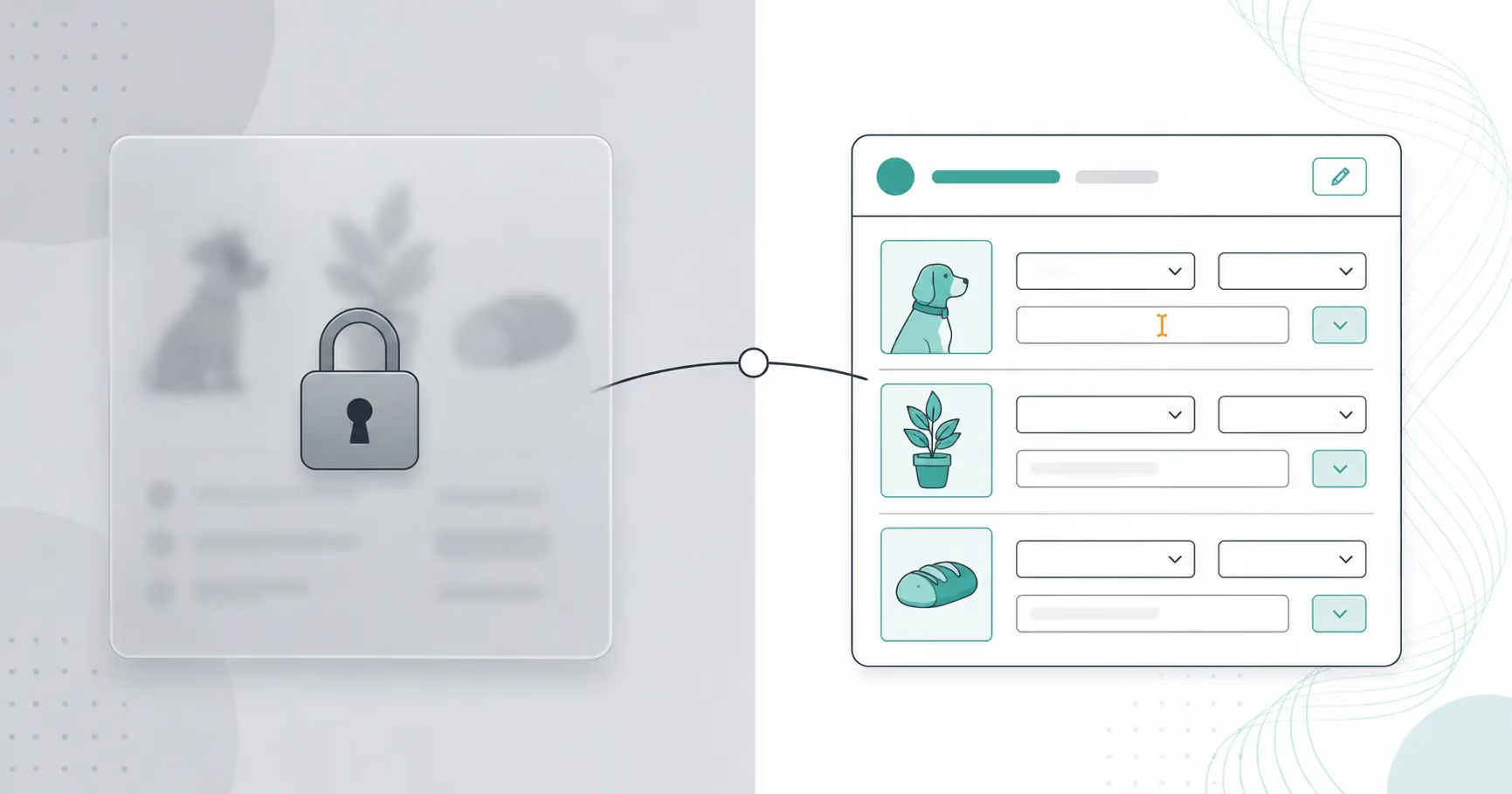
Amazon is teaching your customers to talk about their sourdough starters. Its About You announcement walks shoppers through the example: mention that "your sourdough starter, Doughy, needs to be fed every 12 hours," and Alexa for Shopping, Amazon's AI shopping assistant, learns to suggest flour types and fermentation tools. Every conversation like that one feeds a personalization record Amazon keeps per shopper: named, curated by the shopper, and invisible to you.
Amazon calls that record the About You profile, and since May it has sat between your listing and every buyer the assistant serves. The profile is the variable you can't see, but the match it makes runs against your listing, the variable you fully control.
Most seller coverage of the May launch skipped the profile entirely, and none of your dashboards mention it. So before you touch a bullet point, it pays to know what Amazon actually built. The company has been unusually specific.
What is Amazon's About You profile?
The About You profile is the personal record Amazon builds for each shopper to power its AI shopping recommendations. It launched with Alexa for Shopping on May 13, 2026, and it lets shoppers view and edit the personal details that shape what the assistant suggests to them.
Amazon names exactly what flows in: "your conversations with Alexa for Shopping, product reviews you've authored, your purchase history, items you've saved to Lists, and your searches." The shopper holds the pen, though, because Amazon says they can share what they want, correct specific details, or remove anything they don't want used for personalization. Any shopper can also ask the assistant "What do you know about me?" and get an answer.
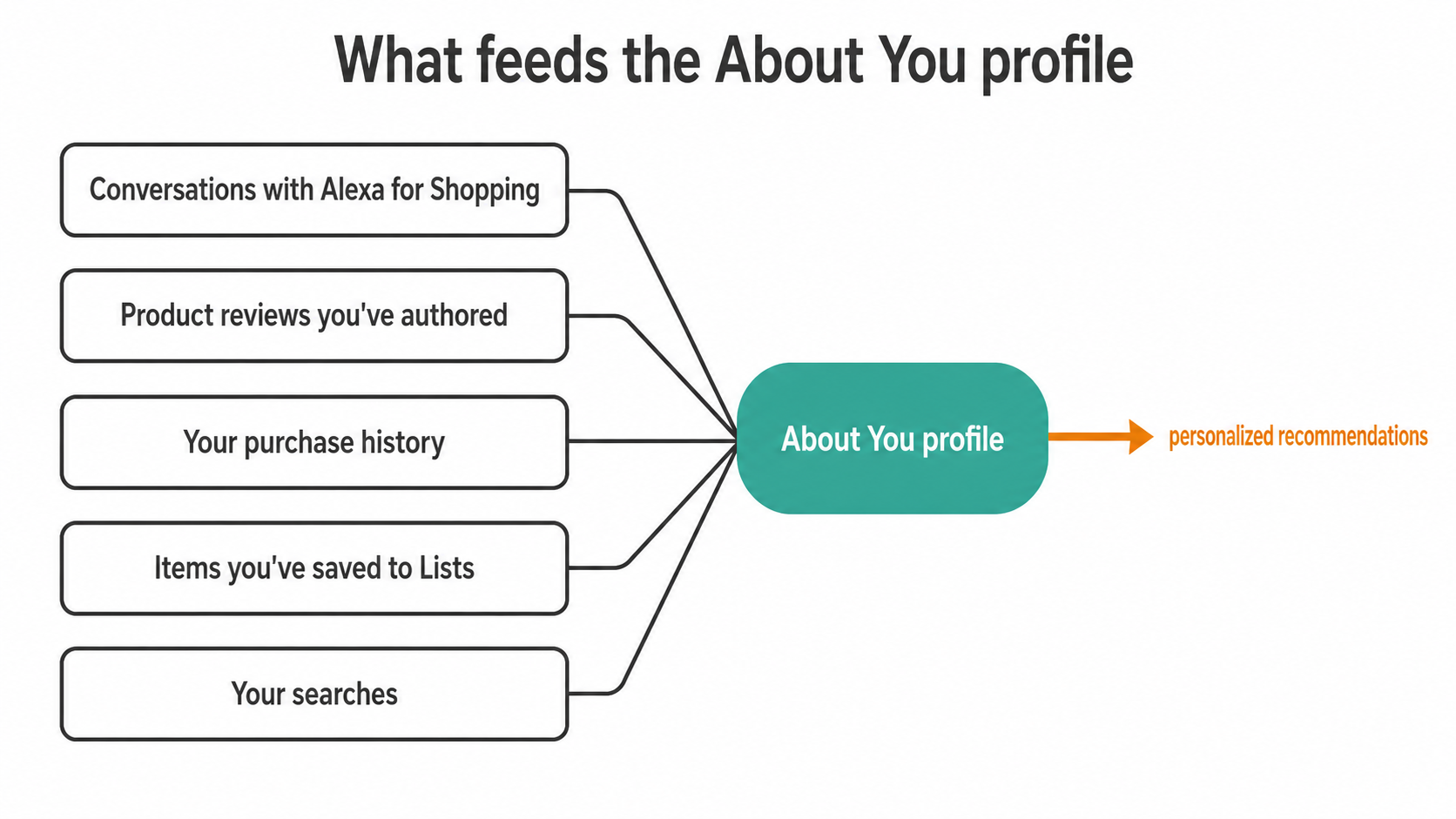
The examples Amazon chose show how specific the stored detail gets. Benson the cat has treat flavors on file, while Doughy's 12-hour feeding schedule marks one household as sourdough bakers. A gardening List triggers soil suggestions, and a run of non-dairy purchases flags a kitchen as non-dairy without anyone typing a word. The profile fields Amazon lists run to "family members, pets, interests, dietary needs, and more." The company also describes conversations and preferences flowing in both directions: the profile shapes the answers, and the answers refine the profile.
All of that powers Alexa for Shopping, which is rolling out to all U.S. customers with no Prime membership or Echo device required. The assistant is the surface shoppers see. Underneath it, the same Rufus engine that Amazon says helped over 300 million customers in 2025 reads your listing to write the answers. This launch explainer covers that rollout in full.
Two shoppers, one query, different answers
Rajiv Mehta, Amazon's VP of Conversational Shopping, describes the assistant as "like having an expert personal shopper who already knows you and remembers your preferences, your past purchases, and your conversations." An expert personal shopper does not show every customer the same shelf. When a shopper asks for a pour-over kettle, the assistant writes its answer from listing content, then filters which products earn a mention through the profile it holds for that shopper. Two people asking the identical question get different recommendations, because different histories and different profiles sit behind them.
We've now watched the filter work on one of our own accounts. In early June, ZonGuru CEO Jon Tilley typed "swingball" into the Amazon search bar, and Alexa for Shopping loaded as the answer directly, before any traditional results page. The assistant's opening line did the personalization in plain sight: "Here's a great selection of swingball and tether games for the backyard - and given your pickleball interest, you might especially enjoy the Swingball Pickleball version." Nobody typed pickleball. The profile held a pickleball set from his purchase history, and the recommendation slots that followed led with the two pickleball editions of the Swingball set.
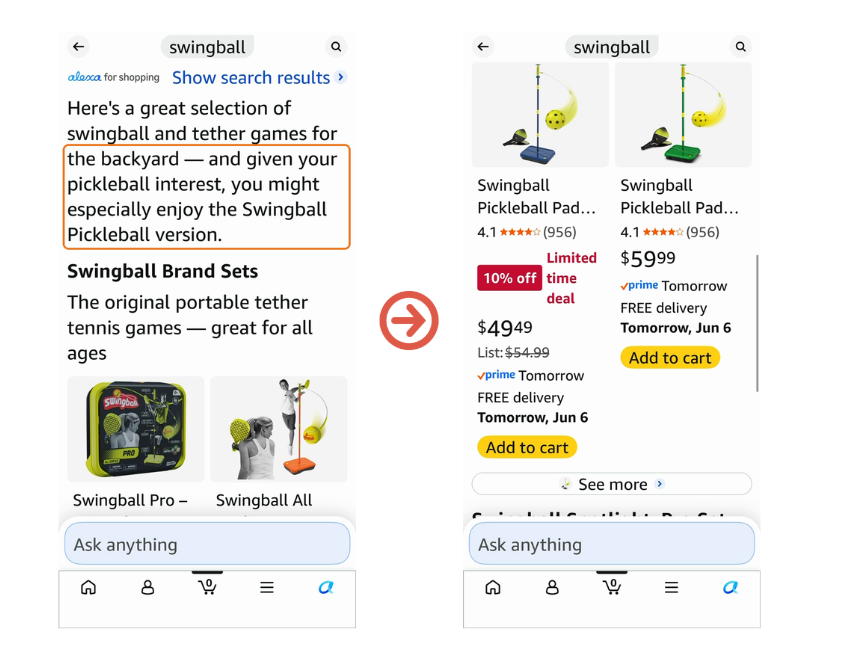
Every other shopper typing that same one-word query gets a different opening line, filtered through whatever their own profile holds. The filter is aggressive, too. Where a traditional results page runs to dozens of products, the assistant's answer names a handful - and in the capture above, the personalized section led with exactly two. The shoppers getting those answers also buy more often: on Amazon's Q3 2025 earnings call, CEO Andy Jassy reported that shoppers using Rufus during a shopping trip were 60% more likely to complete a purchase - and Rufus is the same engine that now answers as Alexa for Shopping.
Nothing Amazon has published puts the profile inside A9. The keyword engine still decides organic rank the way it always has, and every input Amazon has named for About You feeds the layer on top, where the Rufus engine retrieves and recommends products and now personalizes what it retrieves. Two engines, one input: the keyword engine and the AI engine both read the same listing you publish once.

That split explains a pattern your rank tracker can't. The tracker reports one position per keyword, but the assistant's answers vary per shopper, so conversion can drift while rank holds perfectly steady. The listing didn't change and the rank didn't change. The buyers seeing it did.
Can sellers see the About You profile?
No, sellers cannot see any shopper's About You profile. Seller Central surfaces order data, and Brand Analytics reports aggregated search and purchase behavior, but no dashboard, report, or API opens the personalization layer Alexa for Shopping reads for a single buyer.
Brand Analytics walks whole-market search behavior down the funnel, and it does that well, but every one of its reports reads the keyword engine's history in aggregate. The profile lives on the other engine, per shopper, and no aggregate report reconstructs it.
The channel into Amazon is just as closed. In early July 2026, a seller asked in the Seller Central forums whether Amazon would annotate Prime Day pricing on the price chart the assistant shows shoppers. The moderator's answer to the AI-surface question was that "this forum is focused on seller-related topics." A few weeks earlier, another seller had reported that the same assistant showed their price history wrong, and a fellow seller's reply captured the mood: "Welcome to the world of AI. I find over 50% of the time it is wrong."
A shopper can ask Alexa for Shopping "What do you know about me?" and get an answer. You have no version of that question, and there is nowhere to send one. That gap makes the profile a different kind of problem from every Amazon change before it. Sellers spent the Rufus era learning to tune listings for one agent whose behavior could at least be tested from the outside. The profile turns the variable per-shopper, and no test account of yours carries a real buyer's history. Amazon built the layer, imposed it on every listing, and offers no petition into it.
That leaves you the listing. Every match that decides whether you land in one of those few named slots runs against words and fields you author entirely.
The half of the match you control
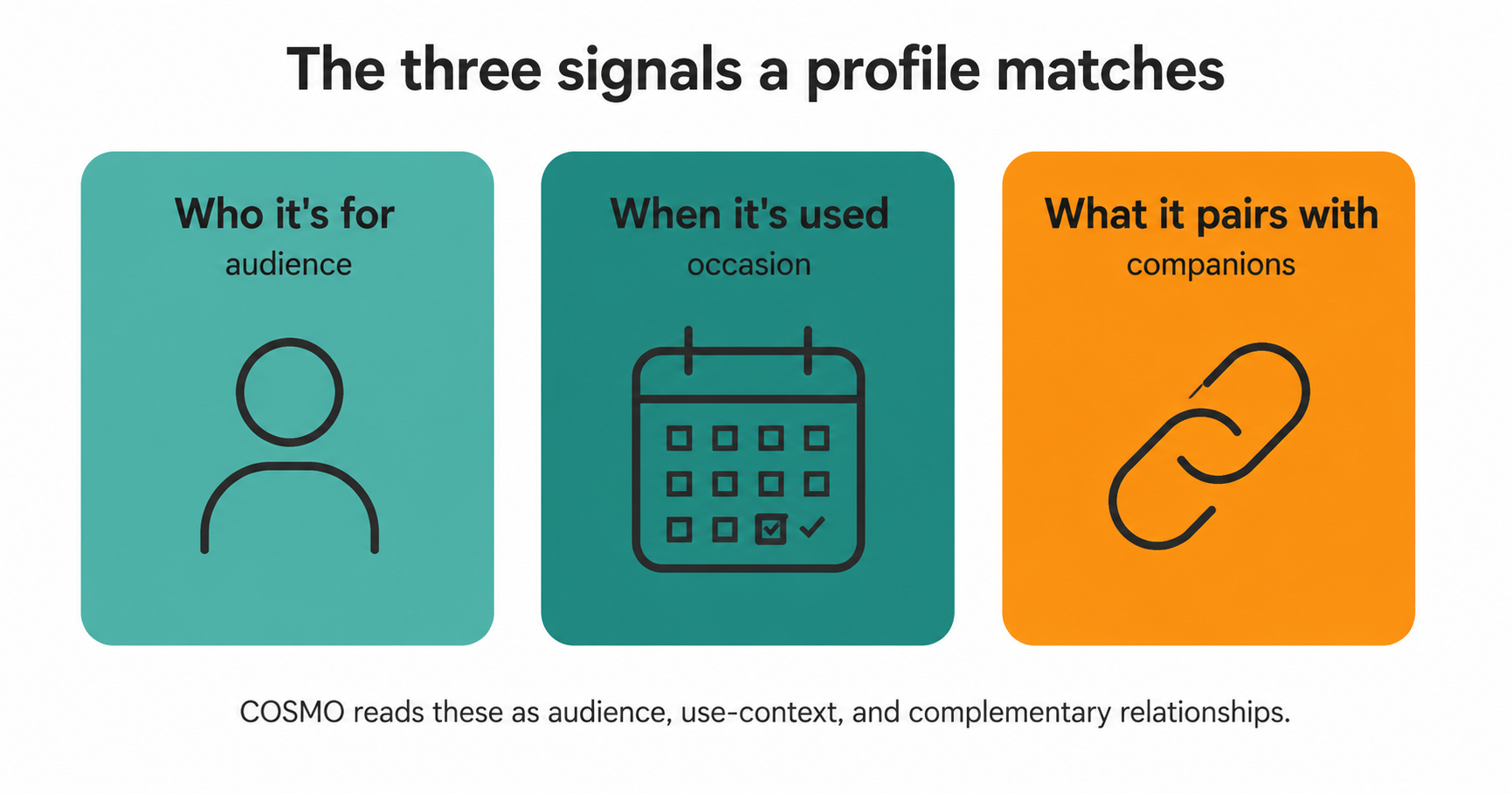
COSMO, Amazon's knowledge graph, reads your listing as a set of relationships rather than a string of keywords. Among its fifteen named relationship types sit the three a personalization match depends on: who the product is for, when it gets used, and what it pairs with. Set those three against what the profile stores, the pets and interests and dietary needs, and the shape of the match comes into focus. The profile supplies the buyer's half, and your listing supplies the product's half, or fails to.
The swingball capture shows the same mechanics from the seller's side. The listings that won the personalized slots were the ones carrying "Pickleball" in their titles, because the profile's signal can only match words that exist on the listing. A swingball set whose copy never mentioned pickleball had nothing for that shopper's profile to catch.
The cheapest signals sit in the attribute fields. Every empty attribute field on your listing is a question Alexa for Shopping can't answer, because attribute completeness feeds the assistant's overviews and comparisons directly. Target audience and intended use are the fields to check first, and a listing written years ago for a keyword engine that ignored them has little reason to have either filled in.
Go back to Doughy. The shopper who told the assistant about a starter on a 12-hour feeding schedule lives inside a profile no fermentation-tools seller will ever read. But that seller's listing either says "for sourdough bakers who feed a starter on a schedule" or it doesn't, and the match happens against those words. Amazon coached the shopper on what to share, and nobody but you coaches what the listing says back.
The old instinct treats every character as keyword inventory, and the keyword engine genuinely doesn't mind. A bullet stuffed with synonyms and a bullet that names its buyer count the same terms to A9. The engine matching against a profile reads them as opposites, because one answers who the product serves and when, while the other says nothing about the buyer at all. Audit your bullets tonight against the three signals: is the audience named, the use occasion named, the companions named?
How do you optimize a listing for About You personalization?
Start where the signals are cheapest: the attribute fields in Seller Central. Fill every field that answers an audience question, target audience and intended use first, since those fields hand the assistant structured answers it can lift without parsing a sentence.
Then move to the bullets and description, and write the language a profile can match: who the product is for, when it gets used, and what it works alongside. Write it in the shopper's phrasing rather than as keyword strings. "For sourdough bakers who feed a starter on a schedule" gives the engine an audience and an occasion in one clause; a synonym run gives it vocabulary it already had.
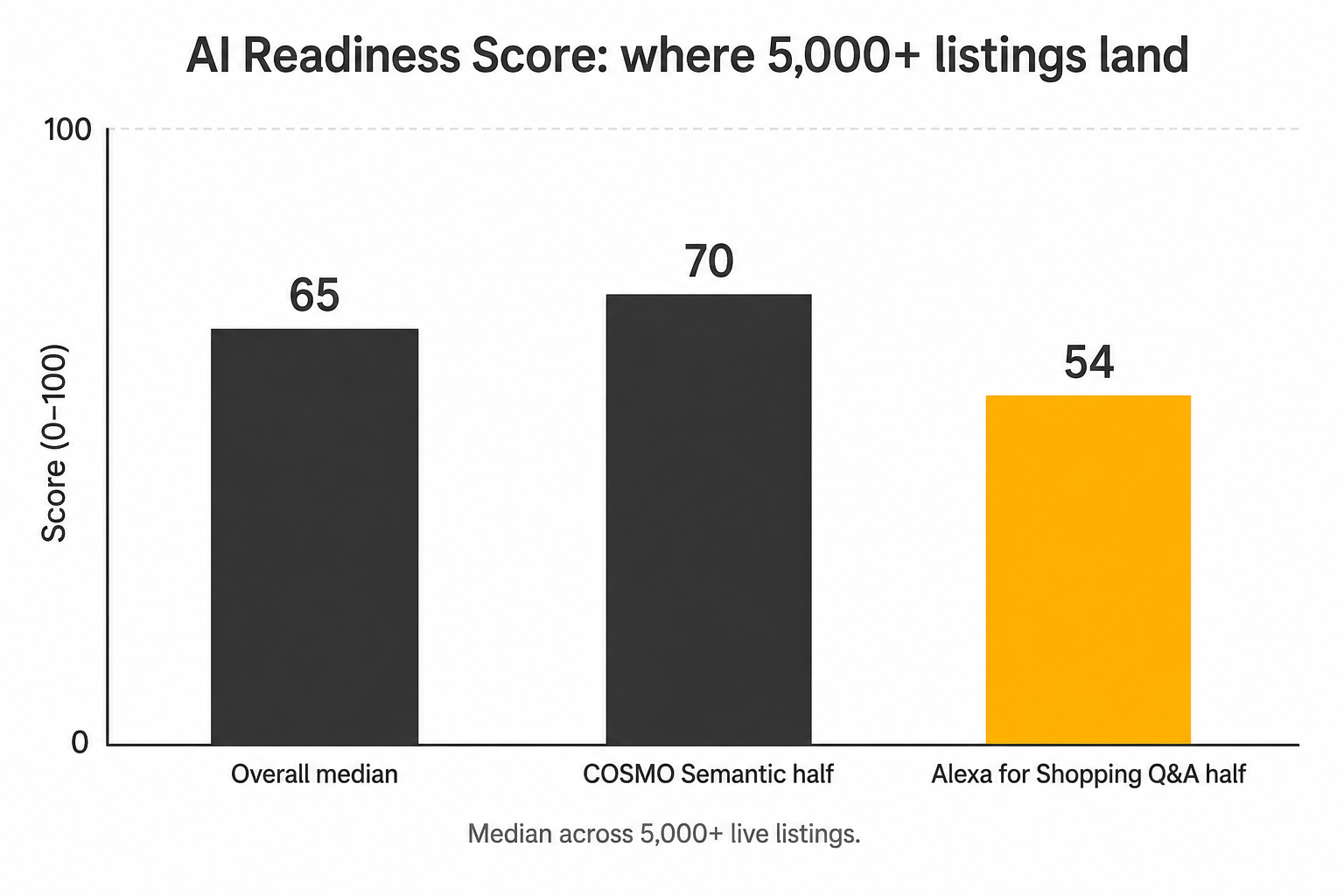
Third, cover the conversational questions buyers actually ask about your product, because that coverage is where listings are weakest today. The AI Readiness Score, a free 0-to-100 read of how well a listing answers what Amazon's AI discovery asks, has now run more than 5,000 live listings. The median lands at 65, with the COSMO half near 70 and the Alexa for Shopping Q&A half at 54. The questions half is the drag, and conversational questions are exactly what the assistant fields all day.
Audience language is only as strong as its source. Ask a generic AI to write it for your product and it can only guess at the audience, because it has no access to your customers or your brand. Helix™, the agentic AI platform that runs ZonGuru's Listing Engineering methodology - structuring a listing deliberately for every engine that reads it - works from the seller's side instead. Its Ingest stage captures your brand positioning and differentiators from you, you verify the product truth before anything ships, and its Structure stage engineers those audience-fit signals into the listing itself. Helix is currently available for US and UK Amazon marketplaces.
Nothing scores your About You match today, the AI Readiness Score included. The Score reads the two live substrates, COSMO Semantic Mapping and Alexa for Shopping Q&A Coverage, as its proxies for how AI-readable a listing is. Audience fit is the direction the framework is built toward, not a sub-score on the report yet. You can measure one thing this week: whether your listing answers the questions the engines already ask.
Frequently asked questions
Can shoppers turn About You personalization off?
They can strip it as far as they like. Amazon lets shoppers share what they want, correct specific details, or remove anything they don't want used for personalization. For sellers, the curation cuts the other way: whatever a shopper leaves in the profile is something they chose to keep, which makes the surviving signals higher-intent than anything an algorithm merely inferred.
Is the About You profile the same as my public Amazon profile?
No, the two are separate things. The public profile shows a shopper's reviews and public activity to anyone who clicks it. The About You profile is private personalization data that only the shopper and Amazon's systems see, managed from the shopper's account rather than any public page.
Does About You affect my A9 keyword ranking?
Nothing Amazon has disclosed connects the profile to organic rank. Every input Amazon has named for About You feeds the AI recommendation layer, and A9 continues deciding organic rank from the keyword-era signals it always has. In practice that means a listing can hold its rank while gaining or losing assistant recommendations.
What data does Alexa for Shopping actually store about shoppers?
Amazon's own list runs five feeds: conversations with Alexa for Shopping, product reviews the shopper has authored, purchase history, items saved to Lists, and searches. Those feeds fill profile fields covering "family members, pets, interests, dietary needs, and more."
Your half of the conversation
The next time you open a listing in Seller Central, run the three-signal audit before you touch a keyword: audience, occasion, companions. Amazon has named what feeds the profile, no seller will ever read one, and every recommendation still gets written from words you control. You can't ask Amazon what it knows about your buyers. Your listing, though, answers the shopper's question in reverse every time the assistant reads it: it says, in whatever words happen to be there, exactly who your product is for. One shopper told the assistant about Doughy; another's profile carried a pickleball set into a swingball search. Your listing is your half of both conversations.
The profile will stay the variable you can't see; the listing never stopped being the one you fully control.
See where your listing stands: Run Your AI Readiness Score on your best ASIN. We analyze only your public listing data, charge you nothing, ask for no credit card, and never send spam.


.avif)