Loading...


Let our Amazon experts show you how to leverage the power of ZonGuru to smash your sales goals. You’re invited to a 15-minute Rocket Demo so you can see the ZonGuru tools first-hand.
Book your seat now!
If your Amazon listing still reads like a keyword-stuffed bullet list, you're writing for an algorithm that no longer makes the decisions. The system evaluating your listing today - COSMO - doesn't grade on keyword density. It grades on structured relationships: who your product is for, what it does, when it's used, where it's used, what it pairs with, what it actually is.
Fifteen relationships, to be exact.
Amazon's research team published the architecture in their 2024 SIGMOD paper, "COSMO: A Large-Scale E-commerce Common Sense Knowledge Generation and Serving System at Amazon". Most sellers still haven't read it. Most listing optimization tools still don't account for it. The result is a measurable gap between what shoppers are asking Rufus - and which listings have the structured content to be confidently recommended back.
This guide walks through all 15 COSMO relationship types with plain-English definitions, concrete examples, and what each one looks like as listing content. It's the framework we use inside every ZonGuru Helix™ transformation, and it's the reason a Readiness Report can surface exactly where your listing is strong and exactly where it's silent.
COSMO is Amazon's AI-powered discovery layer - the system that replaces A9's keyword-matching logic with something closer to how a human shopping assistant would think. It reads listings, reviews, catalog data, and behavior signals, then constructs a structured understanding of every product: what it is, who it's for, what it solves, and when it should be recommended.
That structured understanding is what powers Rufus, Amazon's AI shopping assistant used by over 250 million shoppers. When a customer asks Rufus "What's a good mattress for a toddler who's transitioning out of a crib?" - COSMO is the system deciding which listings have enough structured product knowledge to be surfaced as a confident recommendation.
Amazon's own A/B tests on COSMO-powered search navigation reported a 0.7% relative lift in sales across 10% of U.S. traffic - hundreds of millions of dollars in annualized revenue from a single deployment. COSMO isn't a future shift. It's already grading your listings every day.
For a broader primer, see our guide on What is Amazon COSMO and Understanding Amazon Rufus AI.
COSMO represents product knowledge as semantic triples - (head, relation, tail) - mined from millions of real shopper behaviors. Amazon's paper gives a simple example:
"Customers bought camera case and screen protector glass together because they are capable of providing protection for camera."
The head is the product. The relation is capable_of. The tail is "providing protection for camera." That single structured triple lets COSMO answer questions no keyword could: why these two products are bought together, what problem they solve, which shoppers they're for, what other products probably belong in the same consideration set.
Multiply that by every product in every category and you have what Amazon calls an e-commerce common sense knowledge graph - 6.3 million nodes and 29 million edges, generated from search-buy and co-buy behaviors across 18 product domains.
The system is only as good as the signals it can extract from your listing. And the signals come from 15 specific relationship types.
Amazon's paper publishes all 15 relations in Table 2, along with the "tail type" each one generates and a concrete example. We've grouped them into five functional clusters so you can audit your listing against them one cluster at a time.
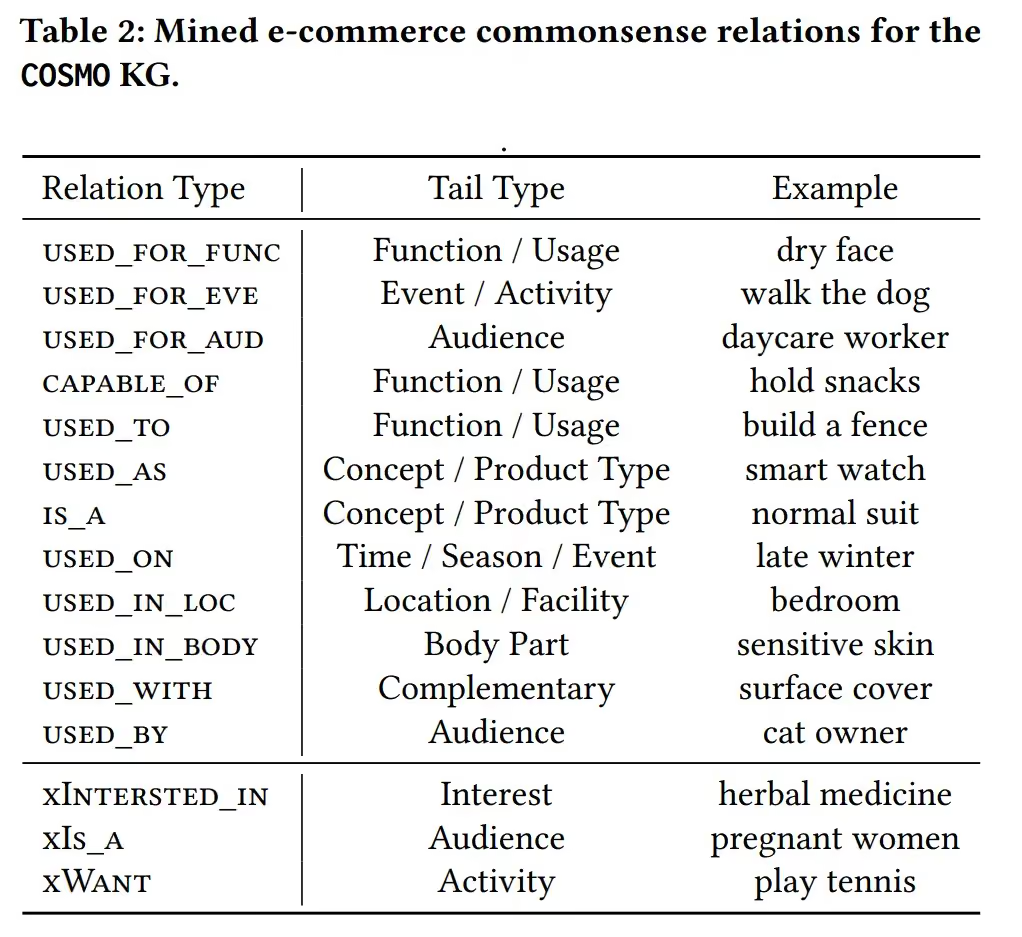
These three relations describe the jobs your product performs. They are the most commonly-present type of signal in existing listings, because sellers have always written about features. But subtle distinctions between the three shape how COSMO interprets your product's role.
1. USED_FOR_FUNC - Function / Usage · Example: "dry face" The core functional purpose. What the product does, at its most basic. For a face towel: dries your face after washing. For a stand mixer: mixes, kneads, and whips ingredients. This is the relation most listings already cover - but often at the wrong level of abstraction.
2. CAPABLE_OF - Function / Usage · Example: "hold snacks" Secondary capabilities beyond the primary function. A hiking backpack's USED_FOR_FUNC is carrying gear; its CAPABLE_OF extends to holding snacks, organizing layers, attaching trekking poles, keeping a hydration bladder accessible. This is where sellers under-deliver - a listing that only names the primary function leaves every co-purchase signal on the table.
3. USED_TO - Function / Usage · Example: "build a fence" An outcome-oriented framing: what the customer accomplishes with the product. A cordless drill isn't just "capable of drilling" - it's used to build a fence, hang shelves, assemble furniture, mount a TV. USED_TO maps your product to the projects customers are actually trying to finish.
Two relations anchor the product in COSMO's conceptual taxonomy. Getting these wrong quietly excludes you from entire shopping journeys.
4. IS_A - Concept / Product Type · Example: "normal suit" The canonical category. Not the long-tail keyword - the category shoppers would name unprompted. A merino wool base layer IS_A thermal shirt. An electric toothbrush IS_A rechargeable toothbrush. If your listing's identity isn't clear in the first two lines, COSMO has to guess, and guessing means lower confidence and lower recommendation weight.
5. USED_AS - Concept / Product Type · Example: "smart watch" The role-based identity. A fitness tracker might IS_A activity band but USED_AS a smartwatch. This is where context-based substitution happens - Rufus needs USED_AS to understand when your product legitimately belongs in a comparison set it wouldn't otherwise enter.
Three relations define the shopper. Across 1,000+ Helix transformations, this is consistently the weakest cluster in keyword-era listings. Most sellers can name their buyer demographic. Almost none structure it in a way COSMO can read.
6. USED_FOR_AUD - Audience · Example: "daycare worker" The occupational or role-based audience. A pair of supportive clogs isn't just for "people on their feet all day" - it's for nurses, teachers, daycare workers, line cooks, retail associates. Each named audience is a separate discovery pathway.
7. USED_BY - Audience · Example: "cat owner" The lifestyle or ownership-based audience. A lint roller USED_BY cat owners, dog owners, people with long hair, suit-wearers, apartment dwellers. This relation maps your product into the communities shoppers self-identify with when they ask Rufus for recommendations.
8. xIS_A - Audience (shopper identity) · Example: "pregnant women" A distinct relation where the tail describes who the shopper is, not who the product is for in general. A slip-resistant shoe might have USED_FOR_AUD of restaurant worker but xIS_A of pregnant women - the same product, two different paths into it. Covering xIS_A is how you show up in conversational queries like "good walking shoes for someone in their third trimester."
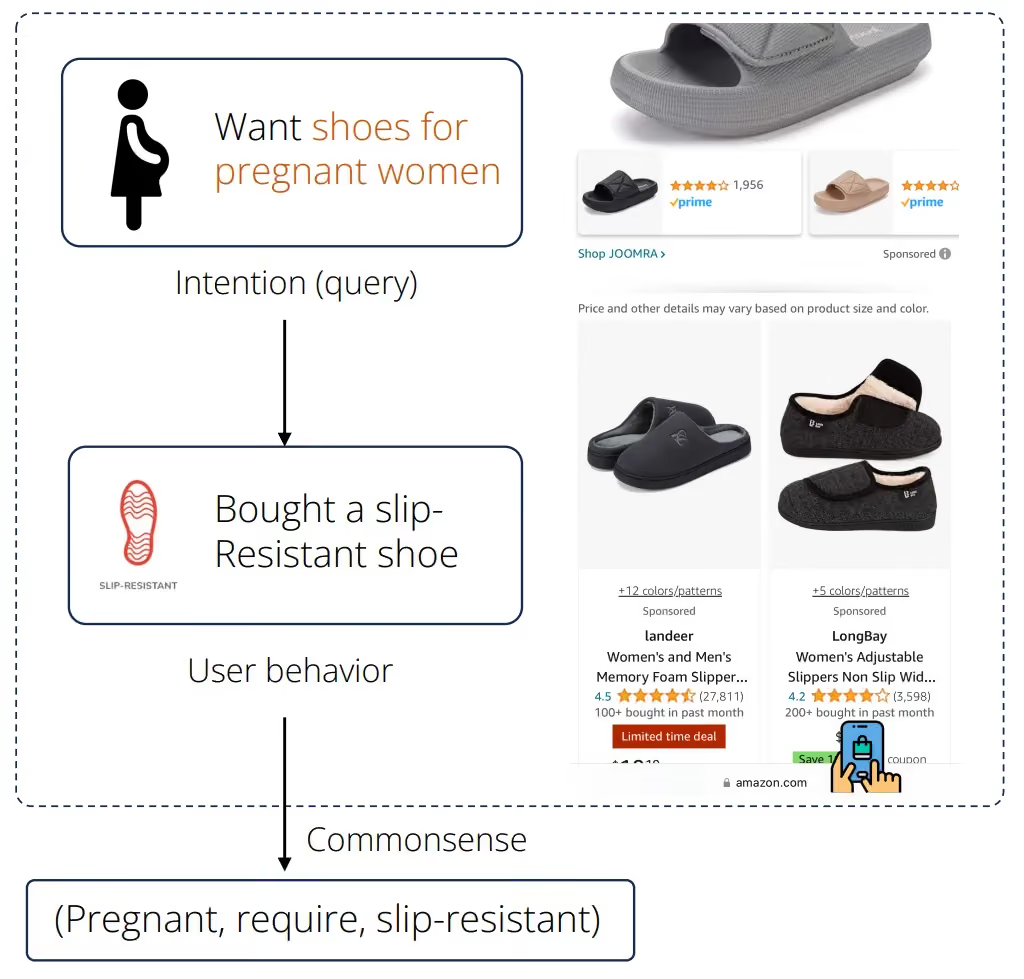
Four relations describe the situations your product belongs in. This is the cluster that expands your visibility the most - and it's almost never deliberate in keyword-era listings.
9. USED_ON - Time / Season / Event · Example: "late winter" Temporal context. A heavyweight parka USED_ON late winter commutes, morning dog walks in January, weekend ski days, below-freezing overnights. Every temporal qualifier is a signal COSMO can match to seasonal query spikes.
10. USED_IN_LOC - Location / Facility · Example: "bedroom" Physical setting. A sound machine USED_IN_LOC bedroom, nursery, dorm, office, hotel room, apartment with thin walls. A laptop stand USED_IN_LOC home office, coworking space, coffee shop, desk, kitchen counter. Locations ground the product in the shopper's daily life - and in the "good for a [X]" queries Rufus handles constantly.
11. USED_IN_BODY - Body Part · Example: "sensitive skin" Physical or physiological context. A moisturizer USED_IN_BODY face, neck, hands, sensitive skin, under makeup. A brace USED_IN_BODY knee, ankle, wrist, post-surgery recovery. This relation is essential in health, beauty, and apparel categories and is where a lot of listings bury the most discoverability-relevant language deep in feature bullets.
12. USED_FOR_EVE - Event / Activity · Example: "walk the dog" The activity context. A waterproof jacket USED_FOR_EVE walking the dog, trail running, hiking, fishing, tailgating, kids' soccer practice. Events map your product to what shoppers are actually doing in the moments they need it.
The final three relations situate your product in the broader ecosystem of a shopper's life - the items it complements, the interests it aligns with, the activities it enables.
13. USED_WITH - Complementary · Example: "surface cover" Products that pair with yours. A Microsoft Surface USED_WITH Type Cover, Surface Pen, dock, USB-C hub, sleeve. A ceramic pan USED_WITH silicone spatulas, wooden utensils, induction cooktops. USED_WITH is the relation that drives co-buy signals - and missing it means Rufus has no reason to surface you in "what else do I need" conversations.
14. xWANT - Activity (shopper intent) · Example: "play tennis" What the shopper wants to do. Structurally similar to USED_FOR_EVE, but mapped to the shopper's stated or implied intent rather than the product's use case. A tennis shoe serves xWANT = play tennis; it also serves xWANT = start a gym routine if the listing makes that connection explicit. Covering xWANT is how you show up in aspirational queries.
15. xINTERESTED_IN - Interest · Example: "herbal medicine" The shopper's broader interest. A tea gift set xINTERESTED_IN herbal medicine, wellness rituals, mindfulness, gifting. This is the relation that connects your product to lifestyle-level discovery - the kind of queries that don't mention the product type at all.
Here's a practical audit. Pull up your listing and ask, for each cluster:
Function - Does my copy name one function, or the full range of functions? Does it describe outcomes customers accomplish, not just features the product has?
Identity - Is the canonical category obvious in the first 100 characters? Does the listing also cover the role-based identity (what the product is often used as)?
Audience - How many distinct audience signals are present? Do I name occupations, lifestyle identities, and shopper-side descriptors (life-stage, skill level, specific needs)?
Context - Which seasons, locations, body parts, and events are named explicitly? How many implied contexts am I leaving to the reader to infer?
Relational - Which complementary products, activities, and interests does my listing connect to?
If your listing covers five or fewer of the fifteen with real specificity, you're in the same position as the majority of catalog pages on Amazon - present on the shelf, invisible in AI-driven discovery.
Across the listings that come through the ZonGuru Helix™ framework, the same gaps repeat:
These are architecture gaps - structural holes in the way a listing encodes product knowledge, and fixing them is a listing engineering job.
The fastest way to see which of the 15 relationships your listing currently covers - and which ones it's silent on - is a free COSMO Readiness Report. Enter any ASIN, and in under 60 seconds you'll see your structured coverage score, the specific relationship types that are weak, and examples of what strengthening them looks like.
Check Your Amazon AI Readiness Score → No credit card. Just your ASIN.
If you already know your listings need work and you'd rather have the transformation handled end-to-end, the COSMO Transformation Service applies the full Helix™ framework - deep research, semantic mapping against all 15 relationship types, engineered listing copy, before/after readiness scoring, image carousel analysis, and an upload-ready flat file. Transformations start at $49/ASIN and complete in minutes.
Start a HELIX Transformation →
COSMO's semantic relationship types are 15 categories Amazon's COSMO algorithm uses to structure product knowledge: USED_FOR_FUNC, USED_FOR_EVE, USED_FOR_AUD, CAPABLE_OF, USED_TO, USED_AS, IS_A, USED_ON, USED_IN_LOC, USED_IN_BODY, USED_WITH, USED_BY, xINTERESTED_IN, xIS_A, and xWANT. Each relation maps a product to a specific kind of information (a function, an audience, a location, a complementary product, and so on) that Rufus and Amazon's search systems use to decide which products to recommend.
Fifteen. Amazon's COSMO knowledge graph covers 18 product domains, 15 relationship types, and 5 downstream task types, according to the 2024 SIGMOD paper that introduced the system.
The 15 relationship types are published in Table 2 of "COSMO: A Large-Scale E-commerce Common Sense Knowledge Generation and Serving System at Amazon" (Yu et al., SIGMOD-Companion '24). The paper includes the full relation list, tail types, and worked examples for each.
USED_FOR_FUNC describes a product's primary, intended function. CAPABLE_OF describes secondary abilities beyond the primary function. A backpack's USED_FOR_FUNC might be carrying hiking gear; its CAPABLE_OF extends to holding snacks, organizing layers, hanging from a hook. Listings that only cover USED_FOR_FUNC leave most of their secondary-use discoverability on the table.
The "x" prefix indicates a shopper-side relation rather than a product-side one. xIS_A describes who the shopper is ("pregnant women," "first-time homeowners"). xWANT describes what the shopper wants to do ("play tennis," "start a garden"). xINTERESTED_IN describes a broader interest ("herbal medicine," "sustainable living"). Together, these three relations let COSMO match products to shoppers based on identity and intent - not just product features.
Across our data from over 1,000 Helix transformations, the most commonly missed relations are xIS_A (shopper identity), USED_BY (lifestyle audience), USED_WITH (complementary products), USED_FOR_EVE (specific activities), and USED_ON (temporal context). Most keyword-era listings cover function and identity reasonably well, but stop there.
COSMO uses the 15 relationships to construct a structured understanding of each product - an "e-commerce common sense" knowledge graph. That structured understanding feeds three downstream systems Amazon has deployed: search relevance prediction, session-based recommendation, and search navigation. A listing with richer, more specific relationship coverage is interpretable to more queries and earns higher confidence in recommendation scoring.
No - and you shouldn't. COSMO extracts these signals from natural listing content, reviews, and catalog data. What matters is that the content itself makes each relationship unambiguously inferable. Stating "for night-shift nurses and daycare workers" covers USED_FOR_AUD naturally; stating "pairs with our compression socks" covers USED_WITH. The structural decision is about which relationships your copy deliberately addresses, not about adding tags.
Partially. A general-purpose model can identify obvious gaps, but it doesn't have access to the category-specific training data Amazon's COSMO system uses, it doesn't know your competitive landscape, and it can't score your listing against category benchmarks. That's the difference between AI-generated copy and listing engineering - and it's why prompt-driven workflows tend to produce listings that read well but still miss the structural gaps that matter.
Run a free Amazon AI Readiness Report. Enter your ASIN, and the report shows your coverage across COSMO's relationship types, which ones are weak, and what a stronger version looks like. No credit card required, and results come back in under 60 seconds.
Rufus is the shopper-facing expression of what COSMO evaluates in the background. When a shopper asks Rufus a natural-language question - "What's a good mattress for a toddler transitioning out of a crib?" - Rufus relies on COSMO's structured relationship data to decide which listings can confidently answer that question. Listings with stronger USED_FOR_AUD, xIS_A, USED_IN_LOC, and USED_FOR_EVE coverage are the ones Rufus surfaces with confidence.
Helix™ is ZonGuru's listing engineering framework. It maps every product through a structured research process that covers deep niche analysis, competitive positioning, and explicit mapping against all 15 COSMO relationship types - then engineers listing copy, image strategy, and A+ content that cover the relationships you're missing today. Helix is the reason a Readiness Report's "after" score is measurably different from a rewrite done with a prompt.
Discover opportunities. Maximize your sales. Grow your Amazon business!

Free score in 2 minutes. See how Amazon's AI reads your listing and what to fix.
 Run my Free Score
.svg)
Get started with ZonGuru, access all the tools with a FREE trial.
.avif) Start FREE Trial
Start FREE Trial