Loading...


Let our Amazon experts show you how to leverage the power of ZonGuru to smash your sales goals. You’re invited to a 15-minute Rocket Demo so you can see the ZonGuru tools first-hand.
Book your seat now!
Amazon COSMO is the AI-powered commonsense knowledge system that is reshaping how Amazon understands what shoppers want - and most sellers have never heard of it.
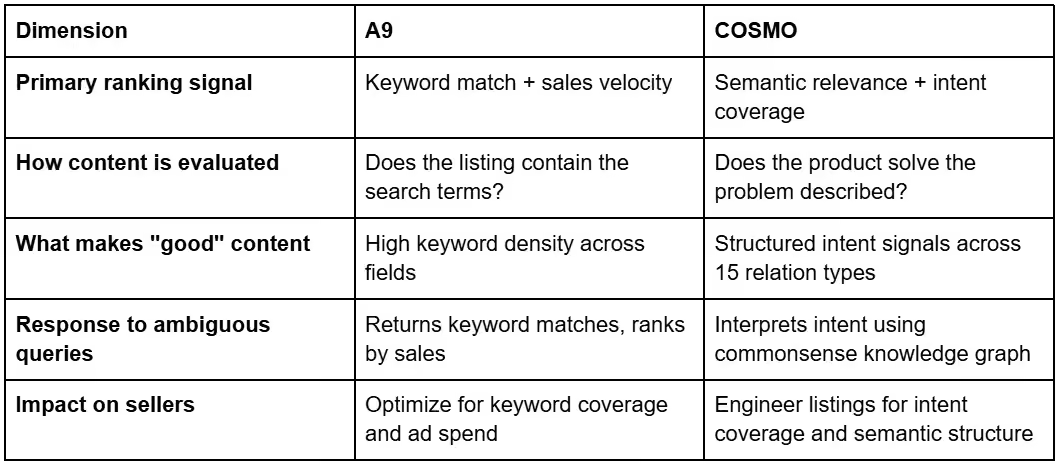
If your Amazon listings were built in the keyword era - optimized for search term volume, stuffed with synonyms, structured around what A9 could index - they are increasingly being evaluated by a system that asks a fundamentally different question. A9 asks: does this listing contain the words the customer typed? COSMO asks: does this product solve the problem the customer described?
This guide is built directly on Amazon's peer-reviewed research paper, published at SIGMOD-Companion 2024. We walk through the complete knowledge generation pipeline, the 15 commonsense relation types COSMO uses to map product knowledge, the evaluation data that proves the system works, and a practical optimization framework you can apply to your own listings.
The structure is layered. Every section delivers practical takeaways. Sections marked as deep dives provide the technical architecture for advanced readers - skip them without losing actionable guidance. Whether you're a brand owner watching sessions decline, an agency building a methodology for clients, or a seller who wants to understand where Amazon search is heading, we've tried to make this the resource we wished existed when we started researching COSMO ourselves.
COSMO - Common Sense Knowledge Generation and Serving System - is Amazon's industry-scale AI system that mines commonsense knowledge from millions of shopper behaviors to understand not just what customers search for, but why they search for it.
That distinction matters - arguably more than any Amazon search update in recent memory.
COSMO is not a traditional search algorithm. It is a knowledge graph system - a structured network of relationships connecting products, queries, and the intentions behind them. Think of it as a massive map where every node is a product or concept, and every edge represents a relationship like "this product is used for this purpose" or "people who buy this also need that." At scale, COSMO's knowledge graph contains 6.3 million nodes and 29 million knowledge edges spanning 18 major product categories.
The system was published as a peer-reviewed paper at SIGMOD-Companion 2024 (the Companion proceedings of the ACM International Conference on Management of Data) in Santiago, Chile. Ten researchers from Amazon's Palo Alto lab and one visiting academic scholar from the Hong Kong University of Science and Technology (HKUST) authored the paper - and the full paper is available on Amazon Science. This is not a marketing claim or a leaked patent - it is published, peer-reviewed research that describes a system deployed at production scale.
COSMO mines two types of real shopper behavior data:
From these behavior signals, COSMO generates what the researchers call commonsense knowledge assertions - structured statements about why customers buy products and how products relate to real-world needs. These aren't keywords. They're semantic relationships: "this yoga mat is used by people recovering from knee injuries," "this water bottle is capable of keeping drinks cold for 24 hours," "this headlamp is used for camping in low-light conditions."
Amazon tested COSMO's integration into its search navigation system - the refinement tiles that help shoppers narrow queries on the search results page - through A/B experiments on approximately 10% of US traffic. Even this single, relatively limited feature produced measurable results:
These are not theoretical projections. They are measured outcomes from a live deployment of one application of COSMO, published in a peer-reviewed venue. The paper's authors noted that extending COSMO across all traffic and additional features "anticipate[s] the potential to generate a revenue increase in the billions."
The system built from only 30,000 annotated instructions was able to generate a knowledge graph of 29 million edges - a ratio that demonstrates the power of instruction-tuned language models to scale human annotation effort by orders of magnitude.
Here is the practical implication: Amazon's discovery systems are increasingly evaluating whether your listing communicates structured intent signals - who the product is for, what it does, when and where it's used, what it's capable of, and what problems it solves. COSMO's deployment in search navigation is the documented evidence of this shift. Rufus's rapid adoption (300 million customers, $12 billion in attributed sales) is the market evidence. Together, they point in one direction: listings that communicate structured intent get recommended. Listings that only repeat keywords increasingly do not.
The classic example from the COSMO paper: a customer searching for shoes during pregnancy. Under A9, the algorithm matches the keyword "shoes." Under COSMO, the system understands that pregnant women need slip-resistant shoes with arch support and low heels - and recommends products whose listings communicate those capabilities, even if the search query never mentions those specific terms.
A9 matches keywords. COSMO interprets intent. That difference has significant implications for how Amazon listings need to be written.
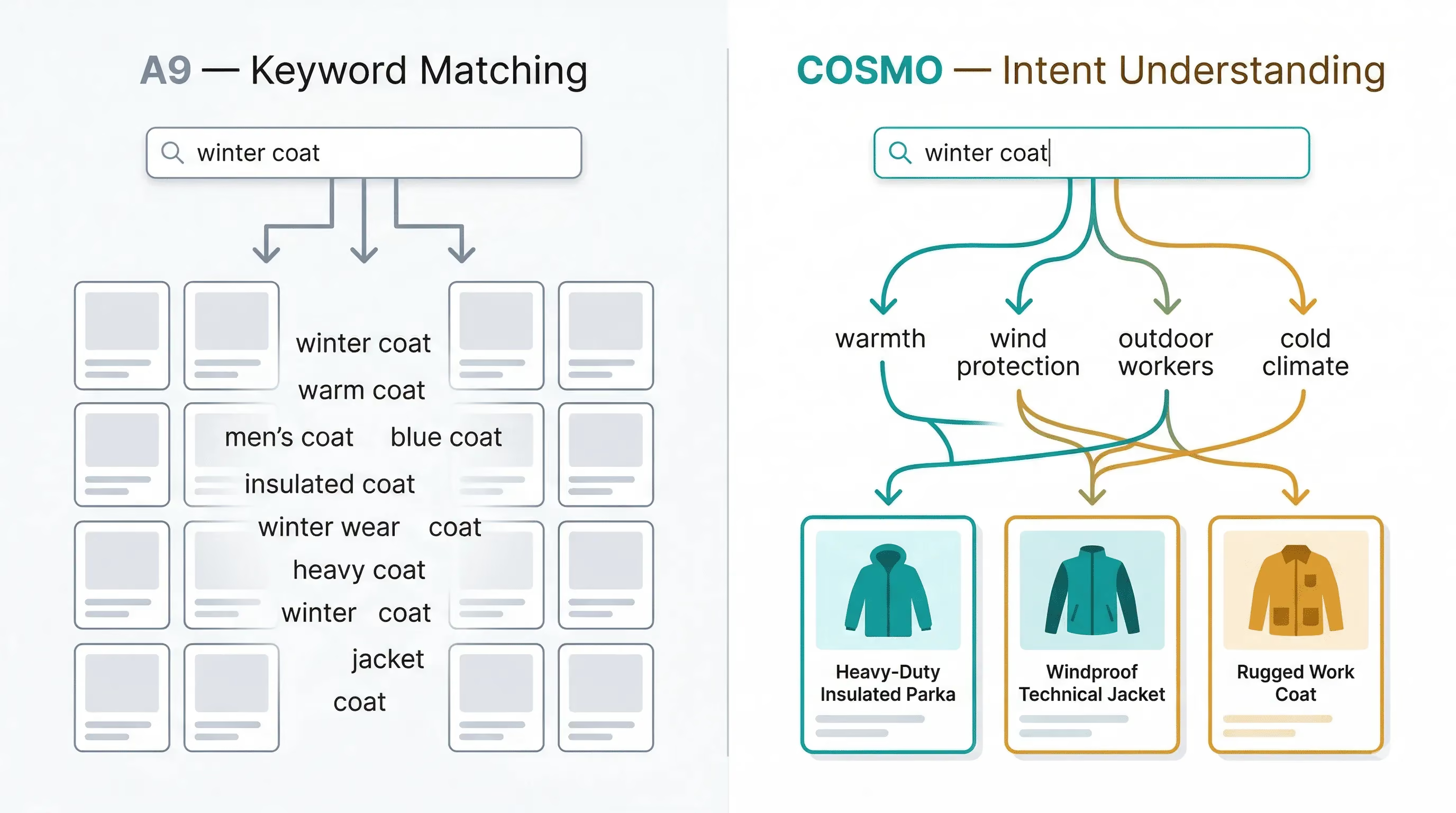
Amazon's A9 algorithm - the system that powered product search for over a decade - operates primarily on keyword matching combined with performance signals. When a customer searches "winter coat," A9 identifies listings that contain those words, then ranks them based on sales velocity, conversion rate, click-through rate, review quality, and other performance metrics. The better your keywords match and the stronger your sales history, the higher you rank.
A9 served sellers well. It created a clear optimization playbook: research high-volume keywords, place them strategically in your title, bullets, description, and backend search terms, then drive sales velocity through advertising. The better your keyword coverage and sales performance, the more visible your listing.
COSMO adds an intent understanding layer that fundamentally changes what Amazon considers "relevant." When a customer searches for "winter coat," COSMO doesn't just match the words - it maps the query against commonsense knowledge about warmth capability, wind protection, cold-weather use, insulation types, and the contexts in which winter coats are needed.
This means a listing that never mentions the word "winter" but thoroughly communicates thermal insulation, wind resistance, and cold-weather functionality can now be surfaced for that query - because COSMO understands the intent relationship.
Important nuance: COSMO does not fully replace A9. Keywords still matter for indexing - they are how Amazon includes your listing in the initial candidate pool. But once you're in the pool, COSMO changes how Amazon evaluates and ranks your relevance. Keywords get you considered. Intent signals get you recommended.
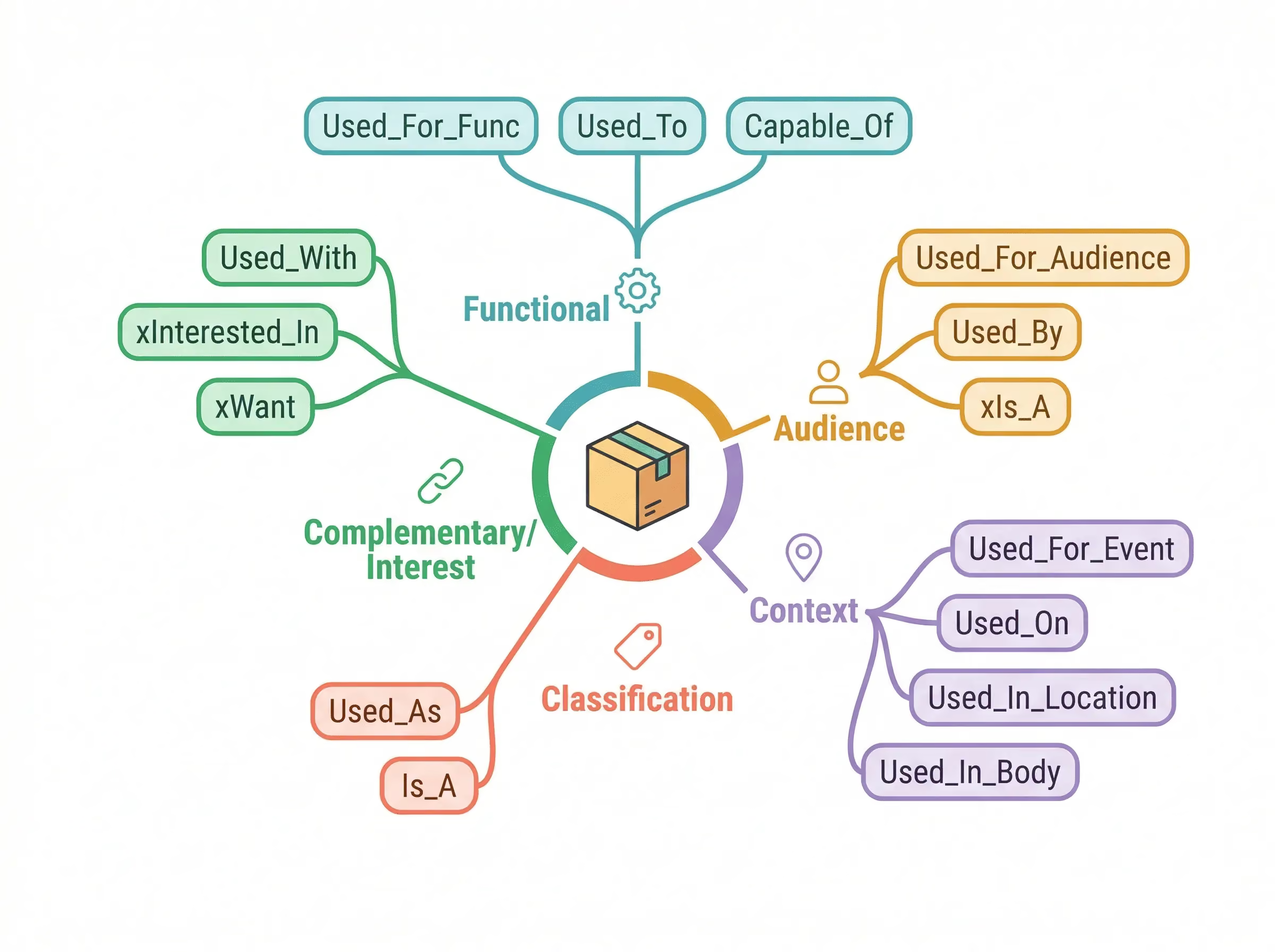
COSMO organizes product knowledge into 15 specific relation types. Below, we've organized them into a mapping framework sellers can use in practice:
Functional Relations - What the product does:
Audience Relations - Who uses it:
Context Relations - Where, when, and how it's used:
Classification Relations - What it is:
Complementary and Interest Relations - What it connects to:
You may have seen references to an "A10 algorithm" in Amazon seller communities and blog posts. Amazon has never confirmed the existence of A10. It is an informal label used by the seller community to describe perceived changes in ranking behavior. COSMO, by contrast, is a specific, documented system with named authors, a peer-reviewed publication, and described deployment architecture. When someone references "A10," they are likely describing effects that are better explained by COSMO's integration into Amazon's search stack.
One honest caveat: The COSMO paper documents the system's deployment in Amazon's search navigation feature - the refinement tiles on the search results page. It does not describe COSMO as a replacement for A9's core ranking algorithm, and Amazon has not issued any statement declaring A9 retired. However, the paper's authors explicitly note that COSMO's potential extends far beyond this initial deployment, and the parallel growth of Rufus (which serves the same intent-understanding purpose on the customer-facing side) suggests Amazon is systematically moving toward semantic discovery. What we present in this guide distinguishes what the paper confirms from what we infer from marketplace observation - because that transparency is what makes analysis trustworthy. For a broader foundation on Amazon SEO fundamentals, see our dedicated guide.
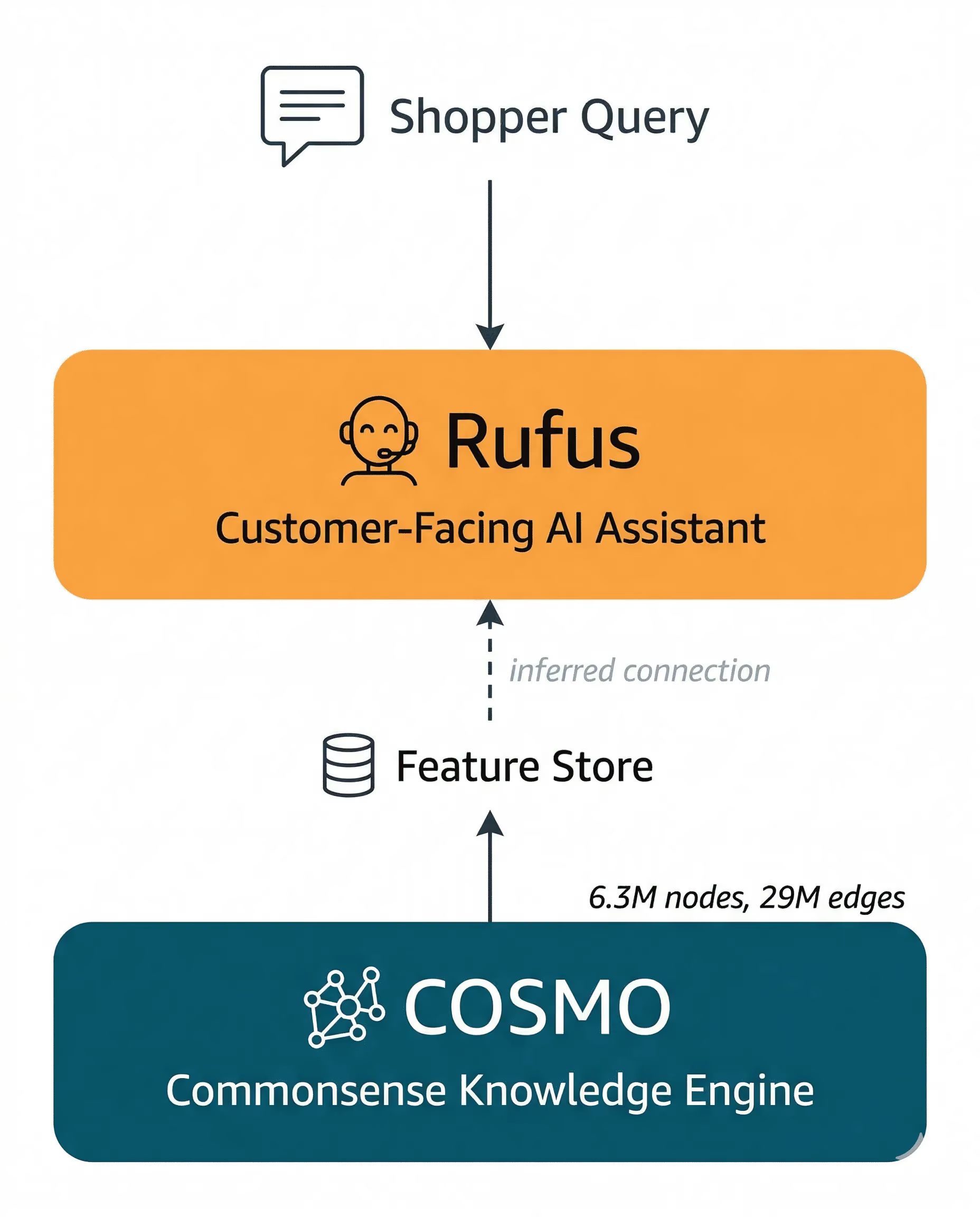
Rufus is Amazon's customer-facing AI shopping assistant. COSMO is a commonsense knowledge system deployed in Amazon's search infrastructure. Both systems aim to understand shopper intent - and the industry widely infers that COSMO's knowledge graph feeds into Rufus's product recommendations. Here's what we know, what we can reasonably infer, and where the line is.
Confirmed by the COSMO paper: COSMO generates structured product knowledge from shopper behavior and has been deployed in Amazon's search navigation system. The paper describes COSMO's outputs being converted into "structured features" via a Feature Store for "downstream applications."
Confirmed by Amazon about Rufus: Rufus is "trained on Amazon's extensive product catalog, customer reviews, community Q&As, and information from across the web" (aboutamazon.com). Amazon has not publicly named COSMO as one of Rufus's data sources.
The industry inference: Both COSMO and Rufus operate in Amazon's search and discovery stack. COSMO generates exactly the kind of structured product-intent knowledge that Rufus would need to answer questions like "What's a good gift for a runner?" or "What yoga mat is best for bad knees?" The paper explicitly describes COSMO's Feature Store feeding "downstream applications." Whether Rufus is one of those downstream applications is a reasonable inference - but it is an inference, not a confirmed fact.
We treat COSMO and Rufus as part of the same paradigm shift - Amazon's move from keyword matching to intent understanding - because optimizing for one optimizes for both. Whether COSMO literally feeds Rufus or they operate as parallel systems, the practical guidance for sellers is identical: structure your listing content around intent signals, not keyword repetition.
The COSMO paper describes a three-layer navigation system deployed on the search results page - the refinement tiles that help shoppers narrow their queries:
This architecture explains why listing content that addresses specific use contexts, audience segments, and capability attributes is increasingly important - the discovery systems narrowing shopper queries rely on exactly these structured knowledge signals.
The adoption data from Amazon's earnings reports tells the story of how quickly AI-assisted shopping has become central to Amazon's experience:
Rufus accepts user-uploaded images in its chat interface - shoppers can photograph a stained rug and ask for cleaning advice, snap a handwritten grocery list, or upload a photo and ask "find dresses with this silhouette but under $100" (aboutamazon.com). Amazon job postings for the Rufus team reference multimodal large language models and computer vision as technologies in development.
However, Amazon has not confirmed that Rufus systematically reads product listing images as part of its standard indexing pipeline. The confirmed multimodal capability is limited to user-initiated image uploads in the chat interface. Some third-party sources claim Rufus processes listing images via CV/OCR, but no official Amazon publication supports this. We note the distinction because it matters for where you invest optimization effort - text-based listing content remains the confirmed input channel.
COSMO-LM is refreshed daily via Amazon SageMaker, ingesting customer behavior session logs. This daily refresh means the knowledge graph evolves continuously - but it also means the system cannot process real-time events like flash sales or sudden demand spikes.
According to Amazon, Rufus draws from the product catalog, customer reviews, community Q&As, and information from across the web. This is why review quality and Q&A completeness matter under AI-driven discovery - they feed the systems that evaluate your listing.
For deeper exploration of how Rufus works, see our dedicated guides: how Rufus decides which products to recommend, what Rufus is and how it works, and the Rufus optimization playbook.
The difference between a keyword-optimized listing and a COSMO-optimized listing is the difference between a list of features and a structured explanation of why a customer should buy this product.
This section makes the shift concrete. Here is what it looks like in practice.
Keyword-stuffed title:
Yoga Mat Thick Yoga Mat Non-Slip Yoga Mat Exercise Mat Fitness Mat Workout Mat Pilates Mat
COSMO-optimized title:
Extra-Thick Yoga Mat for Bad Knees - Non-Slip Cushioned Exercise Mat for Home Workouts, Pilates, and Physical Therapy (72" x 26", 8mm)
The keyword-stuffed title repeats "yoga mat" four times and adds synonyms. It communicates one thing: this is a yoga mat. The COSMO-optimized title communicates structured knowledge across multiple relation types:
Every word in the optimized title is doing double duty: it indexes for search AND communicates structured intent signals to COSMO.
Keyword-stuffed bullet:
YOGA MAT - This yoga mat is a premium yoga mat for yoga and exercise, yoga mat non-slip, yoga mat thick, yoga mat for women
COSMO-structured bullet:
Designed for practitioners recovering from knee injuries or managing joint pain - the 8mm high-density foam provides therapeutic cushioning that standard 4mm mats cannot match, making floor poses and extended holds comfortable without sacrificing stability
The first bullet communicates nothing beyond "this is a yoga mat" repeated in different configurations. The second bullet addresses:
For any product in any category, ask whether your listing explicitly communicates:
Most listings we've analyzed cover two or three of these dimensions well. Across 5,000+ COSMO Readiness Reports, the average score is 46 out of 100 - revealing systematic gaps most sellers don't know they have. Sellers cover the functional basics (what the product is and what it does) but consistently miss audience specificity, use context, complementary relationships, and capability claims.
These aren't minor gaps. Each uncovered dimension is a set of shopper queries where COSMO cannot recommend your product - because your listing doesn't provide the knowledge it needs to make the connection.
Want to see exactly where your listing stands? ZonGuru's free COSMO Readiness Report analyzes your listing against these intent dimensions and gives you a specific score with actionable recommendations. It takes 30 seconds to request.
Optimizing for COSMO requires a fundamental shift from keyword density to intent coverage - and the good news is that most of the work involves making your listings clearer and more useful, not more complex.
Here is a practical, tool-agnostic framework you can apply immediately.
Print out the relation categories from the previous section. Read through your title, bullets, description, and A+ Content. Highlight every passage that addresses a specific relation. If fewer than half the 15 relations are covered, significant optimization headroom exists. This audit takes 15 minutes and reveals gaps no keyword tool can identify.
Lead with product type, then primary use case or audience, then key differentiating attributes. Every word should communicate structured knowledge, not just indexing value. A title like "Stainless Steel Water Bottle Insulated Water Bottle BPA Free Water Bottle" becomes "Insulated Stainless Steel Water Bottle for Gym and Travel - Keeps Drinks Cold 24 Hours, Leak-Proof, BPA-Free (32 oz)." Same keywords, dramatically more intent coverage.
Each bullet should answer a question Rufus might receive. Instead of:
"Made of premium 304 stainless steel"
Write:
"Built from 304 stainless steel that keeps drinks cold for 24 hours and hot for 12 - tested to withstand daily use in gym bags, backpacks, and car cup holders without denting or leaking."
The second version addresses Capable_Of (temperature retention, durability), Used_In_Location (gym, car), and Used_For_Event (daily use, travel). The first version states a material. COSMO already knows what stainless steel is - what it needs from your listing is what that material enables for the customer.
Backend discovery attributes - subject, target audience, intended use, occasion - feed directly into COSMO's knowledge graph. Leaving them blank voluntarily removes structured signals the system uses to connect your product to shopper intent.
This is what the industry is calling the "Death of Null" - every empty field is a gap in the knowledge graph that competing products may fill. If your competitor lists "intended use: physical therapy" and you leave that field blank, the system has structured data for their product and silence from yours.
A+ Content is another opportunity to communicate intent that standard listing fields cannot accommodate. Use A+ modules for:
Each A+ section is an opportunity to cover what your standard listing fields missed and help with converting clicks to sales. For detailed A+ Content strategy, see our A+ Content guide.
Open the Amazon Shopping app, navigate to your product page, and scroll to where Rufus appears. The prompted questions are signals - they indicate what Amazon's AI systems consider important for shoppers in your category. If your listing doesn't answer those questions, it isn't optimized.
These prompts are free market research. They tell you what intent dimensions matter for your category, directly from the AI that interacts with shoppers on your product page.
COSMO mines customer behavior data, and reviews contain the same intent signals. Read your 3- and 4-star reviews - the ones where customers explain trade-offs, unexpected use cases, and specific scenarios. Incorporate the specific phrases real buyers use to describe purpose, limitations, and contexts.
A 4-star review that says "great for my morning jog and the lid locked tight for tossing in my gym bag" is telling you to address Used_For_Event (morning jog), Used_In_Location (gym bag), and Capable_Of (lid security). That's the language your audience uses - and the language COSMO maps.
Backend search terms still matter - but they are a floor, not the ceiling. Mention each keyword once in the most relevant field; spend remaining character space on intent coverage rather than keyword repetition.
Knowledge graph propagation takes time. The COSMO paper describes a daily SageMaker refresh cycle and a two-layer Asynchronous Cache Store that combines yearly pre-loaded patterns with daily batch processing. While the paper does not specify how long listing changes take to propagate, sellers widely report that semantic changes take days to weeks to fully reflect in search behavior. Plan accordingly - don't expect overnight ranking shifts from COSMO-oriented edits.
For a structured assessment of where your listing stands across these dimensions, ZonGuru's free COSMO Readiness Report scores your listing and identifies specific gaps. Over 5,000 sellers have already used it to benchmark their AI readiness.
COSMO's influence may extend beyond search navigation. There are signs that Amazon's advertising systems are shifting toward the same intent-based matching that COSMO represents on the organic side.
Several marketplace changes suggest Amazon's advertising systems are moving toward semantic understanding:
Broad match has become significantly more permissive. Amazon's broad match targeting now surfaces ads for synonyms, related terms, and intent-matched queries that go well beyond the literal keyword. A campaign targeting "stainless steel water bottle" may serve on queries like "insulated metal bottle for hiking." This behavior is consistent with intent-based ad targeting informed by a knowledge graph system.
Sponsored Products prompts launched in 2025. Amazon introduced AI-powered "Sponsored Products prompts" that automatically engage shoppers with relevant product information - moving to general availability on March 25, 2026. These prompts represent Amazon embedding AI-driven product understanding directly into the advertising experience.
If COSMO's knowledge graph informs ad relevance - which Amazon has not confirmed but the direction of product development suggests - then listing quality directly affects ad efficiency, not just organic ranking. A well-structured listing with strong intent signals may achieve better ad relevance scores and lower cost per click, because the system has richer semantic data to match against shopper queries.
This means investing in COSMO-optimized listing content may deliver a double return: improved organic discoverability AND improved advertising efficiency. The two systems appear to be converging.
For sellers considering the COSMO Transformation Service, this convergence is worth factoring into the ROI calculation. A listing engineered for semantic coverage doesn't just perform better in organic search - it may perform better across every system that evaluates product-query relevance. Currently available for US and UK Amazon marketplaces.
Amazon has not publicly confirmed that COSMO directly powers Sponsored Products targeting. The observations above reflect marketplace behavior patterns and industry reporting. We distinguish this clearly because overstating certainty where none exists undermines trust - and trust is what you need from a resource you're using to make business decisions. ZonGuru will update this section as Amazon provides more clarity.
COSMO's knowledge graph is built by instruction-tuning a language model (COSMO-LM) on millions of real Amazon shopper behaviors, then filtering and validating the output through a multi-stage pipeline that combines rule-based filtering, similarity analysis, and human annotation.
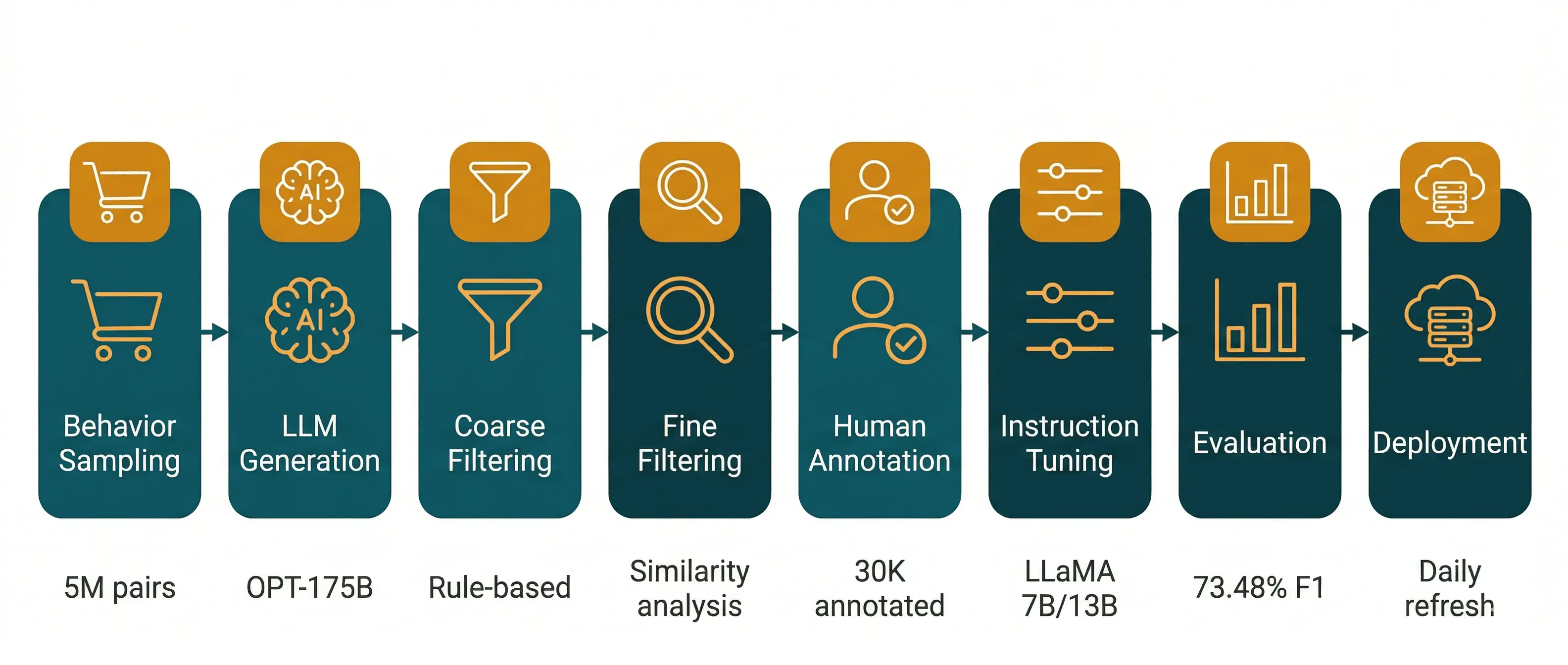
This section provides the technical architecture for advanced readers. If you're primarily interested in practical optimization, skip to the keyword stuffing section below without missing actionable guidance.
Amazon sampled representative behaviors from 18 product categories:
Sampling was weighted toward broad and ambiguous queries (where commonsense knowledge provides the most value) and high-interaction products (where behavior data is richest).
Amazon used OPT-175B and OPT-30B (hosted on 16 A100 GPUs) with structured prompts describing shopping scenarios. The models generated millions of knowledge candidates across all 15 relation types.
Example: given the search-buy pair "winter coat" → puffer jacket, the model generates candidates like "capable of providing high-level warmth," "used in cold weather locations," "used by outdoor workers."
Rule-based filtering removed low-quality candidates:
An in-house language model pretrained on Amazon's e-commerce corpus performed similarity analysis to catch paraphrases and semantic duplicates that rule-based filtering missed. Two candidates saying the same thing in different words add no value to the knowledge graph - this stage ensures each edge carries unique information.
30,000 total candidates (15,000 per behavior type) were sent to professional annotators. Each candidate was evaluated across 5 dimensions: completeness, relevance, informativeness, plausibility, and typicality. Every candidate was labeled by 2 annotators plus 1 reviewer for disagreements.
The quality results reveal important patterns:

The significantly lower co-buy numbers reflect the greater difficulty of inferring shared intent behind co-purchased items. When someone searches for "winter coat" and buys a puffer jacket, the intent connection is relatively clear. When someone buys a puffer jacket and also buys wool socks, the commonsense connection (both for cold weather) requires deeper inference. This is why co-buy knowledge is harder to generate reliably - and why the annotation pipeline exists rather than simply trusting raw model output.
The high-quality annotated knowledge became instruction-tuning data for LLaMA 7B and 13B models. COSMO-LM was fine-tuned across all 18 domains, 15 relation types, and 5 task types:
This multi-task training is what gives COSMO-LM its versatility - it doesn't just generate knowledge; it can evaluate, score, and predict the quality of knowledge across multiple dimensions.
The proof that COSMO works, from the paper's evaluation on the ESCI (Exact-Substitute-Complement-Irrelevant) dataset:
The search relevance and session recommendation numbers are from offline evaluations on benchmark datasets. The online A/B test results (0.7% sales increase, 8% navigation engagement) are from live production deployment. Together, they prove COSMO delivers measurable improvements across both controlled experiments and real-world deployment. The full evaluation methodology is detailed in the SIGMOD-Companion paper.
The production system runs on three components:
Known limitation: The daily refresh cycle means COSMO cannot process real-time events. Flash sales, viral product moments, and sudden demand spikes are invisible to the system until the next refresh. This is why listing-level optimization (which persists) matters more than chasing trending queries (which the system may not yet reflect).
Your listing is evaluated within a graph of 29 million edges connecting products, queries, and intentions across 6.3 million nodes. If your content fails to provide explicit signals about function, audience, use context, and capabilities, you are leaving gaps that competing products may fill.
The HELIX framework was built to map listings against this architecture - all 15 relation types, systematically, with measurable scoring. Across 3,000+ transformations, it is one approach to bridging the gap between understanding COSMO's architecture and applying it to real listings at scale.
Keyword stuffing is not just ineffective under COSMO - it actively works against you by filling your listing with repetitive text that displaces the structured intent signals COSMO is looking for.
Let's be precise about this. Keywords are still essential for indexing - Amazon needs keyword signals to include your listing in the initial candidate pool. If your listing never mentions "yoga mat," it will not appear in results for that search. Keywords are the entry ticket.
But keyword repetition has zero value under COSMO's evaluation. Mentioning "yoga mat" five times in your title does not make your listing five times more relevant. It makes it one time relevant for the keyword and four times wasteful of character space that could communicate intent signals.
Every character in your listing is real estate. Under A9, the optimal strategy was to maximize keyword coverage - more terms, more matches, more visibility. Under COSMO, the optimal strategy has shifted: mention each important keyword once in the most relevant location (title for primary terms, backend for secondary), then use every remaining character to cover as many COSMO relations and intent signals as possible.
Breadth of intent coverage beats depth of keyword repetition.
Amazon's title policy update, effective January 21, 2025, reinforces this shift: a 200-character limit for most categories, restrictions on special characters, and a rule that no word may appear more than twice (prepositions, articles, and conjunctions excepted). Non-compliant titles are flagged and may be automatically modified. This enforcement aligns with the direction COSMO represents - the platform is structurally discouraging keyword repetition.
ChatGPT-generated listings present a specific challenge under COSMO. They produce fluent, well-written copy - the grammar is clean, the tone is professional, the structure looks polished. But they often default to keyword-dense patterns without structured intent signals.
The output reads well to humans but fails to provide the specific semantic signals COSMO evaluates. A ChatGPT listing for a water bottle might produce five eloquent bullets about "premium stainless steel construction" and "sleek modern design" - all keyword-rich, all semantically thin. None of those bullets answer who the bottle is for, where it's used, what activities it supports, or what capabilities differentiate it.
This is why we've argued that ChatGPT listings are the new keyword stuffing - they produce a different form of the same problem: listing content that looks optimized but communicates insufficient structured knowledge for AI-driven discovery. For a balanced guide on using ChatGPT effectively within COSMO's constraints, see our dedicated walkthrough.
Amazon COSMO (Common Sense Knowledge Generation and Serving System) is an AI-powered knowledge graph system that maps commonsense relationships between products, shopper queries, and purchase intent. Published as a peer-reviewed paper at SIGMOD-Companion 2024, COSMO contains 6.3 million nodes and 29 million knowledge edges across 18 product categories, enabling Amazon to understand not just what customers search for but why they search for it.
COSMO stands for Common Sense Knowledge Generation and Serving System at Amazon. The name reflects the system's core function: generating and serving commonsense knowledge about products and shopper intent at Amazon's scale.
A9 matches keywords and ranks by sales performance. COSMO adds an intent-understanding layer that evaluates whether a product solves the problem described in a query, using 15 commonsense relation types. A9 asks "does this listing contain the search words?" COSMO asks "does this product address the shopper's underlying need?" Keywords still matter for indexing, but COSMO changes how Amazon evaluates relevance once a listing enters the candidate pool.
No. "A10" has never been confirmed by Amazon - it is an informal community label for perceived algorithm changes. COSMO is a specific, documented system published at SIGMOD-Companion 2024 by researchers from Amazon and HKUST. When sellers reference "A10," they are likely observing effects better explained by COSMO's deployment and Rufus's growth.
COSMO shifts the competitive advantage from keyword coverage to intent coverage. Listings that only communicate what a product is (via keywords) lose ground to listings that communicate who it's for, what it does, where and when it's used, and what problems it solves. Sellers whose listings were optimized for A9 keyword matching may experience declining sessions and visibility - even while ranking for the same keywords - because COSMO evaluates relevance differently.
A COSMO-optimized listing systematically covers multiple commonsense relation types - audience, function, capability, use context, complementary products, and shopper intent - across the title, bullets, description, A+ Content, and backend attributes. It communicates structured product knowledge that Amazon's AI can interpret, rather than repeating keywords for indexing alone.
Rufus is Amazon's customer-facing AI shopping assistant. COSMO generates structured product knowledge that the industry widely believes feeds into Rufus's recommendations - though Amazon has not publicly confirmed this specific connection. Both systems serve the same goal: understanding shopper intent beyond keywords. Over 300 million customers used Rufus in 2025 (Q4 2025 earnings call), with Amazon attributing nearly $12 billion in incremental annualized sales to AI-assisted shopping.
Yes - keywords remain essential for indexing. Amazon needs keyword signals to include your listing in the candidate pool. However, keyword repetition no longer improves ranking. The optimal approach is to mention each important keyword once in the most relevant field, then use remaining space to cover COSMO's intent dimensions. Breadth of intent coverage beats depth of keyword repetition.
Audit your listing against COSMO's 15 commonsense relation types: does it communicate who the product is for, what it does, where and when it's used, what it's capable of, and what shopper needs it addresses? ZonGuru's free COSMO Readiness Report automates this assessment, scoring your listing against these dimensions with specific gap identification. Over 5,000 sellers have used it - the average score is 46 out of 100.
A COSMO readiness score measures how well your listing communicates structured intent signals across the relation types that COSMO evaluates. ZonGuru's scoring system analyzes your title, bullets, description, A+ Content, and attributes against the 15 commonsense relation categories, producing a numerical score with specific recommendations for improvement. The average score across 5,000+ reports is 46/100, indicating most listings have significant optimization headroom.
COSMO uses 15 relation types organized into five categories: Functional (Used_For_Func, Used_To, Capable_Of), Audience (Used_For_Audience, Used_By, xIs_A), Context (Used_For_Event, Used_On, Used_In_Location, Used_In_Body), Classification (Used_As, Is_A), and Complementary/Interest (Used_With, xInterested_In, xWant). Together, these relations map the complete semantic profile of why a customer would purchase a product.
COSMO-LM is refreshed daily via Amazon SageMaker, ingesting new customer behavior session logs. The Asynchronous Cache Store uses a two-layer strategy combining yearly pre-loaded patterns with daily batch processing. While the paper does not specify how long listing changes take to propagate, sellers widely report that semantic changes take days to weeks to fully reflect. COSMO cannot process real-time events like flash sales due to the daily batch refresh cycle.
The COSMO paper documents the system across 18 major product categories, and Rufus is available across all product categories in the US marketplace. While Amazon has not published a complete list of COSMO-covered categories, the system's architecture is designed for broad coverage and its Feature Store feeds multiple downstream applications. The practical assumption for sellers is that intent-based evaluation extends to their category.
COSMO is a backend knowledge graph system - it generates and structures commonsense knowledge from shopper behavior data and has been deployed in Amazon's search navigation. Rufus is the frontend AI shopping assistant - it answers shopper questions and recommends products. While Amazon has not publicly confirmed that COSMO directly feeds Rufus, both systems serve the same goal of understanding shopper intent beyond keywords. Optimizing for one effectively optimizes for both, because structured listing content benefits any intent-based evaluation system.
Start by auditing your listing against COSMO's 15 relation types. Rewrite your title for intent clarity, not keyword volume. Structure bullets around customer questions, not feature lists. Fill every backend attribute field Amazon offers. Use A+ Content to expand intent coverage beyond what standard fields allow. Check the Rufus prompts on your product page for category-specific signals. Mine 3- and 4-star reviews for the language patterns your audience actually uses. For a detailed walkthrough, see our Rufus optimization playbook.
Understanding COSMO is the first step. The next step is knowing how your listings perform under it.
ZonGuru's free COSMO Readiness Report analyzes your listing against the intent dimensions, attribute coverage, and semantic structure that COSMO evaluates - and gives you a clear score with specific recommendations. It takes 30 seconds to request and delivers actionable insights you can apply immediately.
Over 5,000 sellers have already benchmarked their listings. The average score is 46 out of 100 - which means most listings have substantial room to improve their AI discoverability. Whether you act on the recommendations yourself or have us handle it through the COSMO Transformation Service, the first step is the same: know where you stand.
Discover opportunities. Maximize your sales. Grow your Amazon business!

Free score in 2 minutes. See how Amazon's AI reads your listing and what to fix.
 Run my Free Score
.svg)
Get started with ZonGuru, access all the tools with a FREE trial.
.avif) Start FREE Trial
Start FREE Trial