Loading...


Let our Amazon experts show you how to leverage the power of ZonGuru to smash your sales goals. You’re invited to a 15-minute Rocket Demo so you can see the ZonGuru tools first-hand.
Book your seat now!
Generative Engine Optimization (GEO) for Amazon is the practice of structuring product listings, brand content, and off-Amazon digital presence so that AI-powered discovery systems — including Amazon Rufus, ChatGPT Shopping, Google AI Overviews, and Perplexity — can accurately interpret, trust, and recommend your products in response to natural-language shopper queries.
The discovery model for Amazon products has fundamentally split. Traditional Amazon SEO still matters for keyword-based searches in the search bar. But a growing share of product discovery now begins either inside AI-powered interfaces on Amazon itself or outside Amazon entirely — in AI assistants that compile answers from multiple sources and recommend specific products by name. Amazon's own internal AI, Rufus, powered by the COSMO knowledge graph, operates on the same principle: it reads listings semantically rather than matching keywords.
The commercial stakes are substantial. During Amazon's Q3 2025 earnings call, CEO Andy Jassy disclosed that 250 million shoppers had used Rufus that year, with monthly active users growing 140% year over year and interactions up 210%. Customers who engaged with Rufus during a shopping trip were 60% more likely to complete a purchase. By the Q4 2025 earnings report, Amazon revealed Rufus had generated nearly $12 billion in incremental annualized sales — exceeding the $10 billion pace Jassy had projected just one quarter earlier. Meanwhile, research from Princeton University demonstrated that Generative Engine Optimization techniques can boost content visibility by up to 40% in AI engine responses.
This is not a future trend. It is a current revenue driver. Beyond Amazon, Shopify's own commerce data shows AI-referred orders are up 14x since January 2025, with those orders carrying a 30% higher average order value than typical search traffic. The shift to AI-mediated product discovery is happening across the entire ecommerce ecosystem.
This guide delivers a definitive framework for Amazon sellers — what GEO is, why Amazon GEO is fundamentally different from website GEO, how COSMO and Rufus create a unique optimization challenge, and the practical steps to make your products the ones AI recommends.
Before diving in, you can check where your listings stand today with ZonGuru's free COSMO/Rufus Readiness Report.
Generative Engine Optimization is to AI engines what SEO is to traditional search engines — the discipline of making content discoverable, interpretable, and citable by systems that generate answers rather than return links.
The term originates from a landmark 2024 research paper by a team from Princeton University, Georgia Tech, the Allen Institute for AI, and IIT Delhi. Published at ACM SIGKDD 2024, the study tested nine optimization strategies across 10,000 search queries using a generative engine closely resembling BingChat. The researchers found that techniques such as adding relevant statistics, citing credible sources, and using authoritative language could boost content visibility by up to 40% in generative engine responses. Critically, traditional SEO methods like keyword stuffing performed poorly in the same tests.
The mechanism behind GEO differs fundamentally from SEO. Traditional search engines crawl, index, and rank pages — returning a list of ten blue links. Generative engines retrieve relevant sources, interpret them using large language models, synthesize an answer, and cite only the sources they relied on. The competition is no longer for position on a results page. It is for inclusion in a generated answer that typically cites only two to seven sources.
Several related terms circulate in the industry: Answer Engine Optimization (AEO), LLM SEO, AI Visibility Optimization, and Generative Search Optimization (GSO). These overlap significantly, but GEO has emerged as the broadest umbrella term following the Princeton research, and it is the term gaining traction among Amazon seller communities and ecommerce professionals.
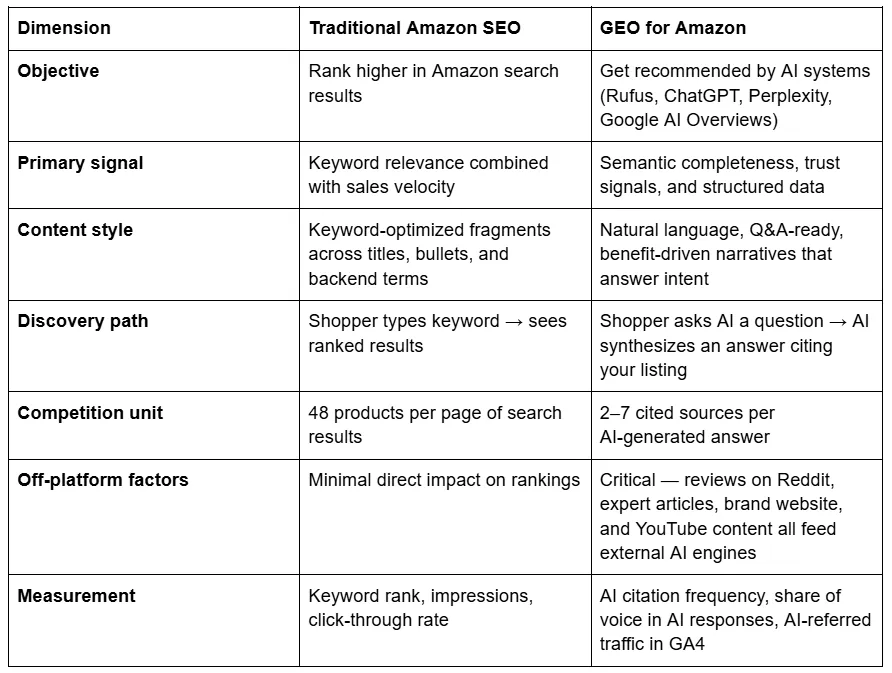
Understanding this table is essential because it reveals a structural shift in what "winning" looks like. In SEO, you compete for one of 48 positions on a search results page. In GEO, you compete for one of two to seven citations in an AI-generated answer. The math is different, the signals are different, and the optimization approach must be different.
Most GEO content published in 2025 and 2026 assumes you control your own website. You can add schema markup in JSON-LD. You can modify site architecture to create topical clusters and pillar pages. You can publish blog content, build backlinks, and control the narrative end-to-end. On Amazon, none of that applies.
Amazon GEO operates under five constraints that make it fundamentally different from website GEO:
No schema markup control. You cannot add JSON-LD, structured data, or rich snippets to an Amazon listing. The structured data available to AI engines comes exclusively from Amazon's attribute fields in Seller Central — the fields most sellers leave half-empty because they were optional under the A9 algorithm.
No site architecture control. You cannot create topical clusters, pillar pages, or internal linking strategies within Amazon. Each product listing is an island. The only architectural signals come from Amazon's own categorization, your Brand Story, and A+ Content modules.
A proprietary AI system with its own rules. COSMO and Rufus are Amazon's own algorithms. They are not Google's AI Overviews, not ChatGPT, and not Perplexity. They have their own knowledge graph built from shopping behavior data, their own ranking signals derived from intent matching rather than keyword matching, and their own trust hierarchies. Optimizing for Google's generative search does not automatically optimize for Rufus.
Two-front optimization. Amazon sellers must simultaneously optimize for Amazon's internal AI (Rufus powered by COSMO) and external AI engines (ChatGPT Shopping, Google AI Overviews, Perplexity) that also recommend Amazon products. The signals each system values overlap but are not identical. Rufus has access to internal Amazon data — your sales velocity, return rates, and customer behavior — that external engines cannot see. External engines rely more heavily on off-Amazon signals like Reddit discussions, expert review sites, and your brand website.
User-generated content as the primary trust layer. On your own website, you control the narrative. On Amazon, the content you control least — reviews and Q&A — is what AI engines trust most. Rufus summarizes review sentiment to answer shopper questions. ChatGPT and Perplexity cite Amazon reviews as evidence when recommending products. Negative review themes you have not addressed in your listing copy become the AI's answer about your product.
This is why we built the COSMO Readiness Report — to diagnose GEO readiness within the constraints of Amazon's ecosystem, where you cannot just "add schema" or "build backlinks."
Understanding Amazon's internal GEO requires understanding two interconnected systems: COSMO, the knowledge graph that maps intent to products, and Rufus, the conversational AI that queries that knowledge graph to make recommendations.
COSMO — which stands for Common Sense Knowledge Generation — is a system Amazon developed to mine user-centric commonsense knowledge from massive shopping behavior data. Published as a research paper at ACM SIGMOD 2024, COSMO represents a fundamental shift from product-attribute matching to intent-based understanding.
Under the legacy A9 algorithm, Amazon's search operated primarily on keyword relevance: does the listing text contain the words the shopper typed? COSMO adds a semantic intelligence layer that asks a deeper question: given what this shopper is trying to accomplish, does this product fulfill their intent?
COSMO builds its knowledge graph by analyzing two primary data sources — search-purchase pairs (what people searched for and then bought) and co-purchase behavior (what products people bought together in the same session). From these behavioral signals, COSMO uses large language models refined through human feedback to generate commonsense knowledge assertions about products. The knowledge graph now spans 18 major Amazon categories with millions of high-quality knowledge entries, all generated from only 30,000 annotated instructions through instruction-tuned language models.
The relationship types COSMO encodes map directly to the questions your listing should answer: who is this product for, what does it do, when and where would someone use it, what occasion or event does it suit, what lifestyle or life situation does it serve, and what other products complement it. These are the "intent questions" — used_for, used_on, used_with, interested_in, capable_of, and similar relational categories — that COSMO uses to transform traditional query-product matching into query-product-intent matching.
For a deeper exploration of how COSMO works and what it means for your listings, see our complete guide: What Is Amazon COSMO?
Rufus is the customer-facing layer — the AI shopping assistant that shoppers interact with directly. Where COSMO builds the knowledge graph, Rufus queries it to generate recommendations and answers.
Rufus reads product listings (titles, bullet points, descriptions), reviews, Q&A, and A+ Content. It accesses off-Amazon sources to validate claims and fill knowledge gaps. And it does all of this at a scale that is reshaping Amazon's commercial landscape — Amazon deployed over 50 technical upgrades to Rufus throughout 2025, transforming it from a question-answering tool into an autonomous shopping agent with memory, price tracking, and automatic purchasing capabilities.
The adoption numbers from Amazon's 2025 earnings reports tell the story: more than 300 million customers used Rufus throughout 2025. The nearly $12 billion in incremental annualized sales Rufus generated represents purchases that likely would not have happened without the AI assistant's intervention. Sensor Tower's independent research corroborated Amazon's claims, finding that Rufus-assisted sessions during the 2025 holiday season had conversion rates 3.5 times higher than non-Rufus sessions — a gap that held consistently from October through December.
Rufus is also likely multimodal to some degree. Amazon's patent filings describe a "Visual Label Tagging" system that extracts meaning from visual content, and practitioner testing is consistent with these descriptions. However, Amazon has not published official documentation confirming that Rufus uses computer vision or OCR to process product listing images in its live recommendation pipeline. What is observable is that image quantity and quality correlate strongly with Rufus recommendation outcomes — a study of 1,300+ Rufus-recommended products found a median of 7 images per listing, with products carrying fewer than 4 images rarely appearing. Whether Rufus directly "reads" images or simply benefits from the richer listing environments that accompany high-quality image sets, the practical takeaway for sellers is the same: invest in clear, informative product photography.
For strategies on optimizing specifically for Rufus, see our guide: How to Optimize Amazon Listings for Rufus
The relationship between COSMO and Rufus creates a feedback loop that defines Amazon's internal GEO: COSMO builds the knowledge graph from shopping behavior → Rufus queries the knowledge graph when shoppers ask questions → Rufus recommends products that have the most complete, structured, and trusted data in the graph → Shoppers who engage with Rufus-recommended products generate new behavior data → COSMO updates the knowledge graph. In Amazon's own testing, a COSMO-enhanced relevance model achieved a 28% improvement in search accuracy over baselines — demonstrating how commonsense knowledge provides complementary information that keyword matching alone cannot replicate.
Sellers who structure their listings to communicate complete, intent-rich product knowledge feed this loop positively. Their products become increasingly well-represented in COSMO's graph, making them more likely to be recommended by Rufus, which generates more positive behavioral signals, which strengthens their position further. This is the compounding advantage of early GEO optimization — and the compounding disadvantage of delay.
The second front of Amazon GEO involves the AI engines that operate outside Amazon — ChatGPT Shopping, Google AI Overviews, Perplexity, and Claude — but frequently recommend Amazon products in their responses.
These external engines discover products to recommend through several sources: Amazon product listing data (titles, descriptions, A+ Content), Amazon reviews and Q&A sections, third-party review sites and comparison articles, Reddit discussions in relevant subreddits, brand websites with educational content, and YouTube reviews and expert content. The volume of AI-driven shopping traffic is growing rapidly — Adobe reported that traffic from generative AI sources to retail sites increased 1,300% during the 2024 holiday season year over year, and that growth has continued accelerating into 2025 and 2026.
When we ran ZonGuru's Baseline AI Visibility Audit — testing 20+ prompts across ChatGPT, Perplexity, Claude, and Google AI Overviews — one pattern was immediately clear. AI engines consistently cited third-party review sites, Reddit threads, and industry publications over brand-owned content. When asked "What is ZonGuru?", ChatGPT sourced its answer from ecommerce-growth.com and projectfba.com reviews rather than from zonguru.com itself. This is not unique to ZonGuru. A Semrush analysis of over 150,000 LLM citations confirmed the pattern at scale: Reddit alone appeared in roughly 40% of all LLM citations, followed by Wikipedia at 26%.
The hierarchy we observed — and that the broader data supports — inverts the control most sellers are accustomed to:
User-generated content — reviews, Reddit threads, YouTube reviews, forum discussions — carries the highest trust weight. AI engines treat this content as authentic, unbiased signal because no brand controlled its creation.
Expert and editorial content — comparison articles in industry publications, professional review sites, curated buying guides — carries high trust. These sources provide structured analysis that AI engines can synthesize confidently.
Marketplace listing data — Amazon product pages, including titles, bullet points, and A+ Content — carries moderate trust. AI engines recognize this is seller-controlled content and weight it accordingly.
Brand-owned content — company websites, press releases, marketing materials — carries the lowest trust weight among these categories. AI engines discount content where the brand controls the narrative entirely.
The implication is uncomfortable but important: the content you control least has the most influence on AI recommendations. This is a mindset shift for most Amazon sellers, who have spent years perfecting their listing copy while treating reviews as a passive outcome rather than an active GEO signal.
This section is the practical heart of this guide. Each pillar addresses a specific dimension of GEO readiness that contributes to how AI engines interpret, trust, and recommend your products.
GEO-optimized listing content communicates intent, not just attributes. The shift is from keyword-optimized fragments to natural-language narratives that answer the questions shoppers and AI engines actually ask.
Titles should communicate who the product is for, what it does, and why it matters — not serve as containers for every keyword you want to rank for. A title structured as "Stainless Steel Insulated Water Bottle for Hiking — Keeps Drinks Cold 24 Hours, BPA-Free, Fits Standard Cup Holders" communicates intent to both COSMO and external AI engines. A title that reads "Water Bottle Stainless Steel Insulated BPA Free Cold Hot Sports Gym Hiking Camping Travel" communicates keywords but not intent.
Bullet points should follow a Benefit → Feature → Proof structure. Lead with what the feature means for the buyer, then name the feature, then provide evidence. This pattern mirrors how AI engines retrieve and synthesize information — they look for claims backed by specifics.
Product descriptions should read as use-case narratives, not restated bullet points. Describe the product in the context of the buyer's life. Who uses it? When? Where? What problem does it solve? What complements it? These are the questions COSMO encodes in its knowledge graph, and descriptions that answer them explicitly give COSMO more structured data to work with.
Backend attributes represent one of the most overlooked GEO signals on Amazon. Every blank optional field in Seller Central is a missed GEO signal. Material composition, target audience, occasion type, certifications, compatibility — these fields are Amazon's equivalent of schema markup. They are how COSMO classifies your product within its knowledge graph.
Amazon's backend attribute system is the closest equivalent to schema markup available to sellers. The Category Listing Report (CLR) — downloadable from Seller Central — reveals every attribute field available for your product category, including dozens of optional fields most sellers never touch.
Fill every relevant field. Material type, target demographic, occasion, certifications, safety ratings, compatibility specifications, size and weight in multiple units — each completed field gives COSMO a structured data point it can use to match your product to specific intent pathways. A product with 15 completed attribute fields communicates more structured knowledge to COSMO than a competitor with 5 completed fields, even if their listing copy is comparable.
This is not speculation. COSMO's published research describes how product titles, descriptions, and attributes are concatenated into a single text span and fed into relevance models alongside COSMO's generated knowledge. The attribute data is part of the input that determines whether COSMO can confidently match your product to a shopper's intent.
A+ Content (formerly Enhanced Brand Content) has always served a conversion function — visually rich modules that tell your brand story below the fold. Under GEO, A+ Content takes on a dual role: it must persuade human shoppers while simultaneously providing structured knowledge that AI engines can parse.
Comparison charts are among the most GEO-valuable A+ modules because Rufus reads these to answer comparative questions. When a shopper asks Rufus "which is better for camping, Product A or Product B?", Rufus can pull structured data from comparison charts to formulate an answer. If your A+ Content includes a comparison chart showing your product's advantages across specific dimensions, you are giving Rufus the data it needs to recommend you.
FAQ modules within A+ provide direct question-answer formatted content that maps precisely to how AI engines retrieve answers. A well-crafted FAQ module answers the exact questions shoppers ask Rufus and ChatGPT.
Alt text on A+ images provides structured descriptive data that Amazon's broader search infrastructure can index. Whether or not Rufus directly processes alt text, completing these fields ensures your visual content is accompanied by machine-readable context — a best practice that aligns with how AI systems generally interpret web content.
Brand Story serves as an authority signal — a consistent narrative across your product catalog that AI engines can use to assess brand credibility and expertise.
Amazon's patent filings describe multimodal capabilities for Rufus, including OCR and visual label tagging. While Amazon has not officially confirmed these capabilities are active in production, the practical evidence is compelling: listings with more and higher-quality images consistently appear in Rufus recommendations at higher rates.
Text overlays on infographic images — "BPA-Free," "Fits 15-inch Laptops," "FDA Approved" — serve dual purposes. If Rufus does use OCR as the patents describe, these overlays provide structured data the AI can extract. Even if it does not, the text overlays improve shopper comprehension and conversion, which generates the behavioral signals (clicks, purchases) that COSMO's knowledge graph definitively does use.
Lifestyle images communicate context that pure text cannot. A backpack shown on a hiker in a mountain setting communicates a use case — hiking outdoors — to both human shoppers and any AI system evaluating the listing. Context matters because COSMO encodes used_for, used_on, and used_with relationships, and the shopper behavior generated by contextually rich images feeds those relationships.
Visual-textual consistency matters regardless of whether Rufus directly processes images. If your title says "compact" but your images show a bulky product, human shoppers bounce — and that negative behavioral signal reaches COSMO even if the image pixels themselves do not.
Under GEO, reviews and Q&A shift from passive social proof to active optimization assets.
Rufus summarizes review sentiment to answer shopper questions directly. When a shopper asks "is this durable?", Rufus scans your reviews for durability-related mentions and synthesizes an answer. If the dominant review theme around durability is negative — "broke after two weeks," "handle fell off" — that becomes Rufus's answer regardless of what your listing copy claims.
Reviews that mention specific use cases feed COSMO's knowledge graph. Reviews stating "great for camping," "perfect for sensitive skin," or "my toddler loves it" provide the behavioral-intent data COSMO uses to build product-intent associations. A product with reviews rich in use-case context is better represented in COSMO's graph than one with generic five-star reviews that say only "great product."
Proactive Q&A management is a high-leverage GEO tactic. Seed 10 to 15 questions covering the prompts shoppers are likely to ask Rufus — questions about compatibility, use cases, materials, comparisons with alternatives, and specific scenarios. Provide thorough, fact-based answers. This Q&A content becomes part of the information Rufus draws on when answering shopper queries.
Address negative review themes in your listing copy. If multiple reviews mention the product is heavier than expected, add weight information prominently in your bullet points. This does not erase the negative reviews, but it shows AI engines that the listing acknowledges and addresses the concern transparently.
External AI engines like ChatGPT Shopping, Google AI Overviews, and Perplexity draw on sources beyond Amazon when making product recommendations. Your off-Amazon presence feeds these engines.
Brand website with educational content. A homepage alone is not sufficient. Guides, comparison articles, use-case studies, and research content give external AI engines authoritative, brand-adjacent content to cite. If an AI engine finds a well-structured buying guide on your brand website that mentions your Amazon products, it has a high-trust source to reference in its recommendations.
Reddit presence in relevant subreddits. Analysis of over 150,000 LLM citations found that Reddit was the most frequently cited web domain by large language models, appearing in roughly 40% of analyzed citations. Authentic, helpful participation in relevant subreddits — answering questions, sharing expertise, contributing to discussions — builds a citation-worthy presence where AI engines actively look.
Expert reviews and comparison articles. Getting your products reviewed by authoritative third-party sites creates high-trust content that AI engines can cite with confidence. A single well-structured review on a respected industry publication can generate more AI visibility than dozens of self-published blog posts.
Cross-source consistency. Ensure your product name, key attributes, and pricing are consistent across all sources — your Amazon listing, your brand website, third-party review sites, and social media. Inconsistencies across sources reduce AI confidence in the accuracy of any single source.
GEO is not a one-time project. AI engines re-evaluate content continuously, and your competitors are also adapting. Measurement and iteration are essential.
Talk to Rufus directly. Open the Amazon mobile app and ask Rufus questions about your product category. Does it recommend your product? What does it say about your product's strengths and weaknesses? What does it recommend instead? This is the most immediate and actionable GEO audit available.
Run the COSMO/Rufus Readiness Report before and after making changes to your listings. The free diagnostic tool scores your listing across the dimensions COSMO and Rufus use to evaluate, interpret, and recommend products — intent coverage, semantic structure, attribute completeness, contextual relevance, and brand authority signals.
A/B test with Amazon's Manage Your Experiments. Test listing elements systematically — titles, images, A+ Content modules — and measure the impact on both traditional conversion metrics and Rufus recommendation visibility.
Off-Amazon, track AI-referred traffic. Set up GA4 segments for traffic arriving from chat.openai.com, perplexity.ai, claude.ai, and other AI referral domains. Adobe Digital Insights reported that generative AI traffic to retail sites increased 4,700% year over year as of mid-2025. Even if the absolute volume is still modest, tracking the trend establishes a baseline for measuring the impact of your GEO optimization.
Commit to a monthly re-audit cycle. GEO optimization is not a campaign with an end date. It is an ongoing operating layer that compounds over time.
The tool landscape for Amazon GEO is still emerging. Most existing Amazon tools were built for the SEO paradigm — keyword research, rank tracking, and competitive analysis. GEO-specific capabilities are developing rapidly, but the options differ significantly in depth and approach.
ZonGuru COSMO Readiness Report (free) — Diagnoses AI-readiness across intent coverage, semantic structure, and attribute completeness. Over 1,500 reports generated to date. The only free diagnostic tool that operationalizes GEO specifically for Amazon's COSMO evaluation criteria. Run your free report here.
ZonGuru COSMO Transformation Service ($100/ASIN) — Done-for-you GEO optimization applying the HELIX Framework, including deep niche research, structured intent mapping, engineered listing copy, before-and-after AI-readiness scoring, image analysis, and a ready-to-upload flat file. Validated across 500+ brands and over 3,000 listing transformations. Learn more about the Transformation Service.
ZonGuru Listing Optimizer — Self-serve listing optimization with real-time scoring built for Rufus-era evaluation criteria. Explore the Listing Optimizer.
Helium 10 and Jungle Scout — Remain essential for keyword research, competitive intelligence, and market analysis, but are fundamentally SEO tools, not GEO tools. Use alongside GEO-specific optimization rather than as a substitute.
Amazon Seller Central "Enhance My Listing" — Amazon's native AI-generated listing suggestions. Free but surface-level — useful for identifying obvious gaps but not a substitute for structured GEO optimization.
ZonGuru is the only platform that combines a free GEO diagnostic (the Readiness Report) with a done-for-you GEO transformation service — bridging the gap between understanding your COSMO readiness and actually closing the gaps it identifies.
After analyzing over 4,500 AI Readiness Reports and transforming more than 3,000 listings, patterns emerge in the mistakes sellers make when approaching GEO.
Generative Engine Optimization for Amazon is the discipline of structuring product listings, brand content, and off-Amazon digital presence so that AI-powered discovery systems can accurately interpret, trust, and recommend your products. These systems include Amazon's own Rufus AI shopping assistant (powered by the COSMO knowledge graph), ChatGPT Shopping, Google AI Overviews, and Perplexity. GEO sits alongside traditional Amazon SEO as a complementary optimization layer focused on the growing share of product discovery that happens through AI-generated responses rather than keyword-based search results.
Traditional Amazon SEO optimizes for keyword matching and search rank position — getting your product onto page one for target search terms. GEO optimizes for AI interpretation and recommendation — getting your product cited by AI systems when shoppers ask natural-language questions. SEO deals with keyword relevance, sales velocity, and click-through rate. GEO deals with semantic completeness, intent coverage, structured data depth, and trust signals from both on-Amazon and off-Amazon sources. The signals, the competition unit (48 results per page vs. 2–7 citations per answer), and the optimization tactics differ fundamentally.
GEO does not replace Amazon SEO. It adds a layer on top. Keyword relevance, conversion rate, sales velocity, and review quality remain foundational ranking signals in Amazon's search algorithm. COSMO adds a semantic intelligence layer that supplements — not supplants — these traditional signals. Sellers need both: SEO to maintain visibility in keyword-based search, and GEO to capture the growing share of discovery that happens through AI-powered recommendation engines. For a comprehensive approach to traditional optimization, see our Amazon SEO Guide.
COSMO is Amazon's AI-powered knowledge graph that maps commonsense intent relationships across 18 major product categories. Rufus is Amazon's customer-facing AI shopping assistant that queries COSMO's knowledge graph to generate product recommendations and answer shopper questions. GEO is the optimization discipline that sellers apply to ensure their products are well-represented in COSMO's knowledge graph and therefore well-positioned for Rufus recommendations. COSMO is the infrastructure, Rufus is the interface, and GEO is the strategy. For detailed coverage, see our guides on Amazon COSMO and Rufus AI.
ChatGPT Shopping recommends Amazon products based on multiple signals: your product listing data, Amazon review content, third-party review sites and comparison articles, Reddit discussions, and brand website content. To improve your chances of being recommended, ensure your listing communicates clear product differentiation in natural language, build a presence on third-party review platforms, maintain consistent product information across all sources, and develop educational content on your brand website. Off-Amazon authority signals are especially important for ChatGPT because it draws on a broader range of web sources than Amazon's internal AI.
A COSMO readiness score measures how well your Amazon listing is structured for interpretation by COSMO's AI evaluation criteria. ZonGuru's free COSMO Readiness Report evaluates your listing across five dimensions: intent coverage (does your listing address the full range of relevant shopper queries), semantic structure (is content organized as parseable knowledge rather than marketing prose), attribute completeness (can AI extract specific product facts), contextual relevance (are features connected to real use cases), and brand authority signals (depth and structure of A+ Content and Brand Story). Enter your ASIN to receive results in under 60 seconds with no credit card or account required.
Keyword stuffing is not effective for GEO. The Princeton study that established the GEO framework explicitly tested keyword stuffing and found it performed poorly in generative engine responses. Large language models do not weight keyword density the way traditional search algorithms do — they evaluate semantic coherence, factual density, and structured completeness. Listings packed with redundant keywords at the expense of natural language actually reduce AI confidence because they read as optimized-for-machines rather than informative-for-humans. Natural language that communicates intent, use cases, and product knowledge consistently outperforms keyword-dense text in AI engine evaluations.
Reviews play a dual role in Amazon GEO. First, Rufus directly summarizes review content to answer shopper questions — making review sentiment a real-time input to AI-generated product assessments. Second, reviews that mention specific use cases, audiences, and scenarios feed COSMO's knowledge graph with behavioral-intent data that strengthens your product's representation. Reviews stating "great for camping" or "perfect for sensitive skin" provide exactly the intent signal COSMO encodes. Managing reviews under GEO means not only pursuing positive ratings but actively encouraging contextually rich reviews and addressing negative themes in your listing content.
GEO optimization typically shows initial directional results within two to four weeks as Rufus re-evaluates updated listing content. COSMO's knowledge graph updates on a rolling basis as new behavioral data accumulates, so the full impact of structured listing changes compounds over at least several months. External AI engines vary in their refresh rates — ChatGPT and Perplexity re-crawl frequently, while Google AI Overviews may take longer to reflect listing changes. The compounding nature of GEO means that early optimization yields accelerating returns: clearer listings lead to higher conversion, which generates stronger behavioral signals, which improves knowledge graph representation, which earns more AI recommendations.
The best tool depends on your approach. For a free diagnostic starting point, the ZonGuru COSMO Readiness Report provides an immediate assessment of where your listing stands under AI evaluation criteria. For done-for-you optimization, the ZonGuru COSMO Transformation Service delivers engineered listing content with before-and-after AI-readiness scoring. For self-serve optimization, the ZonGuru Listing Optimizer offers real-time scoring. Ecomtent offers strong AI content generation with COSMO scoring. Helium 10 and Jungle Scout remain essential for keyword research but address SEO rather than GEO. The best approach for most sellers combines a GEO-specific diagnostic with keyword research tools — using both to cover the full optimization spectrum.
GEO applies to any digital surface where AI engines make recommendations. If you sell products on your own website, GEO principles — structured data, semantic completeness, entity density, Q&A formatting, and off-site authority — directly apply to getting cited by ChatGPT, Google AI Overviews, and Perplexity. The difference is that on your own site, you have more control (schema markup, site architecture, blog content). On Amazon, the constraints require a marketplace-specific approach. Sellers who operate both an Amazon storefront and a DTC site should apply GEO to both — with this guide's framework for Amazon and standard web GEO practices for their owned properties.
Amazon GEO is the discipline of making your products the ones AI recommends — whether that AI is Amazon's own Rufus, ChatGPT Shopping, Google AI Overviews, or Perplexity. It is not a replacement for traditional Amazon SEO. It is the layer that sits on top, optimizing for the growing share of product discovery that happens through AI engines rather than keyword search.
The structural shift is already generating measurable revenue. Rufus drove nearly $12 billion in incremental sales in 2025 alone. Customers who interact with Rufus convert at dramatically higher rates. External AI engines are increasingly steering purchase decisions before shoppers even reach Amazon. The Princeton research quantified what sellers can see in their own data: GEO techniques work, and they work at a scale that rewards early movers.
The sellers who start now gain a compounding advantage. AI engines learn from the data they encounter. The sooner your listings provide complete, structured, trustworthy data to COSMO and external AI engines, the stronger your position becomes over time. Every month of delay is a month your competitors are building that same compounding advantage instead.
Start with your free COSMO/Rufus Readiness Report to see where your listings stand — then decide whether to DIY with the Listing Optimizer or let our team transform them.
Discover opportunities. Maximize your sales. Grow your Amazon business!

Free score in 2 minutes. See how Amazon's AI reads your listing and what to fix.
 Run my Free Score
.svg)
Get started with ZonGuru, access all the tools with a FREE trial.
.webp) Start FREE Trial
Start FREE Trial