
Does A+ Content text get indexed by Amazon's A9 search algorithm? Does Amazon COSMO read it? Does Alexa for Shopping read it?
Here is the straight answer Amazon will never publish: no Amazon engine - not A9, not COSMO, not the Alexa for Shopping AI built on top of it - has ever been confirmed to read your A+ body text. What is settled is narrower and less flattering: A+ body text does virtually nothing for your Amazon keyword rankings, and as of 2026 Amazon is taking the alt text inside your modules out of your hands too.
The body-text part isn't speculation. Major Amazon agencies have split-tested it for years, and the results agree. It also matches the only official word on record: in the most-cited thread on A+ indexing on Amazon's own Seller Central forums, the single staff reply, from Glenn, confirms that alt text "helps your products in search results" - and says nothing about body text.
The alt-text part just changed under everyone's feet. In a phased rollout that began in 2025 and expanded through 2026, Amazon is removing the seller-written alt-text field from A+ modules and Brand Story. An AI now writes the image descriptions instead. Europe already has full removal. A wider rollout is expected. Amazon has published nothing about any of it.
Did manual alt text ever carry real ranking weight? Practitioner tests disagree - and it no longer matters: the one lever Amazon staff ever confirmed is the one Amazon is now taking away. Which leaves the question the AI era actually turns on: if no engine is confirmed to read your A+, does it still shape what COSMO and Alexa for Shopping recommend? Amazon's silence isn't the end of that answer — its own published research is.
Key Takeaways
- Stop spending keyword effort on A+ body text and image alt text. Body text doesn't move A9 rankings, and Amazon is removing the seller-written alt-text field in a phased 2025-2026 rollout, auto-generating descriptions with AI instead. Redirect that effort to the hidden backend description and visible Q&A copy.
- Never let your backend description go blank after A+ ships. A+ hides it from shoppers, but A9 keeps reading it - and with alt text automated away, it's the last hidden field you still control.
- Write A+ copy for humans and you get Google traffic as a bonus. Google indexes A+ body text even though A9 doesn't, so natural-language copy pulls external shoppers A9 can never send you.
- Engineer A+ to win specific conversions, because conversions are what Amazon's AI learns from. COSMO - the graph behind Alexa for Shopping - is mined from search-buy behavior, so the queries your A+ closes sales on become the recommendations you win.
- Use the 15 COSMO relationship types as your A+ build checklist (full mapping table below). Most decorative pages cover only 2-3 of the fifteen - every gap is a sale you can't close.
If the story ended with that ranking answer, the takeaway would be simple: keep your backend description populated, make your images legible enough for Amazon's AI to describe them well, and treat A+ as a conversion asset. Most guides stop at exactly that point - or worse, still tell you to optimize a manual alt-text field that's disappearing, or claim without a source that Amazon's AI "reads your A+ in full."
The story doesn't end there, because of how Amazon's AI actually learns.
On May 13, 2026, Amazon retired the Rufus brand and shipped Alexa for Shopping, the AI surface that fuses Rufus's product reasoning with Alexa+'s personalization. Underneath it sits COSMO, the knowledge graph Amazon described in its own SIGMOD 2024 paper - 6.3 million nodes, 29 million knowledge edges, 18 product categories. And here is the detail that changes what A+ Content is for: COSMO is not built from listing copy. It is built from shopper behavior - the queries shoppers typed before they purchased (search-buy pairs), and the products purchased together (co-buy pairs), sampled from Amazon's own session logs.
Read that again from a seller's chair. The graph that decides which products Amazon's AI recommends is mined from conversions. A+ Content is the highest-leverage conversion surface on your detail page - Amazon itself publishes lift figures of up to 8% for Basic A+ and up to 20% for Premium. So A+ doesn't need to be indexed to shape Amazon's AI. Every sale your A+ closes on a specific query is a training signal: a search-buy pair telling COSMO that your product answers that intent. Your A+ Content writes to the graph through behavior, whether or not any engine ever parses its text.
The practical takeaway - and the thesis of this article: stop asking whether A+ is indexed, and start engineering A+ to win the specific conversions you want.
Here's what you'll learn below: why Amazon will never settle the indexing question (four structural reasons), how your A+ shapes Amazon's AI recommendations through behavior rather than text, how to map all fifteen COSMO relationship types onto the seven A+ module slots, what decorative A+ actually costs you in sales, and the fastest route through the Premium A+ eligibility gate - with pro tips you can apply this week.
Why Amazon Will Never Give You a Straight Answer on A+ Indexing
Amazon has historically kept its search algorithm shrouded in mystery, and Glenn's half-answer is likely the closest thing to an official decree sellers will ever get. There are four structural reasons the silence is deliberate, and understanding them tells you exactly how to allocate your effort.
1. Confirming indexing invites gaming. The moment Amazon explicitly confirms a field is indexed, thousands of aggressive SEO operations weaponize it. If Amazon stated "yes, we index all text inside A+ modules," product pages would become unreadable walls of keyword-stuffed gibberish overnight. Amazon keeps it vague to keep sellers optimizing for humans instead of bots - which, in the COSMO era, is also what the behavioral data rewards.
2. Amazon's internal philosophy splits the listing into two jobs. Titles, bullets, and backend search terms exist to hook the algorithm - that's discoverability. A+ Content exists to close the deal - that's conversion. By refusing to confirm whether body text indexes, Amazon forces you to write A+ for actual shoppers: tell the brand story, handle objections, lower return rates. The irony is that this is precisely the content that produces clean conversion signals for COSMO to mine.
3. The hidden-description architecture is messy. When A+ goes live, it visually replaces your plain-text Product Description on the front end - but the field stays in the backend, and practitioner consensus is that A9 keeps indexing what you write there. The architecture is contradictory enough that Amazon would rather stay silent than explain the nuance to millions of sellers. (More on this loophole below - neglecting it is the single most common A+ mistake we see.)
4. The Google factor. Whatever A9 does, Google absolutely crawls and indexes A+ body text as part of the product page, and A+ drives meaningful external traffic to Amazon via Google Search. If Amazon officially told sellers "we don't index A+ text internally," many brands would strip the rich, keyword-bearing copy out of their modules - hurting their Google rankings and cutting off outside traffic Amazon wants.
Pro Tip: Treat your A+ body copy as Google SEO real estate even though it isn't A9 real estate. Use the natural-language phrases your shoppers Google ("best cold brew maker for small kitchens"), not Amazon-style keyword strings. You get external traffic A9 can't give you, at zero cost to your internal strategy.
What Is Amazon A+ Content in the AI Shopping Era?
A+ Content is the long-form visual block - imagery, copy panels, comparison charts, video - that appears under the "Product Description" heading on brand-registered listings, per Amazon's own A+ Content Design Guide. Amazon publishes it in two tiers, Basic and Premium, plus the parallel Brand Story format. The older name, Enhanced Brand Content (EBC), was retired around 2019.
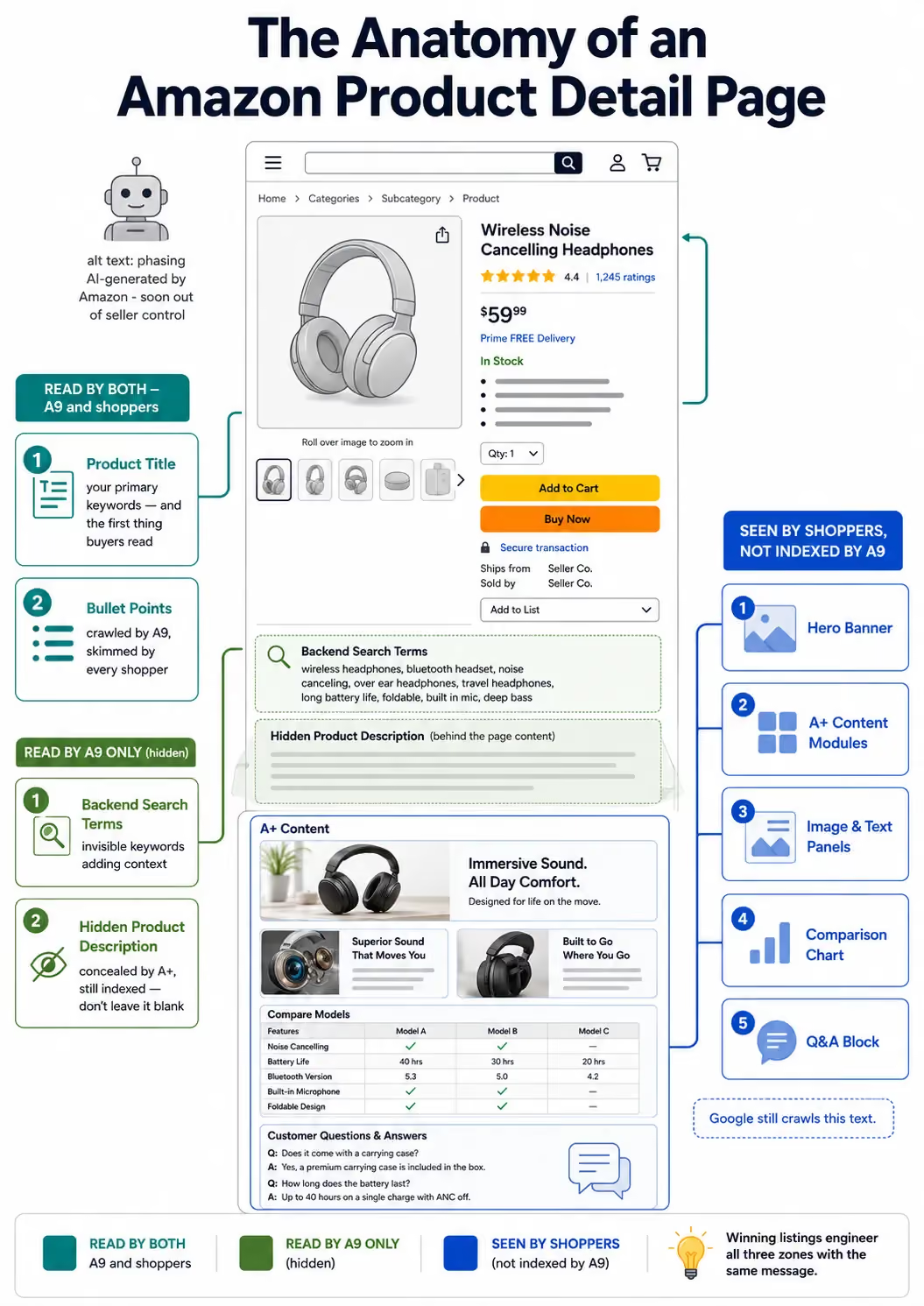
Eligibility is short: a Professional selling account, Amazon Brand Registry, and the right to publish under your brand on the ASINs you're touching. Modules are drafted, previewed, and submitted in the A+ Content Manager inside Seller Central.
Amazon makes the conversion case itself: Basic A+ can lift sales up to 8%, Premium up to 20%, per Amazon's published claims. The indexing case, as covered above, is settled by practitioner testing rather than documentation: body text doesn't move A9, the hidden backend description still indexes, and the seller-written alt-text field is leaving sellers' hands entirely as Amazon's AI takes over image description.
What no tier of A+ documentation covers is the behavioral case - and that's where the leverage now lives.
How Does A+ Content Train Amazon's COSMO Graph Without Being Indexed?
A+ Content trains COSMO by producing the conversions COSMO is mined from. The mechanism is documented in Amazon's own SIGMOD 2024 paper, and it runs in three steps.
Step 1: Amazon logs the behavior. COSMO's inputs are two behavior types with strong intent: search-buy pairs (a shopper types "winter coat," then purchases your Long Sleeve Puffer Coat within the session) and co-buy pairs (your camera case purchased alongside a screen protector). Amazon sampled millions of these pairs across 18 categories to build the graph.
Step 2: An LLM hypothesizes the intent. For each pair, Amazon's pipeline asks a language model why the purchase happened, and stores the answer as a typed relationship. The paper's own example: the "winter coat" query led to that puffer coat because the product is capable of providing high-level warmth. Human annotators then filter for plausibility and typicality, and the surviving knowledge becomes edges in the graph.
Step 3: The graph answers shoppers. When Alexa for Shopping fields a conversational query, the relationships COSMO has already learned about your product determine whether you're part of the answer. Amazon's paper reports that deploying COSMO in search navigation on roughly 10% of U.S. traffic produced a 0.7% sales lift - hundreds of millions of dollars annually - so this isn't a research toy. It's the production substrate.
Now connect the dots from your side of the screen. You don't control Amazon's session logs - but you control what converts. When a shopper lands from a specific query and your A+ Content closes the sale, you've just authored a search-buy pair. When your lifestyle module shows the product working with its natural companion and the shopper adds both, you've authored a co-buy pair. The graph learns whatever your conversions teach it.
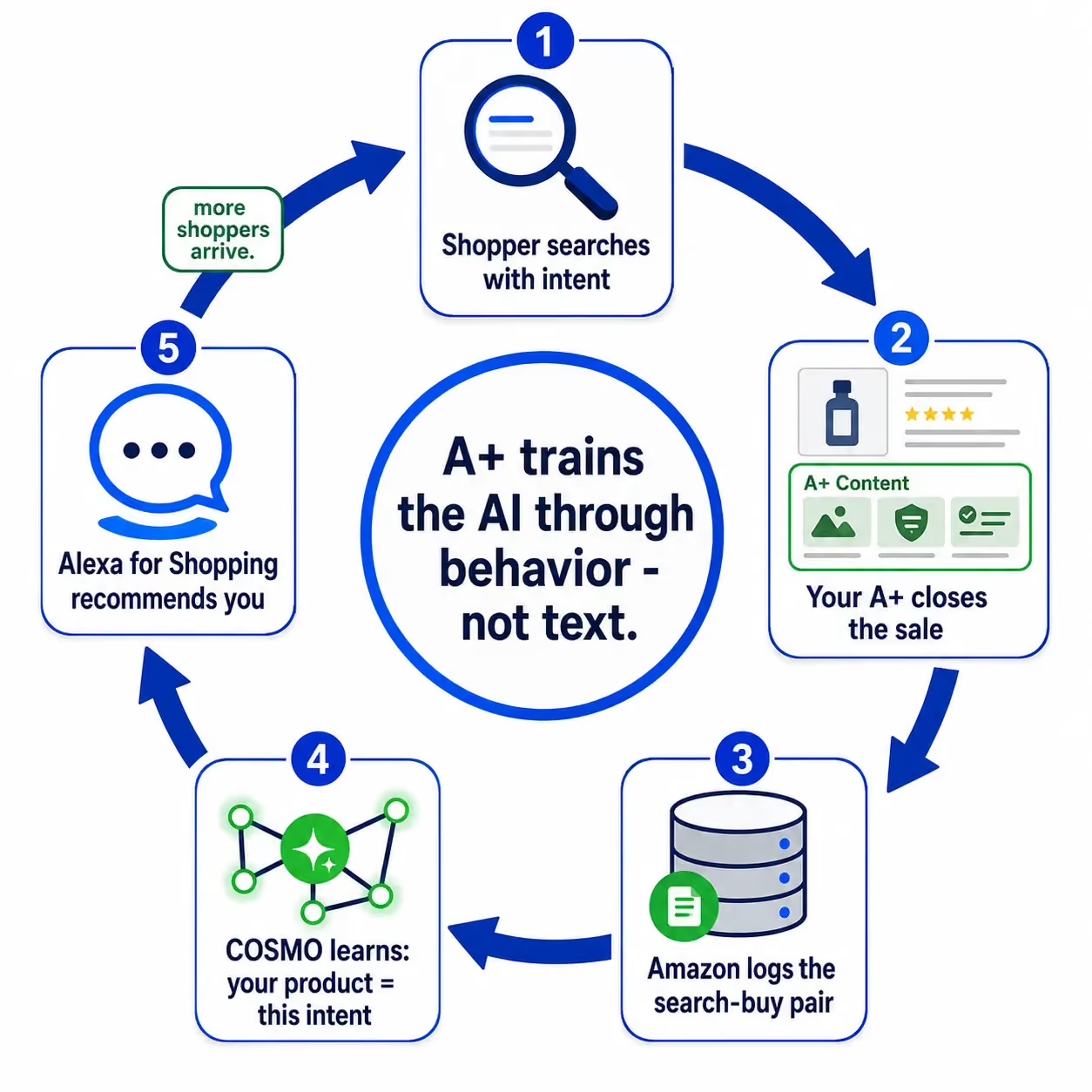
This is why "A+ isn't indexed" was always the wrong frame. Titles and bullets get you found. A+ gets you bought - and in the COSMO era, getting bought on the right queries is what gets you recommended.
Pro Tip: Before building or rebuilding A+, write down the 3-5 search intents you most want Amazon's AI to associate with your product (e.g., "gift for new dad," "fits under airline seat," "safe for sensitive skin"). Then audit every module against one question: does this help close the sale for a shopper who arrived with that intent? A+ that converts random traffic earns you nothing in particular. A+ that converts targeted intents earns you the recommendations attached to those intents.
Pro Tip: Use your co-buy signal deliberately. If your product has a natural companion - your own bundle SKU or a universally-owned complement - show them together in lifestyle imagery and name the pairing in an image-and-text module. Every basket that includes both strengthens a used_with edge in the graph, which is the relationship "frequently bought together" placements and AI bundle suggestions draw on.
The 15 COSMO Relationships - and the A+ Module That Encodes Each One
COSMO's taxonomy isn't abstract. The SIGMOD paper names all fifteen relation types, with examples, and nearly every one maps onto an A+ module you can build this week. This is the part most A+ guides miss entirely: the fifteen relationships are a content brief written by Amazon's own scientists. They tell you which intents the graph stores - which means they tell you which conversions to engineer for.
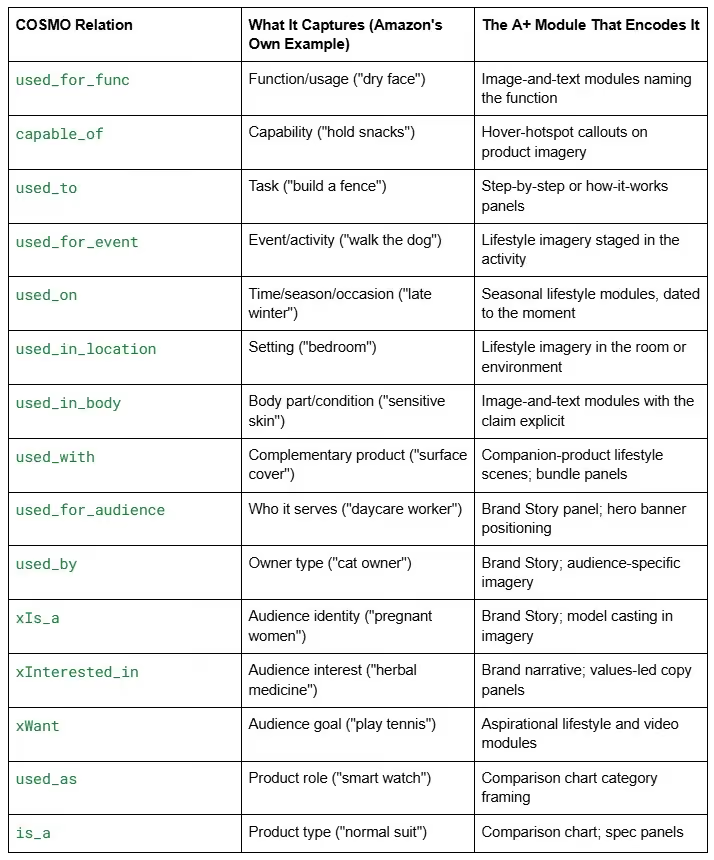
Three clusters deserve emphasis, because they carry the most weight per module.
Use-context relationships (used_for_event, used_in_location, used_on) live in lifestyle imagery and video. Amazon's own design guide cites Dokotoo, which "leads with A+ Content video modules to vividly show how the products could fit into a customer's lifestyle." Each scene is one use-context the listing can win conversions on.
Comparison and identity relationships (is_a, used_as) live in the comparison chart, and the chart does double duty. A chart against three of your own line variants makes one structured statement: which model fits which use. A chart against three named competitors and the use case each fits makes a richer one - it answers the shortlisting question a shopper (or a shopping agent) is actually weighing.
Audience-fit relationships (used_for_audience, used_by, xIs_a, xWant) live in the Brand Story. Amazon's design guide cites Jackery, whose Brand Story explains the brand was founded "to help nature enthusiasts enjoy the outdoors sustainably" - an audience-fit claim encoded in one banner-plus-narrative pair. Uproot Clean does it through founder narrative: a brand born from "frustration with pet hair cleanup," which commits the listing to pet owners before a single spec loads.
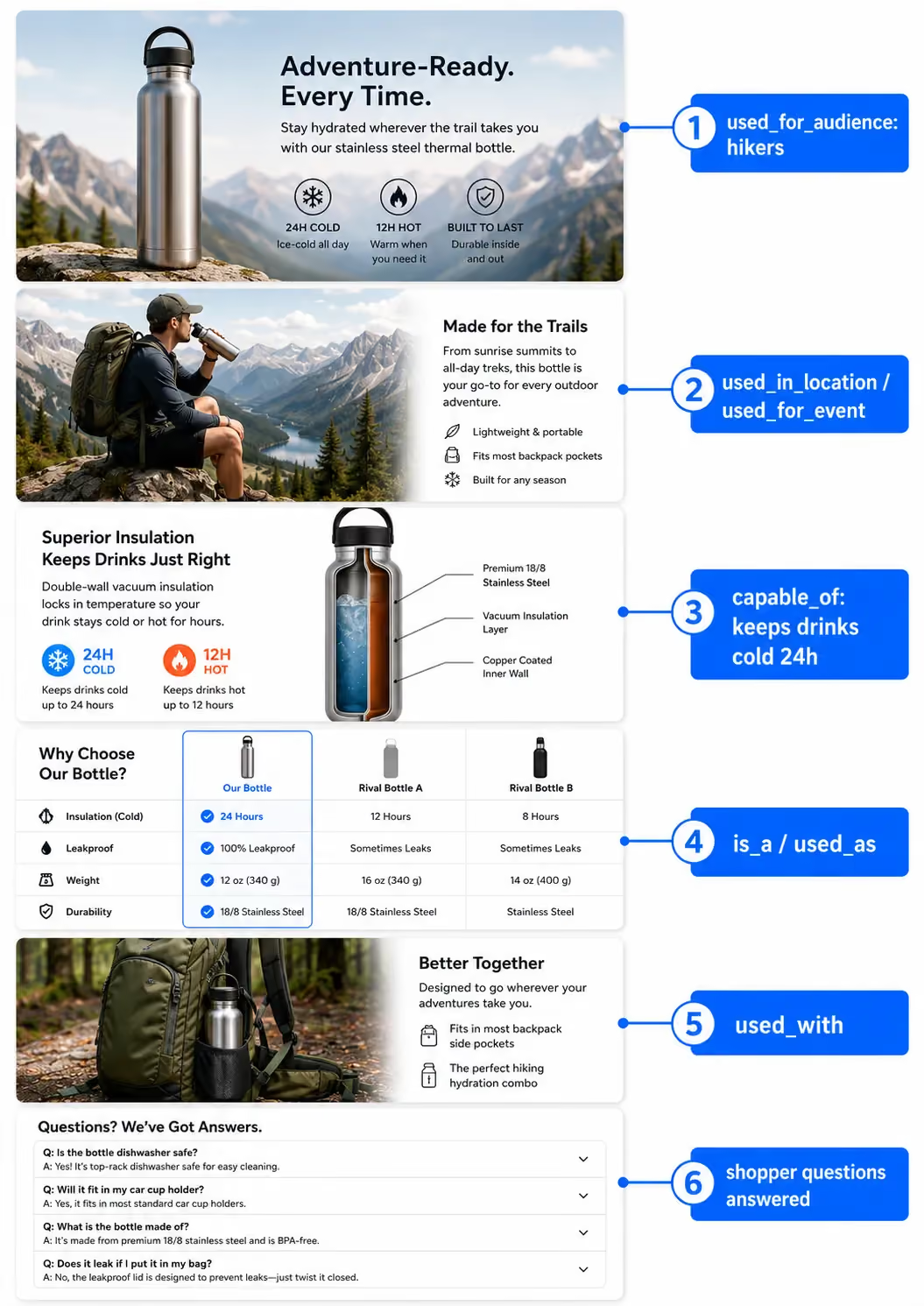
Pro Tip: Run your current A+ against the table above as a 10-minute audit. Most decorative A+ pages encode only 2-3 of the fifteen relationships - usually used_for_func and nothing else. Every uncovered relationship that matters to your category is a sale your listing can't close - and a recommendation you'll never be considered for. Aim to cover 7-8 relationships across your seven module slots.
Whether Alexa for Shopping also retrieves A+ text directly is a separate question - and the honest answer is that Amazon hasn't said. The Rufus announcement named training inputs as "Amazon's extensive product catalog, customer reviews, community Q&As, and information from across the web"; A+ is not on the list by name, and "product catalog" is wide enough to include it at Amazon's discretion. Three of ten 2026 A+ guides assert the AI reads your A+ in full; none cites an Amazon source. You don't need to resolve that question to act, because the behavioral path is documented and the direct-retrieval path is a free bonus if it exists.
What About A+ Q&A Modules and Alexa for Shopping?
Amazon's design guide names Q&A sections explicitly as a Premium module purpose: "anticipate and address common customer questions with Q&A sections." Whether the AI engine retrieves from those modules is undocumented. What circulates as evidence - the widely cited 87% of Rufus-recommended products carrying A+ or Premium A+, per Amalytix's November 2024 analysis of 1,300+ ASINs - is real correlation but weak causation. Brands that publish A+ are the brands investing in their listings overall, which is also the work AI surfaces reward in documented ways.
What can be measured is whether the listing answers the questions at all - and there the gap is concrete. ZonGuru's AI Readiness Score, run across more than 5,000 live Amazon listings, returns a median of 65 out of 100. The COSMO Semantic Mapping half lands at a median of 70; the Alexa for Shopping Q&A Coverage half at 54. Same listings, same gap, same place: sellers cover relationships better than they cover questions.
Pro Tip: Don't invent your Q&A module questions. Mine them from three sources you already own: (1) the customer questions on your own listing and your top three competitors', (2) the recurring objections in your 3-star reviews - the rating tier where shoppers explain their hesitation honestly, and (3) your customer service inbox. Then answer each in the conversational register a shopper would use with an AI assistant: what it's for, what setting it works in, what the trade-offs are, and who it isn't for. The "isn't for" answer is the one competitors never write - and the one that prevents the mismatched conversions that come back as returns.
See where your listing stands. A free, ASIN-only diagnostic walks both dimensions in about two minutes and returns one number out of 100. Run your AI Readiness Score →
The Hidden-Description Loophole: Don't Give Back Your Only Indexed Description Slot
The mechanics from reason #3 above deserve their own checklist line, because this is where decorative A+ silently costs rankings.
When A+ ships, it hides your plain-text Product Description from shoppers - but the field stays in the backend, and by practitioner consensus A9 keeps indexing it. The common failure: brands stop maintaining the field because "A+ replaced it." The result is a listing working against itself on both layers - the visible layer carries imagery A9 can't read, while the only A9-indexable description slot reads as a blank to the engine that still decides organic rank. And since Alexa for Shopping reads the same listing A9 ranks, the damage shows up on the keyword side before any AI-era question is asked.
Pro Tip: Keep a keyword-engineered backend description (per category limits, typically up to 2,000 characters) live behind every A+ page, refreshed whenever your keyword strategy shifts. Write it for the engine - complete sentences, but built around the mid-tail terms your title and bullets can't fit. It costs you nothing visually, because shoppers never see it.
What Does Decorative A+ Actually Cost? Four Concrete Losses
A familiar pattern shows up on A+ pages we audit: the banner promises "for active outdoor use" while the bullets describe a "premium home model"; the comparison chart lists a 1500mAh battery the bullets render as 1200mAh; the Brand Story positions for "the everyday creator" while half the copy sells to a corporate buyer. ICP mismatch, spec mismatch, positioning mismatch - and each one has a price tag.
- Lost conversion, in Amazon's own numbers. The 8% and 20% lift bands assume a coherent listing - A+ reinforcing the title and bullets, not contradicting them. Contradictory A+ doesn't hit the bands. This cost requires zero AI-era speculation.
- A neglected indexed description. Covered above: the hidden-description loophole, surrendered.
- Corrupted training data - your own. This is the behavioral cost, and it follows directly from how COSMO learns. Contradictory A+ converts the wrong shoppers: the outdoor banner closes sales from "outdoor power station" queries for a product that's really a home unit. Those mismatched conversions become search-buy pairs that teach the graph an intent your product doesn't serve - and the returns and 2-star "not what I expected" reviews that follow are negative signals on the same listing. Decorative A+ doesn't just fail to train the graph; it can train it wrong.
- Unreadiness for direct retrieval. Whatever Alexa for Shopping reads today, the direction of AI shopping surfaces is toward reading every detail-page surface they can. Engineered A+ is prepared for that direction; decorative A+ is not. This is the only cost resting on inference - and costs one through three already justify the work even if it never materializes.
Engineer both layers, not just the visible one. Helix engineers the copy and the A+ modules together against the COSMO relationship taxonomy and the Alexa for Shopping Q&A set. Transform your listings →
How to Engineer A+ Content Module by Module
The Premium A+ template most brands converge on carries seven module slots. Name each by the structured-knowledge job it does, not its pixel dimensions.
Hero / Brand Header - encodes audience-fit (used_for_audience, xIs_a) in a single frame. Jackery's outdoor scene plus founding narrative tells the shopper who the brand serves before anything below loads. Commit to your sharpest audience claim here; vague heroes convert vaguely.
Image-and-Text - encodes function and benefit (used_for_func, capable_of). One named function per panel.
Pro Tip: Stop writing alt text into your workflow - in a growing number of marketplaces you can't, because Amazon's AI now generates the image description by analyzing the image itself. That moves the optimization into the image: design each A+ visual so unambiguous that Amazon's AI describes it the way you would have. Show the product, the user, and the function literally, and use a short text overlay naming the benefit ("removes pet hair from car seats") - it guides the shopper, the vision model, and Google's crawl of the rendered page all at once. Then carry the identical phrase in your bullets, which remain the indexed surface you fully control.
Comparison Chart - encodes is_a, used_as, and competitive positioning simultaneously. Charts against named competitors with the use case each fits outperform self-referential variant charts, because they answer the shortlisting question. Pick chart fields from the relationship table, not from your spec sheet.
Q&A Module (Premium) - the A+ slot built for the conversational questions shoppers ask, and the module most A+ pages skip. The AI Readiness Score doesn't read this module - it scores your listing copy, not your A+ - but the questions it flags as uncovered are exactly the ones this module exists to answer in the visible layer. With manual alt text automated away, this is also the last A+ surface where you fully control intent-matching text - the language shoppers, Google, and conversational AI surfaces encounter when the question gets asked. Built per the mining method above.
Brand Story Panel - second pass on audience-fit through narrative (used_by, xInterested_in). Uproot Clean's pet-hair-frustration origin story is the model: a sharply defined shopper, committed to before any spec.
Lifestyle / Hover-Hotspot - encodes use-context visually (used_for_event, used_in_location, used_on). Every scene is a context you're bidding to convert.
Video - multimodal: imagery, caption, and transcript in one asset. Caption and transcript should repeat the structured language the rest of the listing carries.
One rule cuts across all seven: whatever you say in the indexed layer, say in the visual layer, in the same words. Coherence is what converts - and conversions are what get you recommended.
Is Premium A+ Worth the Eligibility Gate?
Premium A+ unlocks the Q&A module and the higher-bandwidth comparison formats - the two modules carrying the most structured-knowledge weight - and roughly doubles Amazon's published lift ceiling (up to 20% vs. Basic's 8%).
Amazon's published gate comes with a terminology trap worth defusing. The Seller Forums announcement phrases the requirement as "five approved A+ Content modules" in the trailing 12 months - but Amazon's A+ help page and practitioner experience both count approved project submissions: a full A+ layout, submitted and approved. One beautiful page holding five design blocks logs as exactly one submission, and sellers in Amazon's own forums report sitting on seven approved modules for one product with no Premium access. The full gate: a Professional account, Brand Registry, a published Brand Story on every brand-owned listing, and five approved A+ Content project submissions in the trailing 12 months. The older 15-submission threshold is outdated - five is current, and access is granted automatically with a banner in your A+ Content Manager once you qualify.
Notice what the gate actually is: the Brand Story requirement is the audience-fit work from the playbook above, and the five submissions are the relationship work. By the time you qualify, you haven't done paperwork on top of the real work - you've done the real work, and Premium gives it more room.
Pro Tip: Fastest legitimate path to the gate for a small catalog: build a strong A+ layout on your best-selling ASIN, get it approved, then improve and resubmit it - a seasonal image swap, a sharper comparison chart, a refined benefit claim. Each approved resubmission counts as a distinct project submission in Amazon's ledger, so five genuine iterations on one hero ASIN clear the threshold. You concentrate the conversion lift (and the behavioral signal) on the listing with the most traffic, and every iteration is a real improvement rather than counter-gaming - which also keeps you safe with Amazon's reviewers, who approve each submission individually. Larger catalogs can simply ship five Basic layouts across five ASINs instead.
How to Score Your Listing's AI Readiness - and Keep Your A+ From Working Against It
Engineering is hard to commit to without a number. The AI Readiness Score is free, ASIN-only, and evidence-extracted from your public listing data: one 0-100 readout across COSMO Semantic Mapping (how fully the listing answers the fifteen relationship types) and Alexa for Shopping Q&A Coverage (the conversational questions a shopper agent draws on). Across 5,000+ live listings the median is 65 - a number that reads like a passing grade and functions as a structural ceiling: where a listing tops out after every keyword-era tactic, with no engineering yet for the AI layer.
One thing stated plainly: the free score reads your listing copy - it doesn't analyze your A+ modules. What it gives the A+ work is the gap map. A COSMO relationship gap (use-context, comparison, audience-fit) is a relationship your A+ should be built to carry. A Q&A Coverage gap is the question list your Q&A module should answer. The score tells you what's missing; the modules are where the answers go.
Helix Listing Engineering is the methodology that does the work the score names - validated across ZonGuru's 500+ Amazon brands, 3,000+ engineered listings in the US and UK, and the same 5,000+ score runs the median is drawn from. Three stages: Ingest the brand's product truth and the audience's real questions, Analyze the listing copy against the COSMO graph and the Alexa for Shopping Q&A set, Structure the copy the engines read and the A+ modules the shopper sees so the two never tell different stories.
The Bottom Line: A+ Isn't Indexed. It's Something Better.
Here's the full picture, ranked by evidence strength.
Settled by testing and rollout: A+ body text doesn't move A9 keyword rankings; the hidden backend description still indexes. Glenn's reply confirmed only the alt-text contribution - and through 2025-2026, Amazon removed that field from sellers' hands in a phased rollout, replacing manual alt text with AI-generated descriptions. The last hidden metadata lever inside A+ is gone; what's left to optimize is visible copy, legible imagery, and the conversions they win.
Documented by Amazon: A+ lifts conversion up to 8% (Basic) and 20% (Premium). COSMO - the graph under Alexa for Shopping - is mined from search-buy and co-buy behavior across 18 categories, organized into fifteen named relationship types.
The connection between the two is the opportunity: the graph is built from conversions, and A+ is your conversion engine. Engineered A+ that wins the right conversions on the right intents is, functionally, how a seller writes to Amazon's AI - today, with documented mechanisms, no speculation required. Decorative A+ forfeits the conversion lift, surrenders the indexed description, and at worst trains the graph on the wrong shoppers.
Still undocumented: whether the AI surface retrieves A+ text directly. The guides claiming it does cite no Amazon source. You don't need them to be right.
The fifteen relationships are the brief. The seven modules are the canvas. The conversions are the signal. The score that maps your gaps is free, and pasting an ASIN takes two minutes.
Run your AI Readiness Score → Free, ASIN-only, evidence-extracted. We analyze only your public listing data, charge you nothing, ask for no credit card, and never send spam.
Frequently Asked Questions
Is A+ Content indexed by Amazon's A9 algorithm?
A+ body text is not indexed by A9 in any way that moves keyword rankings - that's the consistent result of years of agency split-testing. The hidden backend product description remains indexed after A+ goes live, making it the one description field worth engineering for A9.
Can I still add alt text to A+ Content images?
In a growing number of marketplaces, no. Amazon began removing the seller-written alt-text field from A+ modules and Brand Story in 2025, with full removal reported in Europe by 2026, and now auto-generates image descriptions using AI. Amazon hasn't documented the change publicly - the practical implication is that image clarity, not metadata, is what sellers now control.
Does A+ Content increase sales on Amazon?
A+ Content increases sales by up to 8% for Basic and up to 20% for Premium, per Amazon's own published figures. Those bands assume a coherent listing - A+ that contradicts the title and bullets underperforms them.
Does Alexa for Shopping (formerly Rufus) read A+ Content?
Amazon has not said. The engine's published training inputs are the product catalog, customer reviews, community Q&As, and the web - A+ Content is not named, and "product catalog" is wide enough to include it at Amazon's discretion. What is documented is that COSMO, the graph underneath the engine, is mined from conversions - which A+ directly produces.
What is Amazon COSMO, and why does it matter for A+ Content?
COSMO is Amazon's product knowledge graph - 6.3 million nodes and 29 million edges across 18 categories, per Amazon's SIGMOD 2024 paper - built from search-buy and co-buy shopper behavior, not from listing copy. It matters for A+ because conversions are COSMO's raw material, and A+ is the listing's strongest conversion surface: every sale your A+ closes on a specific query teaches the graph which intents your product answers.
Should I still write a product description if I have A+ Content?
Yes, always. A+ Content hides the plain-text description from shoppers, but the field stays in the listing's backend, and practitioner consensus is that A9 keeps indexing it. Leaving it thin surrenders the only A9-indexable description slot on your listing.
Does Google index Amazon A+ Content?
Yes. Google crawls and indexes A+ body text as part of the product detail page, and A+ copy drives external traffic to Amazon via Google Search - which is one of the reasons Amazon stays deliberately vague about internal indexing.
What is the difference between Basic and Premium A+ Content?
Basic A+ offers standard image, text, and chart modules with Amazon's published lift ceiling of 8%. Premium A+ adds video, hover hotspots, larger formats, and the Q&A module - the slot built for the conversational questions shoppers ask - with a published lift ceiling of up to 20%.
What are the requirements for Premium A+ Content in 2026?
Premium A+ requires a Professional selling account, Amazon Brand Registry, a published Brand Story on every brand-owned listing, and five approved A+ Content project submissions in the trailing 12 months. Note the unit: Amazon's announcement loosely says "modules," but the counted unit is the submitted layout - one page with five design blocks logs as one submission. Sequential approved revisions of the same project each count, and the older 15-submission threshold is outdated.
What happened to Enhanced Brand Content (EBC)?
Enhanced Brand Content was retired around 2019, when Amazon merged it into A+ Content. The same surface now ships in Basic and Premium tiers, plus the Brand Story format.
How do I check whether my listing is ready for Amazon's AI surfaces?
Run the free AI Readiness Score - ASIN-only, about two minutes, one 0-100 number across COSMO Semantic Mapping and Alexa for Shopping Q&A Coverage. The median across 5,000+ live listings is 65, and the gaps the score surfaces are the exact brief for your A+ rebuild.