Loading...


Let our Amazon experts show you how to leverage the power of ZonGuru to smash your sales goals. You’re invited to a 15-minute Rocket Demo so you can see the ZonGuru tools first-hand.
Book your seat now!
An Amazon review not showing up is almost always caused by one of eleven specific factors: Amazon's 48–72 hour moderation window, a Community Guidelines violation, an unverified purchase, a reviewer account with insufficient history, a suspected incentivized review, a reviewer–seller relationship flag, a variation or parent-ASIN merge, a category filter applied on the product page, a regional marketplace mismatch, a review removed during a hijack investigation, or a content-policy block on specific words or media. Most missing reviews return - or get permanently removed - within five business days.
A missing review has always cost sellers something. Under Amazon's A9 algorithm, it costs review count, star-rating strength, and review velocity - all direct organic-ranking inputs. In 2026, it costs a second thing on top: structured product knowledge that COSMO and Rufus use to decide which products to recommend to over 250 million Amazon shoppers. The same missing review now damages two ranking systems at once.
This guide covers the eleven reasons Amazon reviews don't show up, the fix for each, how to defend your review pipeline proactively, and the HELIX-era concept most sellers are still missing: reviews as AI signal, not just social proof.
A missing Amazon review matters more in 2026 because it now damages two ranking systems at once instead of one.
The A9 cost hasn't gone away. Amazon's A9 algorithm has always treated reviews as a core organic-ranking input. Review count, star rating, review velocity, and review recency all factor into where a listing appears in standard keyword search results. A suppressed review still lowers your review count, still drags your star average, and still breaks the velocity curve A9 expects to see on a healthy listing. That cost is the same in 2026 as it was in 2020.
The COSMO cost is new. COSMO - Amazon's AI-powered ranking and recommendation system - and Rufus - the conversational shopping assistant now used by over 250 million shoppers - also read the full text of customer reviews as primary evidence of what a product is, who it's for, and when it should be recommended. A9 counts the review. COSMO reads it. When a review fails to post, A9 loses a numerical signal and COSMO loses a sentence of product understanding.
Those three missing reviews on a listing with 800 existing ones used to be a rounding error. Under COSMO they can be the exact sentences that would have taught Rufus your product is "good for travel," "fits a size 8 foot," or "doesn't require assembly" - the phrasings a shopper types into the Rufus chat window when they ask "what's the best [category] for [use case]?"
The practical implication: defending your review pipeline is now both an organic ranking task (A9) and an AI-readability task (COSMO/Rufus). The fixes below restore individual reviews. The HELIX angle in the next section explains how to build a listing that compounds every review you keep across both systems.
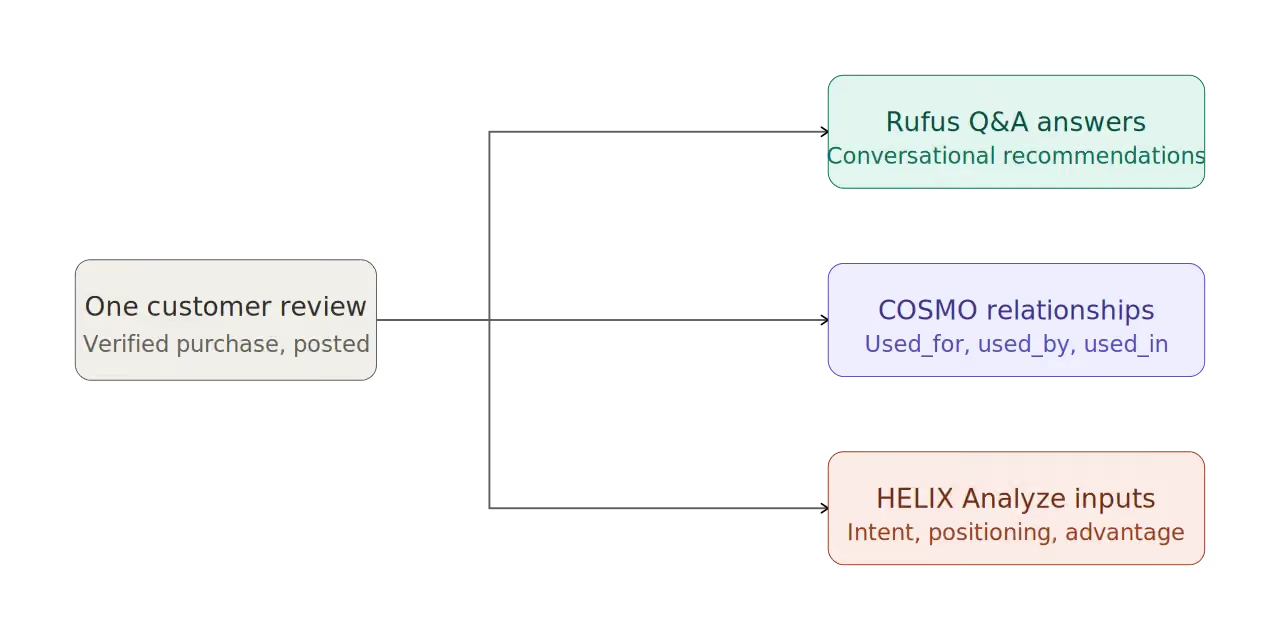
The Review Signal Pipeline is the path a single customer review travels from the moment it's submitted to the moment it influences an AI-generated Amazon recommendation. ZonGuru identified this pipeline while mapping over 1,000 COSMO transformations through the HELIX™ framework, and it explains why some listings recover fast from review disruption while others never do.
Each Amazon review feeds three distinct AI surfaces:
1. Rufus Q&A answers. When a shopper asks Rufus "does this stroller fold one-handed?", Rufus reads your bullet points - but bullets have limited real estate, so it also reads the review that says "I love that it folds one-handed while I'm holding the baby." One lost review equals one lost answer source.
2. COSMO semantic relationships. Amazon's COSMO paper defines 15 relationship types - used_for, used_by, used_in_location, capable_of, used_as, and more. Reviews are the richest data for these relationships because customers describe products in natural, intent-laden language - "used it on my camping trip" (used_in_location), "my 7-year-old loves it" (used_by), "great for stocking stuffers" (used_for_event).
3. HELIX "Analyze" inputs. ZonGuru's HELIX™ framework - the Listing Engineering system behind ZonGuru AI - ingests review data during its deep niche research phase to uncover intent pathways, competitive gaps, and the positioning angles a product can uniquely own. Listings built on thin review data start the pipeline with thin inputs and produce thin outputs.
When a review fails to post, all three surfaces lose information. When a listing is engineered - through deep research into the language patterns the highest-signal reviews in your niche already use - every new review compounds across all three surfaces simultaneously. That is the HELIX-era advantage, and it is why missing reviews cost more than they used to.
An Amazon review fails to appear on a product listing for one of at least eleven specific reasons. Each has a distinct cause, a distinct fix, and a distinct timeline.
Most verified-purchase reviews appear within 24 hours, but Amazon's automated moderation system holds some reviews for up to 72 hours - and, during peak seasons like Prime Day or the Q4 holiday window, up to five business days. This is the single most common reason a review appears to be "missing."
Fix: Wait the full 120 hours before treating it as a problem. Ask the reviewer to confirm the timestamp on their submission confirmation email.
Amazon's Community Guidelines prohibit profanity, promotional content, personal identifying information, URLs, email addresses, competitor mentions, defamatory claims, and content unrelated to the product. Violations are auto-filtered and usually never surface publicly. Amazon does not notify reviewers or sellers when a review is suppressed for this reason, and sellers cannot contact reviewers directly - Amazon's policy prohibits it, and seller accounts have been suspended for trying.
Fix: None at the individual-review level. Focus effort on the reviews you can influence - use the Request a Review button to drive new verified-purchase reviews, and make sure nothing in your own packaging, inserts, or post-purchase communications prompts reviewers toward policy-violating language (for example, inserts that ask for a review "with a photo and a link to our website" invite the exact URL violations that trigger suppression).
Unverified reviews - reviews from customers who did not purchase the product through Amazon at the standard price - are subject to stricter moderation, weighted less in the overall rating, and in some categories are not displayed at all.
Fix: There is no post-hoc fix. Focus on encouraging reviews from verified purchasers through the Amazon Request a Review button, which is the only Amazon-approved review-solicitation mechanism.
Amazon suppresses reviews from accounts that are new, have no prior purchase history, or show patterns consistent with sockpuppet activity. An account created the same week as the review submission is almost always filtered.
Fix: No direct fix. This reason disproportionately affects small or niche products where many customers create Amazon accounts specifically to buy them.
Amazon's policy against incentivized reviews - reviews written in exchange for a free product, a discount, a refund, or any other compensation - is one of the strictest in e-commerce. Amazon's detection systems flag reviews even when the incentive was offered months earlier or through a third-party insert card.
Fix: Audit every insert card, packaging flyer, post-purchase email sequence, and external service (review clubs, "review for free product" groups) for incentive language. Remove any offer of compensation in exchange for a review. Use only the Request a Review button.
Amazon cross-checks reviewer data against seller account data, delivery addresses, IP addresses, and social-graph signals. A review from a reviewer whose account shares signals with the seller - even a distant one - is suppressed. Family, employees, business partners, and even Facebook connections have been flagged.
Fix: None, and this is by design. Ensure no one with any connection to the business submits a review.
When parent/child ASINs are restructured, Amazon occasionally migrates reviews unpredictably. Reviews sometimes display only under the parent ASIN, sometimes only under specific variations, and sometimes disappear during the merge entirely before reappearing 7–14 days later.
Fix: Open a Seller Support case with the specific reviewer's order ID and the ASIN the review should display under. Variation-related review issues are one of the few review disputes Seller Support will actively investigate.
The product page defaults to "Most recent" or "Top reviews" based on the viewer's location and browser state. A review may exist but sit behind a filter - for example, on a product sold in multiple sizes, the review may only appear when the specific size variant is selected.
Fix: Check all variations, then toggle the "All reviewers" filter, the star-rating filter, and the sort order before escalating.
A US reviewer's review posts on amazon.com. It does not cross-post to amazon.co.uk, amazon.de, or amazon.com.au - even for the same ASIN. Sellers sometimes check the wrong marketplace.
Fix: Verify which marketplace the reviewer purchased from, and check that marketplace's listing specifically.
When Amazon investigates a listing - for hijacking, counterfeit claims, a brand-registry dispute, or a policy violation - it can temporarily suppress all new reviews on the ASIN until the investigation resolves.
Fix: Contact Brand Registry support with documentation of the investigation or the triggering event. Reviews typically release once the case is closed.
Amazon does not accept reviews that include external image links, unapproved video formats, QR codes, phone numbers, or content written in a language not supported by the marketplace. These are auto-filtered in the same pass as Community Guidelines violations, and a seller has no way to contact the reviewer or request a resubmission.
Fix: None at the individual-review level. The lever sellers do control is what their own product and packaging invite reviewers to do - QR codes on inserts, requests for video reviews in formats Amazon doesn't support, or any prompt that leads international customers to review in a non-marketplace language all increase the share of reviews that get suppressed for content-type reasons.
Defending Amazon reviews is a five-part discipline: eliminate incentive signals, route all solicitations through the Request a Review button, structure your listing to generate verified purchases, monitor for hijacking, and engineer the listing to extract maximum signal from every review that does post.
1. Remove all incentive surfaces. Inspect insert cards, follow-up emails, and any external service for language that could be interpreted as compensation-for-review. Amazon's detection is probabilistic; even phrasing that implies an incentive can trigger suppression.
2. Use only the Request a Review button. The button sends an Amazon-templated message at a compliant time. It is the only solicitation mechanism that cannot be construed as manipulation. ZonGuru's Review Automator (available to existing subscribers) automates this button at scale on a compliant cadence.
3. Drive verified purchases, not discounted ones. Coupons at 50%+ depth are sometimes flagged as manipulated purchases; reviews from those buyers can be suppressed or weighted down. Moderate discounts of 15–25% attract verified buyers whose reviews are less likely to be filtered.
4. Monitor for hijacking and variation tampering. A listing hijacked by a counterfeit seller, or restructured by a bad-actor variation merge, can lose months of review signal overnight. Automated alerts from the Amazon Brand Registry and from tools like ZonGuru surface these events within hours.
5. Engineer the listing to mirror review language. This is the HELIX step most sellers skip. When your title, bullet points, and A+ content use the same phrasings your best reviews use - "lightweight for travel," "holds up after 50 washes," "fits a standard stroller cup holder" - COSMO reinforces the relationship between the listing and the review instead of treating them as two different documents about the same product. Listings transformed through ZonGuru AI, powered by HELIX, embed review-derived language directly into the structured product knowledge the listing exposes to Amazon's AI systems.
Recovering a listing after review loss requires three parallel moves: file targeted Seller Support cases for recoverable reviews, rebuild review velocity through compliant solicitation, and restructure the listing so new reviews carry more weight than the ones that were lost.
File specific, evidence-backed Seller Support cases. Generic "my reviews are missing" cases get templated responses. Cases with the reviewer's order ID, the approximate submission timestamp, and a screenshot of the reviewer's confirmation email get manual review.
Rebuild review velocity slowly. A listing that suddenly generates 40 new reviews in 48 hours after a period of zero triggers Amazon's velocity-anomaly detection. Pace solicitations to match historical patterns for the first 30 days of recovery.
Restructure the listing itself. This is the step the HELIX framework exists to perform. A listing that was losing review signal before the suppression event is likely structurally misaligned with COSMO - keyword-dense but semantically thin. Running a Free COSMO/Rufus Readiness Report quantifies exactly which semantic relationships the listing is missing and which Rufus buyer questions it fails to answer.
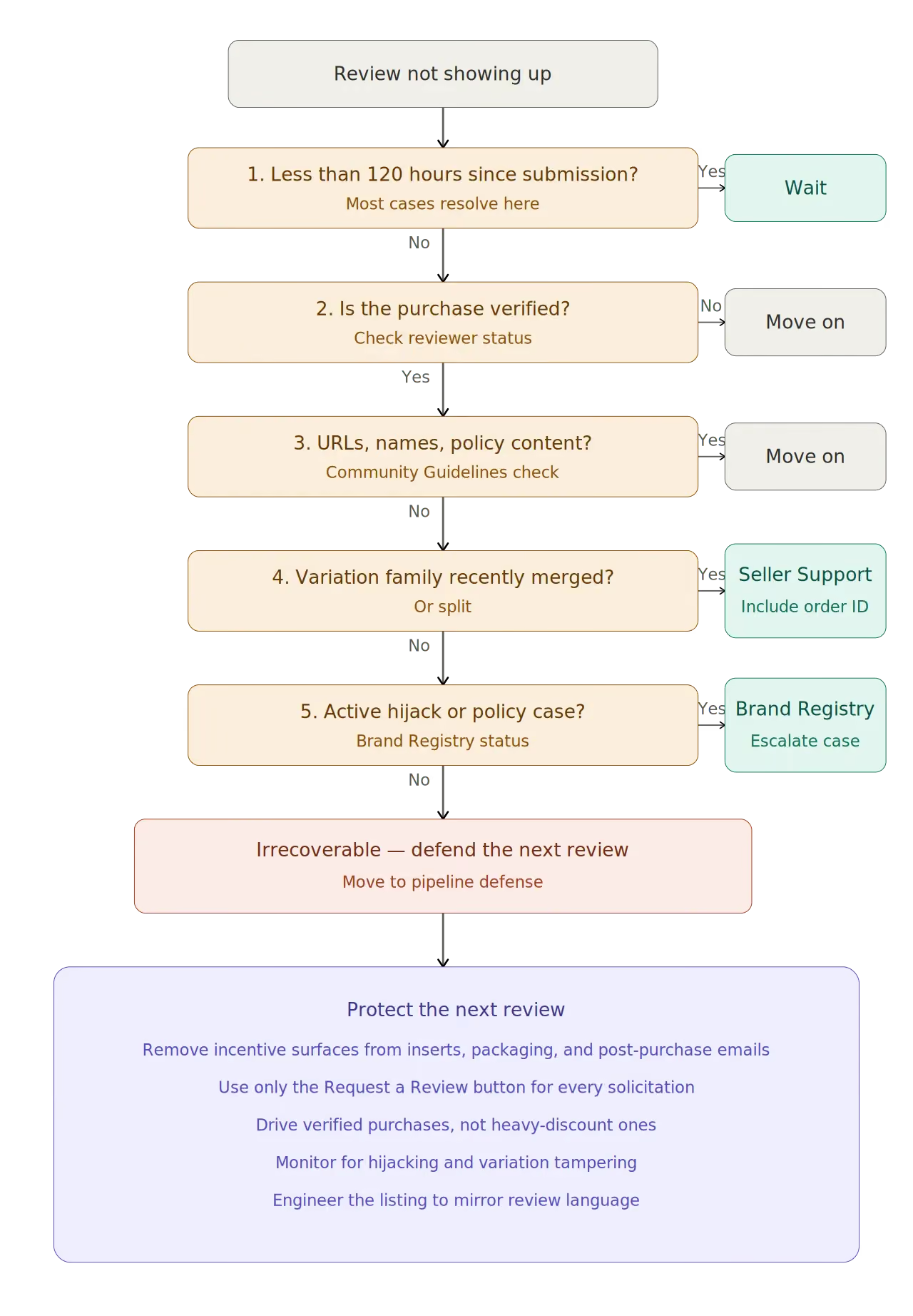
A seller whose review hasn't shown up should work through a six-step decision flow before escalating:
Amazon reviews have always been a top-tier listing asset - they power A9 organic ranking through review count, star rating, and velocity, and they drive conversion by building shopper trust. In 2026 they carry a third role on top of those two: they are the richest training input for COSMO and Rufus, the AI systems deciding which products get recommended in natural-language search. A review now defends organic rank (A9), conversion rate (shopper trust), and AI recommendation visibility (COSMO/Rufus) simultaneously.
Most sellers still manage reviews for the first two roles and ignore the third. The listings that win in 2026 will be the ones where every review that survives Amazon's moderation is also a semantic asset the listing knows how to hold onto.
An Amazon review that disappears after posting was almost always removed during a delayed moderation pass - Amazon re-scans recently posted reviews for up to seven days and removes any that match incentive, sockpuppet, or relationship-flag patterns that weren't caught on first review.
Amazon typically posts verified-purchase reviews within 24 hours, but moderation can extend to 72 hours under normal conditions and up to five business days during Prime Day, Black Friday, and the December holiday window.
An Amazon review stays pending when Amazon's automated moderation system flags something that requires a secondary check - typically a policy keyword in the review text, a reviewer-account signal, or a velocity anomaly on the ASIN. Most pending reviews resolve within five business days.
Amazon reviews do not expire. They are only removed if the reviewer deletes them, the reviewer's account is closed, Amazon determines a policy violation retroactively, or the product is deleted and recreated under a new ASIN.
Yes, but Seller Support will only investigate missing reviews tied to variation-family changes, brand-registry investigations, or documented technical errors. Seller Support will not restore reviews removed for Community Guidelines or incentive violations.
No. Vine reviews receive the same moderation scrutiny as organic reviews. Vine reviews are tagged as verified and carry the "Vine Voice" badge, but individual Vine reviews can still be suppressed for policy reasons.
Reviews sometimes fail to appear across variations when the parent ASIN was merged after the review was submitted, or when a specific variation was added after the fact. Opening a Seller Support case with order IDs is the only reliable fix.
No. Rufus and COSMO supposedly only have access to reviews that are publicly visible on the listing. A suppressed review is invisible to both the A9 ranking algorithm (which loses the review-count and velocity signal) and to the COSMO/Rufus AI layer (which loses the review text used to interpret the product). Defending the review pipeline now protects organic rank and AI visibility at the same time.
Yes. Amazon's moderation system is applied equally to positive and negative reviews. A 1-star review can be suppressed for the same reasons a 5-star review can - policy violations, incentive flags, or reviewer-account issues.
No. Any arrangement where a reviewer receives a product, a refund, a discount, or any other compensation in exchange for a review violates Amazon's policy and results in review suppression, account warnings, and in repeat cases, account suspension.
No direct effect. PPC campaigns drive verified purchases, which are the strongest review-source signal, so PPC indirectly improves review retention. But there is no direct weighting of reviews based on ad-driven traffic.
COSMO is Amazon's AI-powered ranking algorithm that replaced much of the legacy A9 logic. COSMO reads customer reviews as primary evidence for product understanding, extracting 15 types of semantic relationships - including used_for, used_by, and used_in_location - that determine which products Rufus recommends for natural-language shopper queries. Learn more in our What Is Amazon COSMO guide →
Run the Free COSMO/Rufus Readiness Report. The report scores your listing on semantic relationships, Rufus Q&A coverage, and review-derived signal strength, and identifies which specific relationships are weak or missing on the current listing.
ZonGuru AI is the self-serve listing engineering platform powered by HELIX™. It transforms Amazon listings into structured product knowledge that captures and compounds review signal across COSMO, Rufus, and Amazon's other AI-driven discovery surfaces. See how it works →
Discover opportunities. Maximize your sales. Grow your Amazon business!

Free score in 2 minutes. See how Amazon's AI reads your listing and what to fix.
 Run my Free Score
.svg)
Get started with ZonGuru, access all the tools with a FREE trial.
.avif) Start FREE Trial
Start FREE Trial